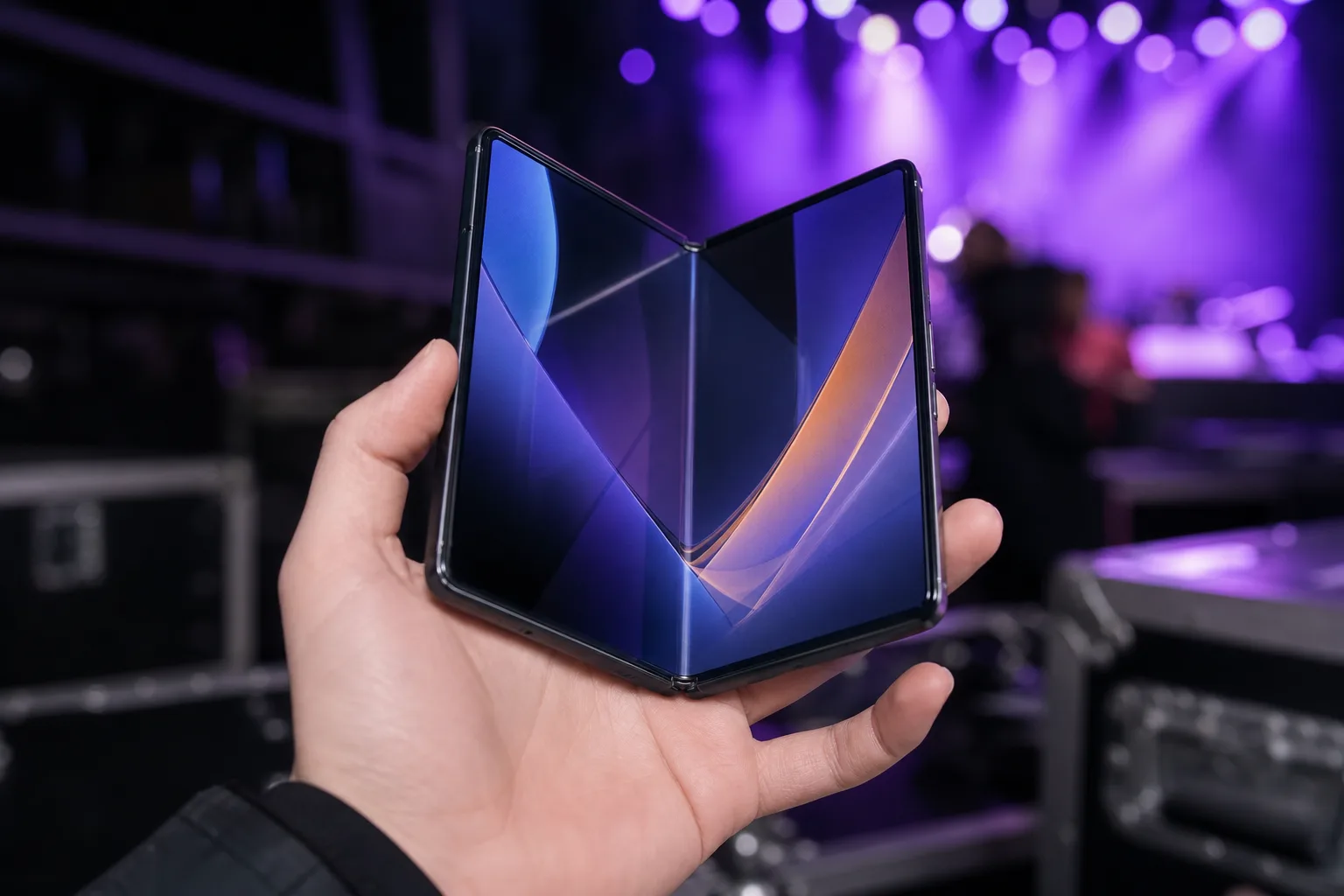
Samsung has found a more effective way to put a phone in front of millions of people than another moody product render: hand it to BTS’s J-Hope. A brief video posted ahead of the group’s Paris show appears to show the Galaxy Z Fold 8, giving fans a fleeting but unusually natural look at Samsung’s next book-style foldable before its expected July 22 unveiling.
There is no deep feature tour here. No camera samples, no benchmark charts, no executive explaining why a hinge is thinner by fractions of a millimeter. J-Hope flashes a peace sign while holding what looks like the new device, and that is basically the whole tease. But the point is not the footage’s technical value. Samsung is putting its upcoming hardware into pop culture’s bloodstream before it takes the stage in London.
Frankly, that makes more sense than pretending foldables sell themselves on specifications alone. At close to two grand, this category still asks buyers to make an emotional purchase as much as a practical one.
- A BTS video featuring J-Hope offers an early real-world glimpse of the Galaxy Z Fold 8 ahead of Samsung Unpacked.
- The Galaxy Z Fold 8 is expected to pair a wider cover display with familiar flagship folding-phone hardware and a reported $1,899 starting price.
- Samsung’s celebrity campaign signals that foldables remain a premium lifestyle product, not yet a mainstream smartphone category.
- Samsung will reportedly unveil its next Fold and Flip models in London on July 22.
Table of Contents
Galaxy Z Fold 8 gets a pop-culture runway
BTS has a global reach that even Samsung’s enormous marketing budget cannot manufacture from scratch. J-Hope’s appearance is particularly well timed: the group is touring, social feeds are already full of concert clips, and the phone is presented as something someone actually carries backstage rather than a sterile slab floating in a dark studio. That makes a difference when the product itself is trying to escape the “interesting, but maybe next year” trap.
Samsung has been here before. It has used celebrities and entertainment tie-ins to turn hardware launches into events, and it recently paired its foldable promotion with Spider-Man. The strategy is obvious: a folding phone is more visually legible than a conventional handset. You can see it open, close, and transform in a second. A creator or performer holding one does more work than a paragraph about multitasking.
The Galaxy Z Fold 8 cameo also arrives at a moment when Samsung has real competitive pressure. Google’s Pixel Fold line demonstrated that a wider outer screen can make a foldable feel more like an ordinary phone when closed, while Chinese brands including Honor, Oppo, and Huawei have repeatedly pushed the industry on thinness, weight, charging, and camera hardware. Samsung remains the brand many buyers associate with foldables, but being first in people’s minds is not the same as being automatically ahead.
The promotional clip cannot tell us whether Samsung has closed those gaps. It does suggest the company believes the design is ready to be seen outside a controlled leak cycle.
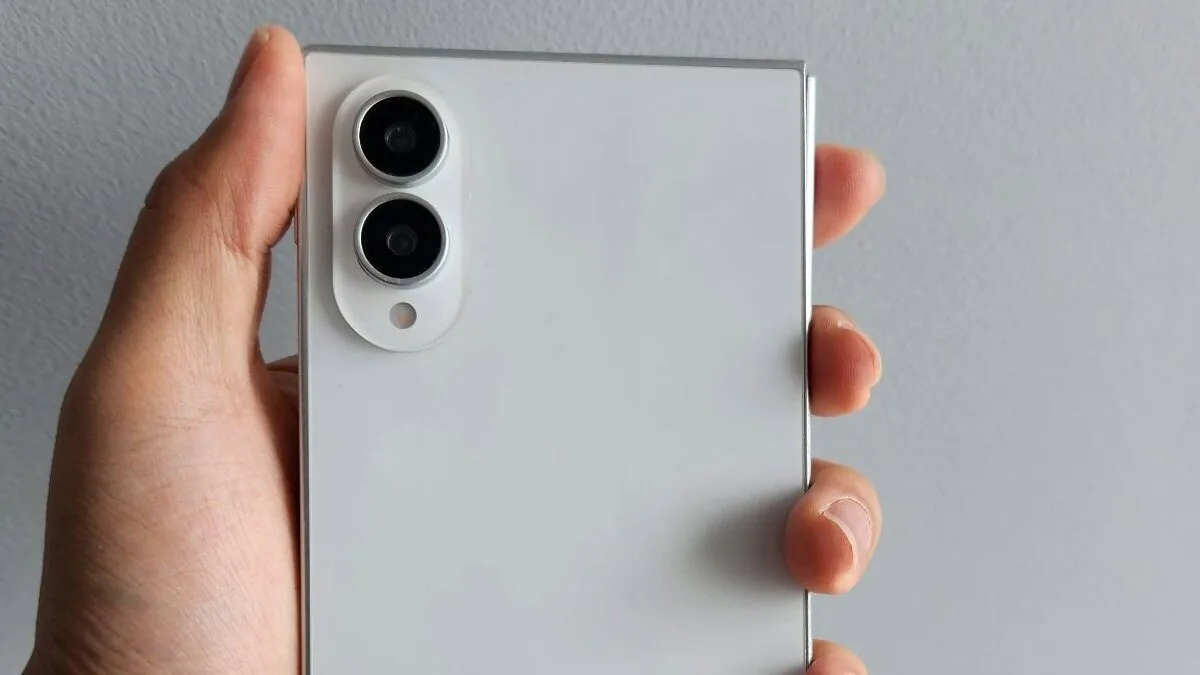
In the short video, the apparent Galaxy Z Fold 8 is visible only briefly, so readers should not try to extract a full spec sheet from a fan clip. Still, the sighting broadly matches the picture painted by months of reporting: Samsung appears poised to make the Fold’s closed-phone experience less compromised.
A wider phone when closed may be the real upgrade
The reported display configuration is a 7.6-inch QHD+ internal panel with a 4:3 aspect ratio, alongside a 5.5-inch QHD+ cover screen at 16:10. If those numbers are accurate, they point toward a deliberately wider and more conventional front display than older Galaxy Fold models. That may sound like a small design adjustment. For someone replying to messages, checking maps, or using a banking app one-handed, it is the entire argument.
Early Fold generations often felt like carrying a narrow remote control when shut. They were brilliant at showing off a large internal canvas, but routine tasks on the outside display could feel cramped. Samsung has gradually corrected that course, yet the Galaxy Z Fold 8 could make the correction more decisive. A usable cover screen means fewer moments where you have to unfold the phone simply to do something trivial.
That is the kind of improvement foldables need. Not a feature that looks dramatic in an Unpacked video, but a reduction in daily friction. Nobody wants to open a phone like a paperback book just to approve a two-factor login.
The practical questions are still there. Is the device thinner and lighter enough that it does not dominate a pocket? Has Samsung further reduced the visibility of the display crease? Are the cameras competitive with conventional flagships at the same price? And perhaps most importantly, does the hinge still inspire confidence after years of opening and closing? A few seconds of J-Hope footage cannot answer any of that.
Samsung’s official Galaxy Unpacked page is the place to watch for the company’s confirmed specifications, pricing, markets, and release date. Until then, the display details and other hardware claims belong firmly in the reported-but-unconfirmed column.
Premium hardware, premium price, familiar gamble
Current leaks point to a 4,800mAh battery, 12GB of RAM, and storage options of 256GB, 512GB, or 1TB for the Galaxy Z Fold 8. Those are credible flagship-level figures, though they do not immediately signal a major break from the formula. Battery capacity in particular is only half the story; screen efficiency, processor behavior, software optimization, and thermal management determine whether a phone comfortably reaches bedtime.
The reported starting price of $1,899 is easier to read: Samsung is not trying to turn the Fold into an impulse purchase. It is still laptop money, or the cost of a very good conventional phone plus a respectable tablet. Trade-in promotions and carrier installment plans will soften that sticker shock, as they always do, but the underlying economics have not changed.
That price leaves the Galaxy Z Fold 8 with a very specific job. It must convince people who already own an excellent smartphone that paying a premium for a larger pocketable display changes their working or entertainment life. For power users who live in email, documents, travel apps, video, and split-screen workflows, it can. For everyone else, a standard Galaxy S Ultra-type phone remains a much simpler purchase with fewer compromises.
My read is that Samsung knows this. The BTS tease is not evidence that foldables have become mass-market appliances; it is evidence that Samsung wants them to feel desirable enough that the compromises are part of the story, not the headline. We will get the hard answers in London. But if Samsung has finally made the outside screen feel normal without sacrificing the unfolded experience, the company may have solved the most persistent complaint about its flagship foldable.
That would be more meaningful than any celebrity cameo, even one from one of the world’s biggest groups.