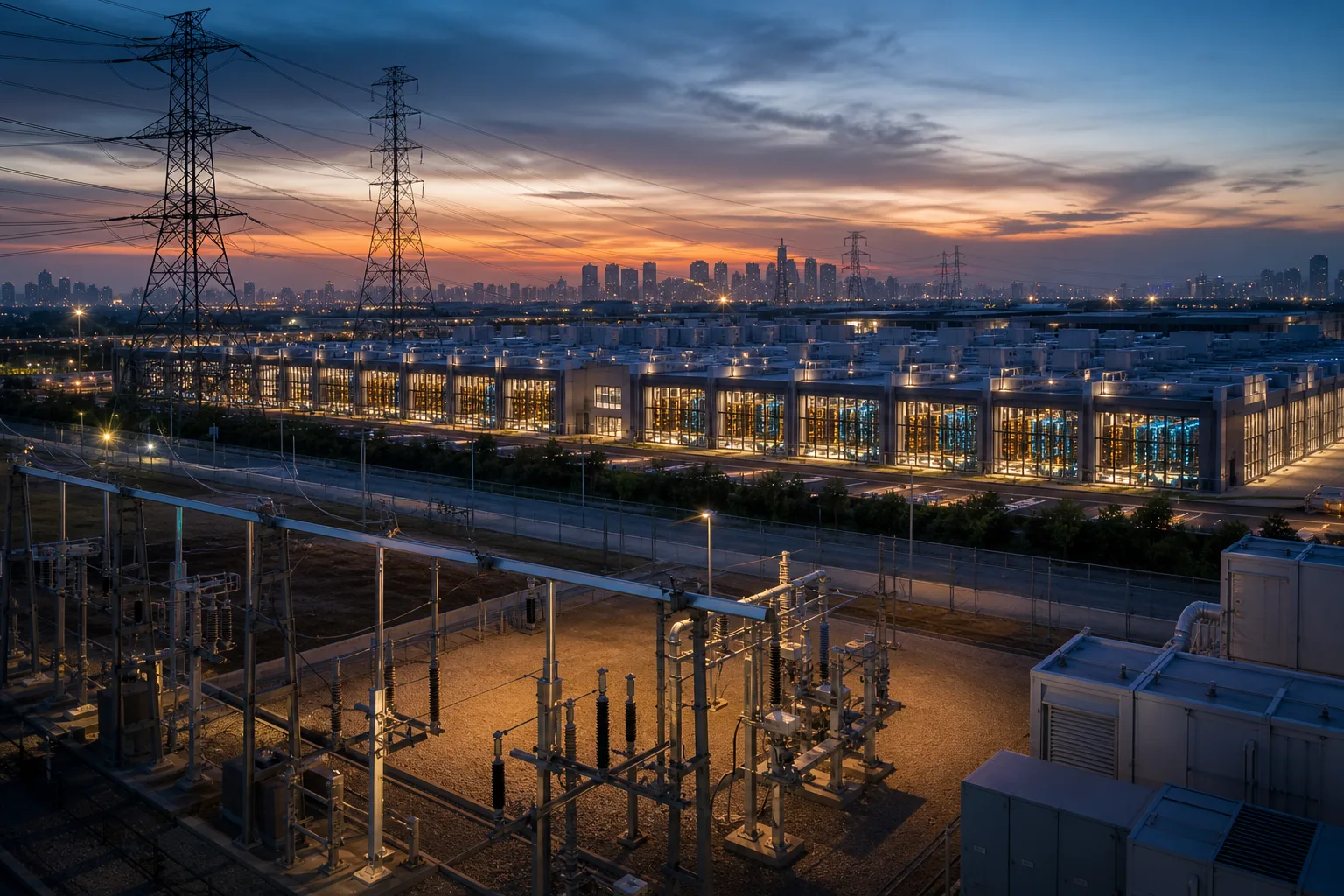
The central question in AI geopolitics is no longer who has the cleverest chatbot. It is who controls the machinery behind it: the chips, the cloud campuses, the electricity, the training data, the talent pipeline and, increasingly, the rules everyone else must live under.
That is the sharper implication behind a growing body of commentary framing artificial intelligence as part of a wider struggle over power and world order. The AI geopolitics debate can sound grandiose, and sometimes it is. Every technology boom attracts people eager to declare a new era before lunch. But this time there is a hard physical reality underneath the rhetoric. AI runs on factories, mineral supply chains, undersea cables and power grids. Those things have always been geopolitical.
My read is that AI will not produce one clean new global center of power. It is more likely to create a messy map of dependencies: American cloud platforms, Taiwanese chip fabrication, Dutch lithography machines, South Korean memory, Japanese materials, Chinese manufacturing capacity and energy-rich countries trying to turn cheap power into strategic relevance.
That is not a frictionless market. It is a contest over who gets to set the terms.
- AI geopolitics is increasingly decided by access to chips, energy, data centers and the people capable of operating them.
- The AI geopolitics contest extends beyond Washington and Beijing as middle powers pursue technology sovereignty and influence over global standards.
- Export controls can slow rivals, but they also encourage costly parallel supply chains and a more fragmented internet.
- Countries that treat AI only as an app economy risk missing the infrastructure race already reshaping political power.
Table of Contents
AI geopolitics starts with the physical stack
For years, the software industry sold itself on a pleasant fiction: code was weightless, the cloud was everywhere, and digital services floated above the old constraints of geography. Then Nvidia became one of the world’s most valuable companies, Taiwan Semiconductor Manufacturing Co. became a recurring subject of national-security briefings, and Microsoft, Google, Amazon and Meta started shopping for electricity like industrial-era steelmakers.
The modern AI stack is concentrated in ways that should make policymakers uncomfortable. Nvidia dominates the market for the high-end accelerators used to train many frontier models. TSMC produces the most advanced logic chips at scale. ASML, based in the Netherlands, is uniquely positioned in extreme ultraviolet lithography, the equipment needed to make leading-edge chips. The United States, Japan and Europe each hold pieces of the manufacturing-tool chain that cannot be quickly replaced.
In AI geopolitics, that concentration makes semiconductor export controls especially consequential. Washington’s restrictions on advanced AI chips and chipmaking equipment aimed at China are not merely trade policy. They are an attempt to constrain a competitor’s ability to build and deploy frontier computing capacity.
Neither side gets a clean win. Controls can impose real costs and delays, particularly around the most advanced systems. Yet they also give Beijing a powerful incentive to reduce its reliance on foreign suppliers. If you have watched the technology industry long enough, you know the pattern: restrictions create pain, then they create a domestic business case. Sometimes that business case becomes an industry.
The White House’s AI executive order is part of a broader U.S. AI policy effort. It combines safety reporting, standards work and support for domestic technical capacity. Other governments are reaching broadly similar conclusions, even if they disagree on the values that should govern the technology.
The contest is bigger than the United States and China
Washington and Beijing dominate the headlines because they have the capital, research depth and industrial scale to do so. Still, reducing AI geopolitics to a two-country scoreboard misses the most interesting part of the story.
The European Union has taken a different route: rulemaking. Its AI Act tries to create obligations based on a system’s risk, with stricter requirements for uses deemed high risk and separate transparency duties for general-purpose AI models. Brussels is betting that market access will make its rules consequential beyond Europe, much as the GDPR influenced global privacy practices. For AI geopolitics, that is a bid to turn regulatory reach into strategic influence. Whether that bet pays off is another question. Compliance rules can shape behavior, but they do not manufacture GPUs or build giant data centers.
Countries in the Gulf are pursuing a more direct infrastructure strategy. The United Arab Emirates and Saudi Arabia have money, abundant energy resources and a stated desire to become AI hubs rather than merely customers of American and Chinese platforms. Their challenge is political as much as technical: access to the most capable chips can be constrained by U.S. security concerns, while partnerships with multiple powers invite scrutiny from all sides.
India, Japan, South Korea, Singapore, Brazil and others are taking more tailored approaches. One may back domestic language models; another may insist on data localization; a third may try to become a trusted manufacturing partner as companies diversify supply chains. None needs to become the next Silicon Valley to matter. In this environment, owning one critical layer of the stack can buy a country a seat at the table.
And yes, standards matter. Boring? Often. Decisive? Frequently. Technical standards determine how systems interoperate, how security is measured and which companies can sell into public procurement markets. The country or bloc that writes the templates can quietly shape the market for a decade. Think of it as setting the measurements for a construction project before everyone else starts building.
AI geopolitics will be fought through energy and data centers
The public image of AI remains an interface: a prompt box, a generated image, perhaps a synthetic voice that sounds a little too pleased with itself. The industrial reality is a building full of servers drawing extraordinary amounts of power.
Training a top-tier model can require large clusters of accelerators, and inference at global consumer scale creates another ongoing demand. Electricity consumption from data centers, AI and crypto is expected to rise, with AI a significant driver of the increase. Exact forecasts will move around, as forecasts do, but the direction is hard to dispute.
AI geopolitics therefore turns grid capacity into AI policy. A country can announce a national AI strategy every Tuesday, but if it cannot connect data centers to dependable power, source transformers, secure water where needed for cooling and obtain high-end hardware, that strategy is mostly a brochure.
It also gives new relevance to places that can offer cheap renewable power, nuclear generation, gas supplies or rapid grid buildouts. That does not mean energy-rich states automatically become AI powers. Talent, capital, legal stability and network connectivity still count. But the era when software could pretend it had escaped resource politics is over.
There is an environmental complication, too. Governments eager to attract AI investment may find themselves choosing between local energy needs and server campuses owned by foreign firms. That is a difficult political sell when households face high bills or factories need the same capacity. The next wave of AI backlash may have less to do with scary robots than with whose substation gets upgraded first.
The danger of a splintered AI world
There is a legitimate case for national security controls. No responsible government should ignore the military, surveillance and cyber implications of capable AI systems. Models can assist with intelligence analysis, targeting, malware development, propaganda and scientific research with dual-use potential. Pretending all of this is simply a consumer technology story would be naïve.
But AI geopolitics also carries a real risk of overcorrection. If every government treats data, models, cloud capacity and standards as national assets to be fenced off, the result could be a fractured technical world: incompatible rules, duplicated infrastructure and companies forced to choose political camps.
That AI geopolitics risk is not theoretical. We have seen smaller versions of this before. The internet became more national. Telecom equipment became a security flashpoint. Huawei’s place in 5G networks turned into an alliance test. The difference with AI is that the technology is embedded in more decisions, from education and hiring to health research, logistics and defense.
Fragmentation may protect some strategic interests, but it is expensive. It limits scientific collaboration, raises compliance costs and can leave smaller countries with fewer choices. It may also entrench the very giants governments say they want to restrain, because only the largest firms can afford separate models, data arrangements and legal teams for every jurisdiction.
What a serious AI strategy looks like
A serious national plan for AI geopolitics cannot stop at funding flashy startups or announcing a chatbot for public services. Those may be useful projects, but they are not sovereignty.
It means deciding where a country can genuinely contribute. That could be chip design, specialized manufacturing, public research, open models, secure cloud services, energy generation or an excellent testing and regulatory environment. It means educating engineers and technicians, not only sponsoring a handful of elite labs. It means procurement policies that do not hand every public workload to one overseas vendor by default.
It also means accepting trade-offs. Full technological independence is mostly fantasy; even the United States depends on allies and overseas supply chains. The more realistic goal is resilient interdependence: enough domestic capability and diversified partnerships that a political dispute or supply shock does not shut off access to critical systems overnight.
That may sound less dramatic than declaring an AI arms race. Frankly, it is more useful. The future of AI geopolitics will be shaped less by who delivers the snappiest keynote and more by who can keep the lights on, train skilled people, maintain alliances and write rules that others choose to follow. The center is not disappearing so much as being redistributed — and the countries that understand the plumbing may be the ones that matter most.
Frequently Asked Questions
What is AI geopolitics?
AI geopolitics describes how governments use artificial intelligence capabilities, computing infrastructure, semiconductor supply chains and technical standards to pursue security, economic and diplomatic influence. It is broader than generative AI products because it includes the physical systems that make those products possible.
Why are advanced chips so important to national AI plans?
Training and running leading AI systems requires enormous amounts of specialized computing power. Advanced chips, the tools used to manufacture them, high-bandwidth memory and data-center networking are concentrated among a relatively small group of companies and countries, creating strategic chokepoints.
Can countries without major chip companies compete in AI?
They can, though not by copying the United States or China dollar for dollar. Countries can build influence through targeted research, public-sector deployment, reliable energy, regional cloud capacity, language-specific models and active participation in international standards bodies.