- Reference Image mode binds a photo’s pixels and sensor data to cryptographic signatures created before iOS can alter the image.
- Apple says Reference Image mode can verify authentic photographs while preventing outsiders from identifying photographers or tracking their devices.
- Private Cloud Compute checks sensor, Secure Enclave, and timestamp evidence before producing a signed final JPEG.
- Apple’s system uses post-quantum cryptography and revocation lists to preserve trust if a camera sensor or image is later compromised.
Table of Contents
Reference Image mode is Apple’s answer to a collapsing trust problem
A photograph used to arrive with a basic presumption: someone pointed a camera at something that happened. That presumption is getting harder to keep. Apple’s new Reference Image mode, debuting on the iPhone 18 Pro, is its attempt to give serious photographs something closer to a tamper-resistant receipt.
The company has published an unusually detailed technical account on its Security Research site, and the core idea is refreshingly direct. If an image may be used as evidence, news documentation, or simply proof that an event occurred, Apple wants a verifier to establish where its pixels came from and whether the chain between camera and final file was broken.
That’s a timely ambition. Generative-image tools have made convincing fabrication cheap, fast, and accessible. Ordinary editing was already enough to muddy plenty of online arguments; synthetic photography has made the old question — “is this real?” — feel almost quaint. Apple isn’t claiming Reference Image mode can solve misinformation. Frankly, no camera feature can. But it is building a stronger way to identify images captured through a particular trusted process.
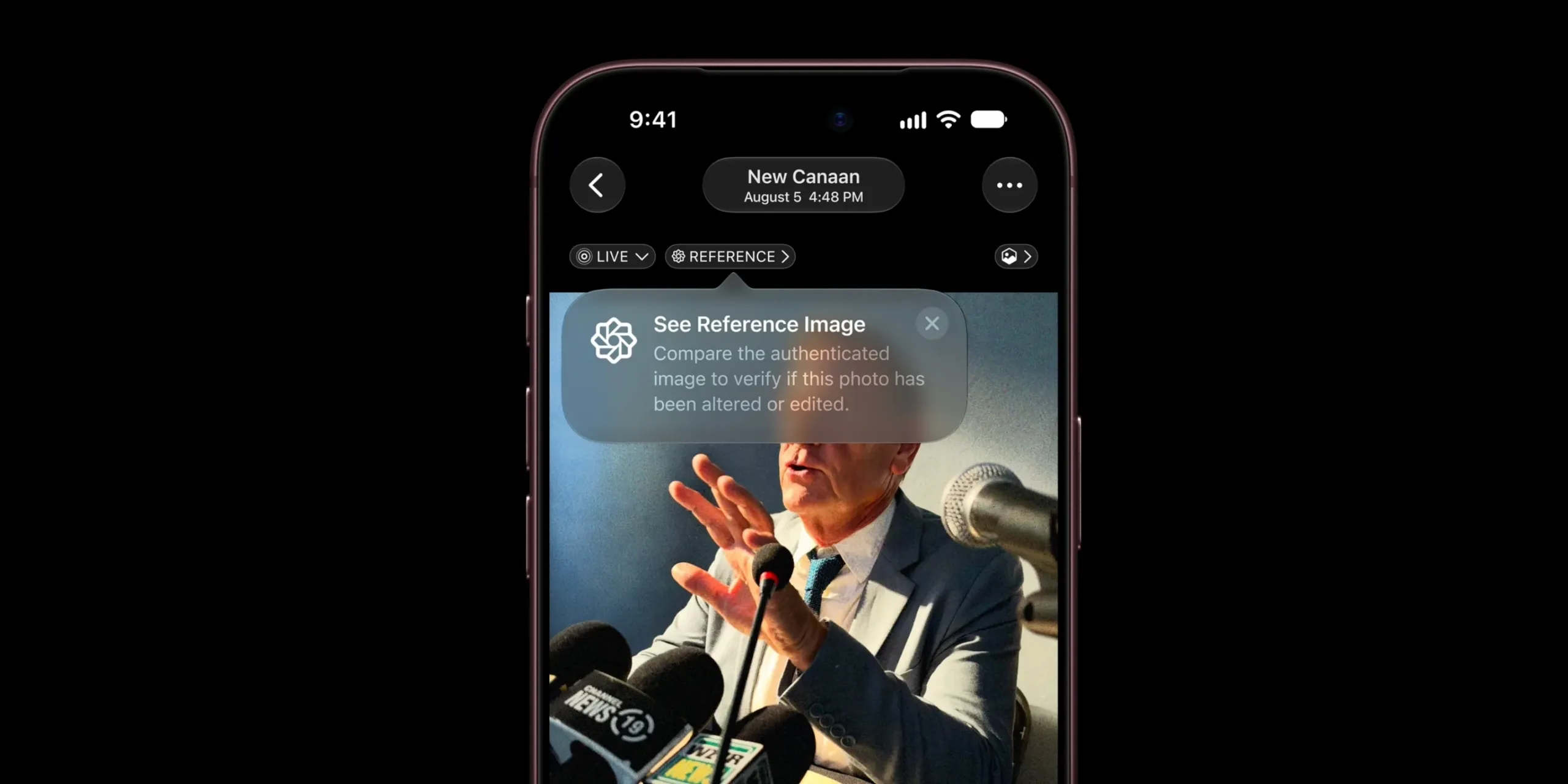
Apple describes the outcome as a secure digital negative. Think of it less like a watermark stamped onto a completed JPEG and more like a sealed record assembled from the instant of capture onward. The company says the approach goes beyond existing provenance efforts such as C2PA, the industry specification backed by companies including Adobe, Microsoft, Google, and OpenAI. C2PA can document an image’s editing history, but Apple’s argument is that trust can still fail at weak links in that history.
The proof begins inside the camera sensor
The most interesting part of Reference Image mode is where its trust chain starts: not in the Camera app, not in iOS, and not after a photo hits cloud storage. It begins with the sensor during iPhone manufacturing.
According to Apple, each sensor creates its own signing-key pair when it is initialized. Its private key remains on the sensor, while the public key is recorded and certified during factory provisioning, then included in the device’s hardware manifest. When that sensor captures a Reference Image, it signs the raw pixels and sensor metadata before the data gets passed higher into the operating system.
For Reference Image mode, that factory-established identity is what ties the photograph back to the physical sensor that captured it. That ordering matters. Software can be modified, compromised, or fooled in ways hardware ideally cannot. Binding the pixel data to the physical sensor at the source makes later manipulation far easier to detect. It’s the digital equivalent of placing a numbered seal on a box before it leaves the warehouse, rather than asking someone to swear it was unopened after it reaches the store.
Of course, no hardware-rooted system is immortal. Apple acknowledges this indirectly through a confidence-scoring and revocation system. If a sensor is deemed untrustworthy, Apple can stop signing new images from it. Devices also receive updated revocation lists, allowing them to recognize photos or sensors whose status has changed after the fact.
Apple avoids trusting the phone’s ordinary clock
Time is another weak spot in digital evidence. A phone’s system clock can be changed, whether innocently by a user traveling across time zones or maliciously by somebody trying to make a photo appear older or newer. Reference Image mode handles this with cryptographic timestamp tokens rather than accepting the operating system’s word for it.
The iPhone receives a secure timestamp before capture, establishing a lower boundary. It gets another after the image is taken, creating an upper boundary. The result is not a magical declaration that a photo was shot at precisely 10:42:13. Instead, Apple can verify that it was captured within a bounded window. That bounded interval is central to Reference Image mode, and it is a more honest technical claim — and a more useful one for evidence.
The Secure Enclave, Apple’s hardware-backed security component, signs additional metadata that does not originate on the camera sensor. Apple’s Private Cloud Compute infrastructure then verifies the sensor signature, verifies the Secure Enclave signature, confirms both components belong to the same iPhone, and checks the timestamp evidence. Only then does it process the secure negative into the final JPEG.
There’s a trade-off here. This isn’t a purely offline provenance format where every action happens on your phone. Apple is asking users to trust Private Cloud Compute as a verification service. The company has spent years positioning that system as private by design, but this will still draw scrutiny from security researchers — as it should. A chain of trust is only as persuasive as its least inspectable link.
Why privacy may be the feature that makes it usable
A less thoughtful provenance system would make each camera a visible serial number. That would be disastrous for a photojournalist documenting an authoritarian crackdown, a whistleblower, or a person recording abuse. Apple says Reference Image mode was specifically designed so outside parties cannot learn the photographer’s identity, identify the particular device, or determine whether two images were taken by the same iPhone.
This may be Apple’s smartest design choice. Authenticity systems have a habit of treating privacy as an inconvenience to be solved later. But proving that an image emerged from a trusted camera should not automatically create a tracking beacon for the person holding it. Those goals are in tension, and Apple appears to be taking the tension seriously.
After verification, Apple signs the final Reference Image JPEG with both conventional cryptography and post-quantum cryptography. The latter is a hedge against a future where quantum computers can break some of today’s public-key protections. It sounds futuristic because it is, but archival photographs can remain important for decades. If a system is selling long-lived evidence, planning for long-lived cryptographic threats is sensible.
The difficult part is getting anyone else to trust it
Reference Image mode could be technically elegant and still struggle with the human side of provenance. Newsrooms, courts, social platforms, and fact-checkers need tools that can validate these images without becoming dependent on opaque Apple-only workflows. Apple’s privacy claims are strong, but independent verification procedures and broad support outside the company’s ecosystem will decide whether this becomes meaningful infrastructure or an impressive iPhone feature that rarely leaves the Apple bubble.
There’s also the unavoidable cultural problem: verified photos will coexist with billions of ordinary, unverified ones. A missing signature cannot prove an image is fake. It can only mean the image lacks this particular trail of evidence. That distinction will need to be communicated carefully, because the internet is already very good at converting technical caveats into blunt weapons.
Still, my read is that Apple is aiming at the right target. In a world where pictures increasingly need receipts, the company is trying to preserve the value of a camera as a witness — without turning the witness into a surveillance device. Whether platforms and institutions accept that receipt is the question that now matters.
Frequently Asked Questions
What is Apple’s Reference Image mode?
Reference Image mode is an iPhone 18 Pro camera setting designed to create photographs with verifiable provenance. It records signed evidence from the image sensor, Secure Enclave, and cryptographic timestamps, then uses Apple’s Private Cloud Compute to validate and sign the finished image.
Does Reference Image mode reveal who took a photo?
Apple says the system was built to avoid exposing the photographer’s identity, the specific device used, or whether two verified images came from the same iPhone. That privacy design is intended to support photographers working in sensitive environments.
Why does Apple use Private Cloud Compute for photo verification?
Private Cloud Compute performs the checks needed to validate the sensor signatures, Secure Enclave metadata, and capture-time window without making the final verification chain a public device identifier. Apple then creates and signs a verified JPEG after those checks pass.
Can a verified iPhone photo be revoked later?
Yes. Apple says it can revoke a sensor if it is identified as low-scoring, preventing future Reference Images from receiving signatures. Individual images can also be revoked, with Apple devices downloading updated revocation information regularly.