

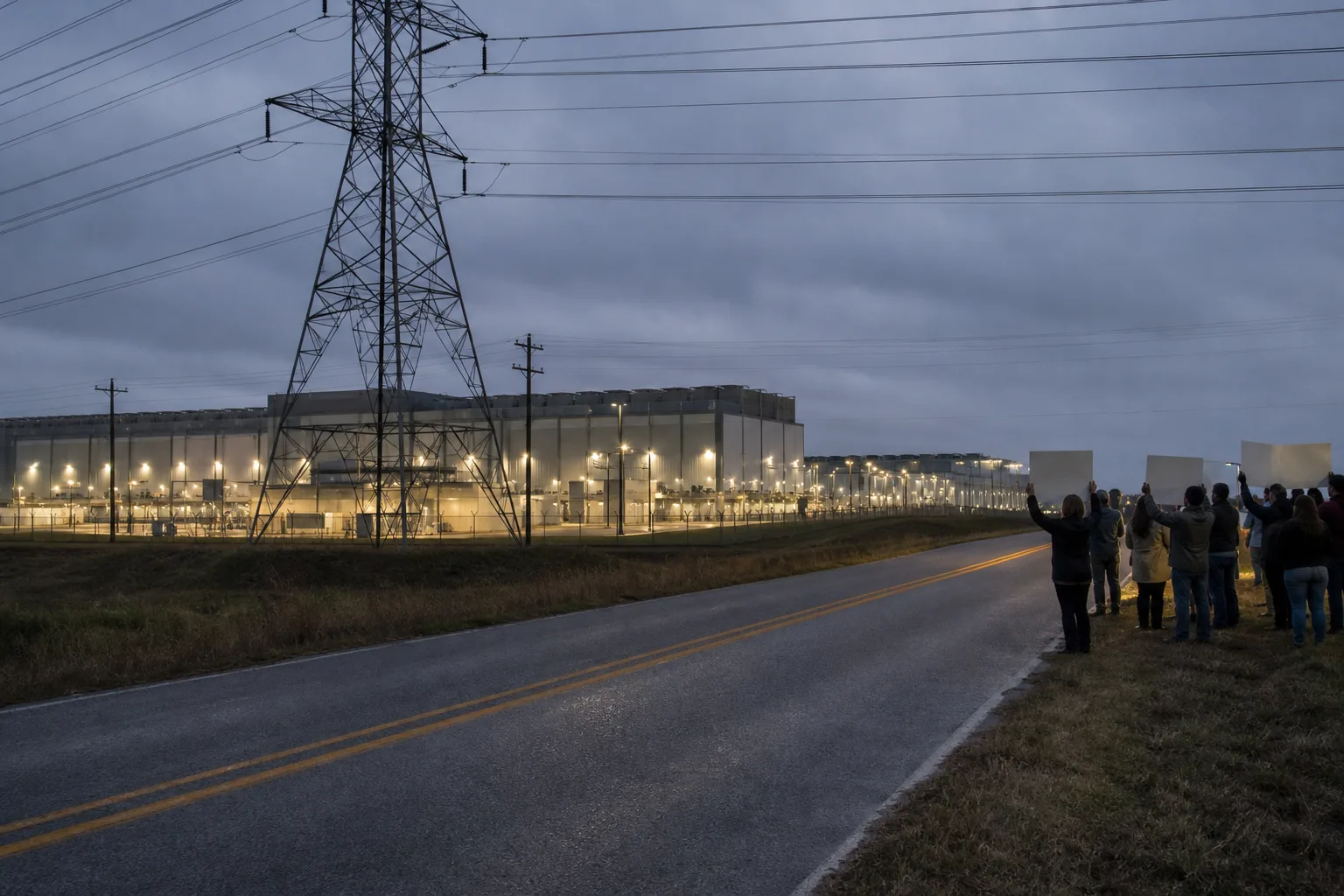
The political honeymoon for AI data centers appears to be ending. For years, governors treated giant server campuses as a clean shorthand for economic ambition: announce a project, promise construction jobs and tax revenue, pose beside a tech executive. Voters in a growing number of communities are looking past the ribbon-cutting. They see the substation, the diesel generators, the water demand, and sometimes a power bill that keeps creeping upward.
That collision was all over the latest US election cycle. Even where no data-center referendum appeared on a ballot, candidates from statewide races down to utility commissions found themselves answering the same basic question: why should residents absorb the costs of an AI construction boom whose rewards often flow elsewhere?
- AI data centers became a defining local issue as candidates faced voter anger over energy bills, water use, and industrial disruption.
- Election victories by moratorium-friendly candidates could slow AI data centers in Texas, Georgia, Pennsylvania, Arizona, and other fast-growing markets.
- Utility commission races matter because regulators decide who pays when enormous new computing campuses connect to an already strained grid.
- The industry now faces a political problem that more servers, splashy announcements, and promises of future jobs cannot easily solve.
Table of Contents
AI data centers became an unexpectedly potent campaign issue
Texas offered the clearest version of the backlash. The state has marketed itself as a welcoming home for tech infrastructure, and outgoing Republican Governor Greg Abbott had openly pitched Texas as an AI hub. Data Center Map lists nearly 600 projects in the state, including sites still planned or under construction. That is an astonishing amount of computing infrastructure in a state that already knows what it means to worry about grid reliability. The scale helps explain why AI data centers have become such a potent political issue there.
Democratic state Representative Gina Hinojosa made that tension central to her successful gubernatorial campaign against Abbott. She called for a halt to new deals while lawmakers establish rules that give communities a genuine voice. Speaking in El Paso, where residents have protested a Meta facility, Hinojosa said: “When I am governor, we will put a pause — a moratorium on any agreements until we can pass laws to make sure that the people of El Paso and Texas have a seat at the table to decide if and how these data centers come into their communities.”
Abbott had already announced a permitting pause, though reporting found regulators continued processing applications. His office drew a distinction between processing and approval. To a family living near a proposed site, that probably sounds like the sort of procedural distinction lawyers enjoy and everyone else distrusts.
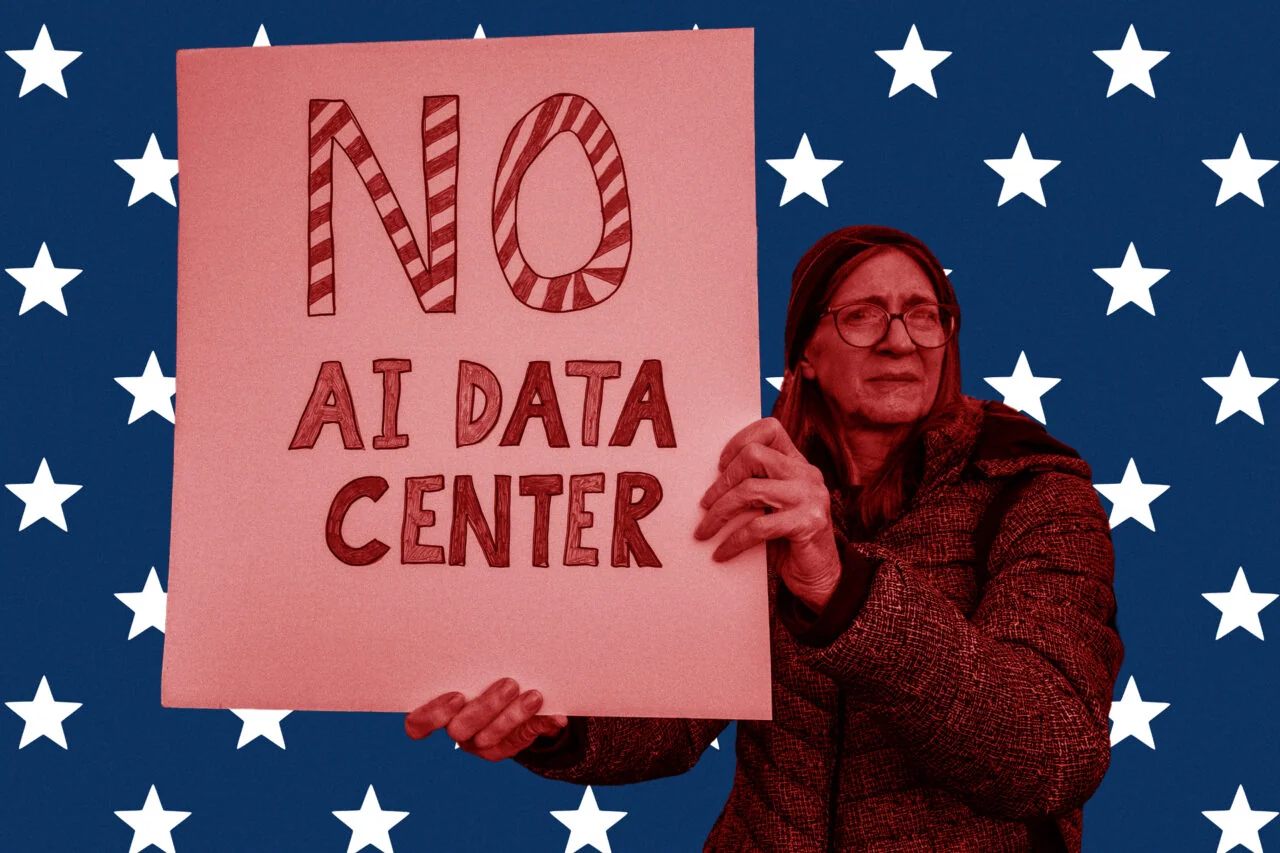
The Texas result is not a simple anti-technology revolt. It is a demand for terms. Residents are asking whether AI data centers will pay their fair share for grid upgrades, whether water supplies will be protected during drought, and whether local governments have enough authority to say no. Those are ordinary bread-and-butter political concerns, not sci-fi anxiety.
The bill is no longer abstract
The AI industry likes to discuss infrastructure in grand terms: national competitiveness, scientific discovery, future productivity. Those arguments have merit. Training and running modern models requires an enormous amount of compute, and hyperscale operators are racing to secure land, power, fiber, and cooling capacity. But a new data center feels very different from a chatbot on a phone. It is physical, noisy, power-hungry, and located somewhere near someone.
For communities hosting AI data centers, local complaints have become remarkably consistent: constant equipment noise, concerns about backup-generator emissions, lost farmland, pressure on groundwater, and fear that new grid spending will be socialized across residential customers. Research is still developing on several of these effects, including localized heat, but the political reality has arrived well ahead of academic consensus.
The wider energy picture is not speculative. The US Energy Information Administration expects electricity demand from data centers, AI, and cryptocurrency to rise sharply through the decade. A grid can support new load, of course, but somebody must build generation and transmission first. The central fight is over timing and cost allocation. If a company needs hundreds of megawatts tomorrow and the public grid needs upgrades to accommodate it, who writes the check?
My read is that the industry badly underestimated how quickly that question would reach the ballot box. Tech companies have experience negotiating tax abatements with city halls. They have much less experience persuading a skeptical neighborhood that a windowless industrial building represents a shared civic good.
Georgia and utility races show the fight is spreading
Georgia has become one of America’s fastest-growing data-center markets, particularly around Atlanta, and the issue took a prominent place in its governor’s race. Democrat Keisha Lance Bottoms, who supported a statewide pause, defeated Republican Rick Jackson, who argued projects should proceed when they have local backing. The difference may sound narrow, but it goes to the heart of the debate: should local consent be enough when a project’s energy effects can spill across an entire state? Georgia’s growth shows that AI data centers are now a statewide concern, not merely a local land-use dispute.
AI data centers also surfaced in races most voters might once have ignored: utility commissions. These bodies are not glamorous. Their meetings rarely produce viral clips. Yet commissioners can determine rates, grid investments, and connection terms for massive industrial customers. In Arizona, Democrats Clara Pratte and Jonathon Hill were expected to break a Republican majority after campaigning against price increases tied to the buildout. Georgia Democrats flipped a commission long held by Republicans.
Georgia Commissioner Hubbard put the argument plainly during a debate: “What I’m looking to do with the majority on the commission is to work to lower folks’ power bills using clean energy and make sure that we’re holding data centers accountable.” That may be the most consequential phrase in this entire election story: holding them accountable.

In Pennsylvania, Democrat Mark Pinsley won a state Senate district contest after advocating a statewide moratorium on hyperscale facilities. Taken together, these results suggest voters are not necessarily rejecting computation or AI products. They are rejecting a version of development that asks communities to trust first and negotiate later.
Why the AI industry cannot simply build around opposition
There is a temptation in Silicon Valley to treat local resistance as a permitting annoyance. Build in another county. Offer a richer tax package. Buy more land. But AI data centers cannot be relocated as easily as software teams. They require high-voltage transmission, dependable generation, fiber routes, water or alternative cooling systems, and political permission. The available places are finite.
That makes endless jurisdiction-shopping look less convincing. Texas, Georgia, Arizona, Virginia, Ohio, and other favored markets have grids, land, and development experience. They also now have electorates that have watched what the first wave of projects brought. A company that loses trust in one county may find the next county has already read the headlines.
Elon Musk responded to the election results by posting that “Data centers in space looking pretty appealing right now.” It is a classic Musk line: provocative, technically interesting, and nowhere close to solving the immediate terrestrial politics. Launching compute into orbit does not settle a resident’s objection to a facility being built beside their home. Nor does it answer where today’s models will get their electricity.
OpenAI chief executive Sam Altman struck a more reflective note, writing that people should not cede control of the future to superintelligence and that this requirement should constrain AI progress. Fair enough. But democratic control is not only a distant question about hypothetical superintelligence. It also means allowing a town to question a major facility before concrete is poured.
A slower buildout may be the industry’s own fault
The likely consequence is not the end of AI infrastructure. Demand is real, and the biggest platforms have too much capital committed to simply walk away. What changes is the deal. Expect more moratoriums, tougher interconnection rules, formal community-benefit agreements, stricter water reporting, and sharper scrutiny of tax incentives. Developers of AI data centers will, in some cases, have to wait. In others, projects will cost more.
Frankly, that might be healthy. The early cloud era trained people to imagine computing as placeless. AI shattered that illusion. AI data centers are factories for the digital age, and factories have always involved land, resources, workers, neighbors, and politics. The companies building them can either accept that bargain or discover that local democracy is considerably harder to scale than a GPU cluster.