

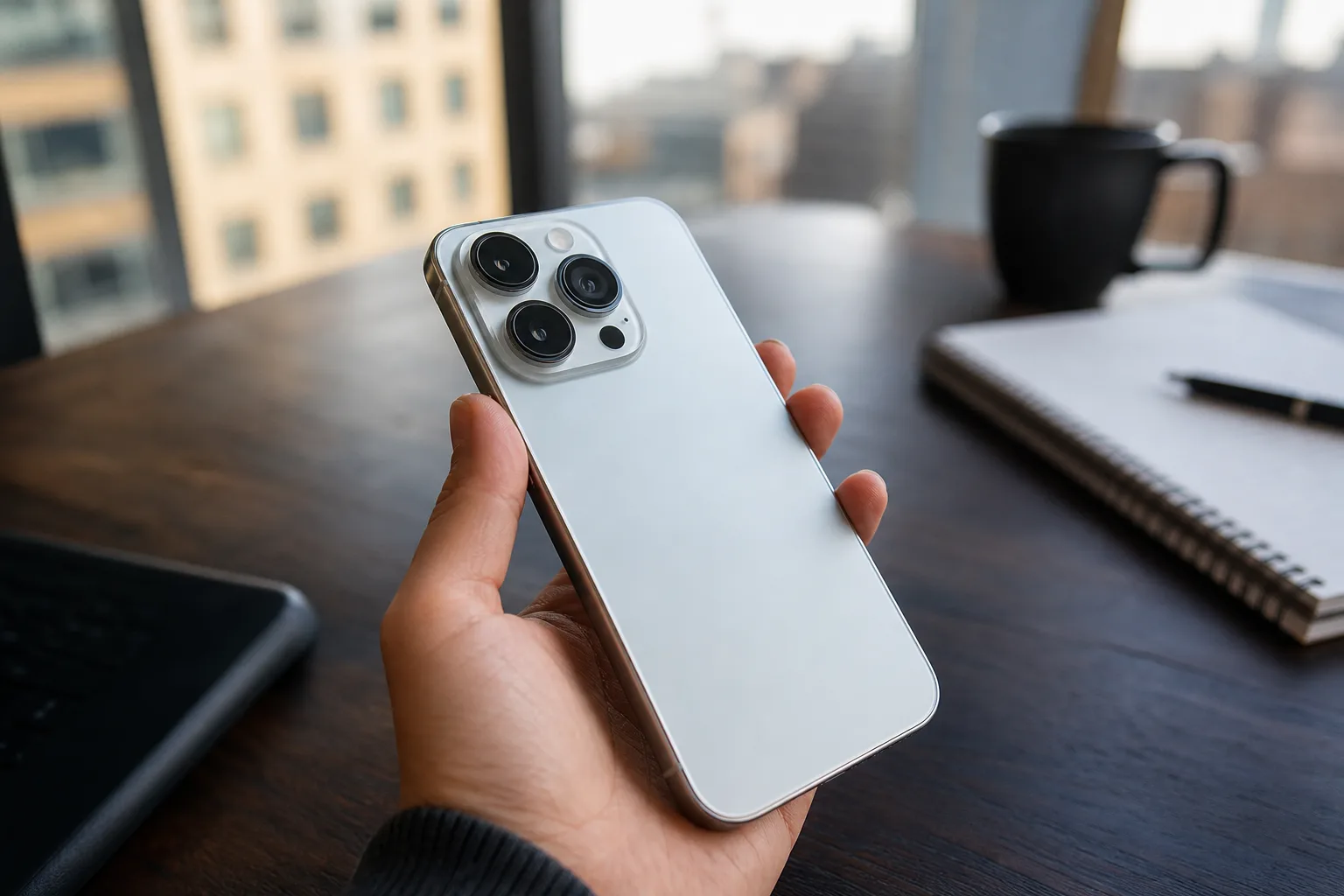
- The iPhone 20 Pro camera is rumored to use 17nm logic circuitry beneath its main sensor’s pixel layer.
- A smaller-process iPhone 20 Pro camera sensor could read data faster, use less power, and give computational photography more room to work.
- Samsung has reportedly developed a 17nm process for image-sensor signal circuitry and is working with Apple in Texas.
- Apple’s 2027 anniversary phone may also combine those camera changes with a largely uninterrupted curved OLED display.
Table of Contents
iPhone 20 Pro camera rumor points beneath the lens
Apple’s cameras have spent years winning the smartphone spec war through software, but the iPhone 20 Pro camera could make a more consequential change far below the glass. A new report from Weibo leaker Ice Universe claims Apple’s 2027 flagship will use a main image sensor with logic circuitry made on a 17-nanometer process.
That sounds like chip-fabrication trivia. It isn’t, really. The logic layer is the part of a modern stacked sensor that moves image data off the pixels, manages readout, and feeds the phone’s image-processing pipeline. Shrinking that circuitry could mean a sensor that reads scenes more quickly, burns less power, or handles more data before Apple’s software starts doing its familiar computational-photography work.
For people who actually use their phone camera, the prize is less likely to be a dramatic resolution bump than fewer small failures: less motion distortion in moving subjects, better burst shooting, cleaner video capture, and perhaps a little more flexibility in difficult light. Those are the improvements that matter after the launch-event demo reel ends.
Why a 17nm sensor layer could matter
Most high-end phone cameras now use stacked sensor designs. Put simply, the light-catching photodiodes sit on one layer, while transistors and processing circuits occupy another. Separating those jobs gives manufacturers more freedom to optimize each one, much like moving the noisy machinery of a restaurant kitchen away from the dining room.
In the case of the rumored iPhone 20 Pro camera, a 17nm logic process would apply to that lower circuitry, not necessarily to the pixel layer itself. A denser logic layer can create room for faster analog-to-digital conversion and memory functions, while also reducing the energy used to shuttle huge amounts of image information around. Video is where this gets especially interesting. Readout speed is a major factor in rolling shutter artifacts, where fast-moving objects appear bent or skewed because different parts of a frame are captured fractions of a second apart.
There’s a caveat the rumor mill tends to skip: 17nm is not automatically better in every meaningful camera metric. Sensor performance still depends on pixel size, lens quality, thermal behavior, image-signal processing, and Apple’s choices around exposure and noise reduction. A superior logic node can enable better results; it does not guarantee them. Anyone expecting DSLR-like physics from a thinner phone should keep their expectations in check.
Still, Apple has good reason to chase faster sensor readout. The company has made video a central iPhone selling point, from Cinematic mode to ProRes and Log recording. Faster capture hardware would give those features a sturdier foundation than software alone can provide.
Samsung’s role makes the claim plausible, not proven
The 17nm claim has a real-world thread worth watching. Market-research firm Omdia reported in 2024 that Samsung was developing its 17LPV manufacturing process for CMOS image sensor signal-processing circuitry. Samsung is also reported to be working with Apple on advanced image sensors at a facility in Austin, Texas.
That doesn’t establish that Samsung will supply the rumored iPhone 20 Pro camera sensor, or even that the two reports describe the same project. Apple’s supply chain is deliberately layered, and Sony has long been a crucial supplier of iPhone camera sensors. But the possibility of Apple drawing on Samsung’s manufacturing expertise for part of an imaging stack is no longer far-fetched.
The Austin reports point to work with Samsung in Texas, even if the precise sensor program remains murky.
My read is that Apple is pursuing options. Camera sensors are among the few smartphone components where physical hardware can still visibly separate one premium phone from another. Better chips are nice; a photo of a child running indoors without smeared detail is nicer.
LOFIC may be the bigger photographic story
Another rumored Apple project may matter more than the manufacturing node: a proprietary sensor using lateral overflow integration capacitor, or LOFIC, technology. The technique is designed to expand a sensor’s usable dynamic range by storing excess charge when bright areas would otherwise clip.
Translated into normal-human language, it could help preserve detail in a bright sky without turning a shadowed face into murky sludge. Phones already fake some of this through multi-frame HDR, but that approach can struggle with motion. A sensor that captures more range at the hardware level would give the image pipeline better raw material to work with.
There is no evidence yet that LOFIC and the purported 17nm design are one product. They may be separate research tracks, or one may never reach a shipping phone. Apple’s camera development pipeline is full of experiments that the public never sees. That’s normal, not a sign of failure.
If both technologies arrive together, though, the iPhone 20 Pro camera could be aimed at the stubborn edge cases where phone photography still looks most phone-like: harsh backlight, high-contrast interiors, fast motion, and scenes that demand serious video latitude.
A 2027 anniversary phone has a lot to live up to
The timing is almost as interesting as the component. Apple is expected to mark the original iPhone’s 20th anniversary in 2027, and reports have suggested it could skip the iPhone 19 name in favor of iPhone 20, echoing the jump from iPhone 8 to iPhone X for the first iPhone’s tenth anniversary.
That anniversary model is also rumored to have a display that curves around its edges with no obvious cutouts. Pair a radical front design with a materially upgraded iPhone 20 Pro camera, and Apple would have a sensible answer to a problem it knows well: anniversary products need more than a new coat of titanium.
But this is still a long-range leak, nearly a year before the supposed launch window. Plans change, suppliers miss targets, and Apple is famously willing to hold a feature for another cycle if yields or quality aren’t where they need to be. Remember when the industry treated under-display cameras as inevitable? They arrived, mostly looked compromised, and promptly stopped being the next big thing.
For now, the 17nm detail is best viewed as an intriguing clue rather than a finished-spec-sheet promise. If it holds, the iPhone 20 Pro camera may make its biggest advance in the least visible part of the device. Frankly, that’s often where the useful upgrades live.