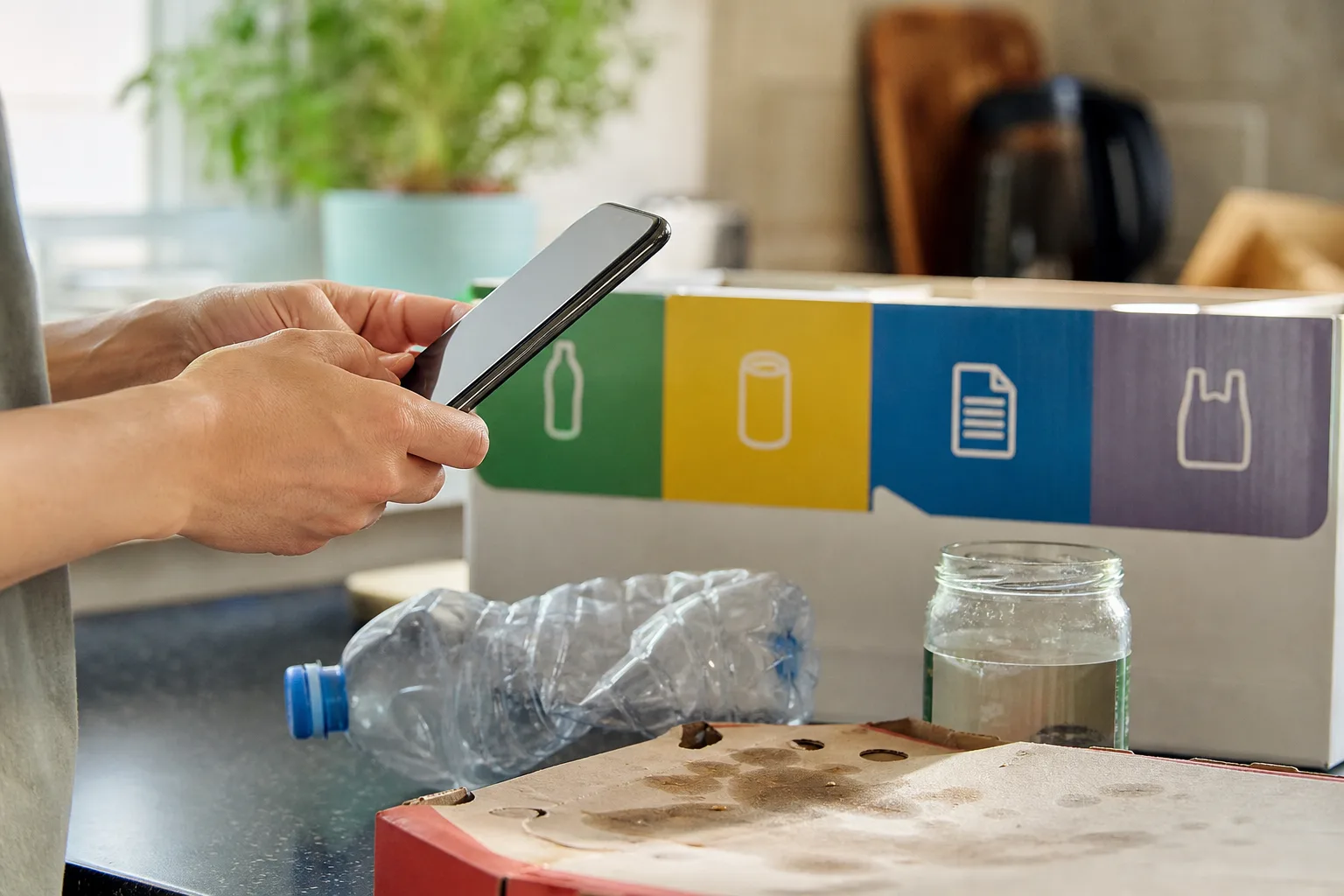
- A new AI recycling app called Gdzie to wyrzucić uses Gemma 4 to identify which bin Polish waste items belong in.
- The AI recycling app processes photos entirely in-memory — no images are stored, addressing a key privacy concern.
- Built by a technical writer using Claude Code and Gemini, the project shows how AI tools are reshaping who can build software.
- Multilingual support for English and Ukrainian is planned, targeting expats and minority communities living in Poland.
Table of Contents
Poland Has a Recycling Problem — and an AI Recycling App Might Fix It
The AI recycling app making waves in Polish developer circles started with a very ordinary dilemma: where do you throw a plastic hair dye bottle that still has product inside? Klaudia Grzesiak, a technical writer based in Poland, found herself stumped by exactly that question — and when she turned to her mum for help, neither of them had a clue. That moment of shared confusion sparked something practical.
It’s a scenario millions of Polish households face every week. Poland’s waste sorting system uses six colour-coded bins, and while the obvious stuff — cardboard, glass bottles, old clothes — is straightforward enough, the edge cases are brutal. A greasy pizza box. A blister pack from a strip of painkillers. A ceramic mug. A broken mirror. None of these belong where you’d instinctively put them, and Poland’s recycling rules don’t exactly come with a cheat sheet attached to every bin.
Search “gdzie wyrzucić” (Polish for “where to throw”) on Google and you’ll see the scale of the confusion immediately. There are Reddit threads, Facebook arguments, and entire forum posts dedicated to debating whether a used coffee cup is paper waste or mixed waste. (For the record: the plastic lining usually makes it mixed waste — but even that depends on your municipality.) Grzesiak decided to build an AI recycling app that could settle these arguments on the spot.
How the AI Recycling App Actually Works
The result is Gdzie to wyrzucić? — Polish for “Where do I throw this?” — a web app that lets you photograph any item and receive an instant AI-powered sorting verdict. The app is built on Gemma 4, Google’s open-weights model family, specifically the 26B Mixture-of-Experts variant available through Google AI Studio’s free tier.
The technical setup is leaner than you’d expect. You snap or upload a photo, hit the Analizuj button, and wait roughly 10–30 seconds. Gemma 4 analyses the image against a roughly 200-line system prompt that encodes current Polish recycling rules — sourced from government documentation and eco-expert guidance — and returns a structured JSON response: which bin, how to prepare the item, a plain-language explanation, and any additional caveats. The frontend converts that into a result card coloured to match the relevant bin. Clean, functional, purposeful.
Privacy is handled simply but effectively. Photos are processed in-memory by the API route, passed to Gemma 4, and discarded immediately after the response comes back. Nothing is stored. For an AI recycling app that involves people photographing items in their own homes, that’s not a trivial detail.
The choice of Gemma 4’s MoE architecture is worth unpacking. The 26B model only activates around 4 billion parameters per token despite having 26 billion total — meaning it delivers strong reasoning capability without the compute cost of a dense model of equivalent size. That’s what makes it viable on the free tier, which is how Grzesiak keeps the AI recycling app demo running around the clock at zero ongoing cost.
Built Without Being a Developer
Perhaps the most interesting part of this AI recycling app’s story isn’t the technology — it’s who built it. Grzesiak is frank about this: she’s a technical writer, not a software engineer. She describes the project as “vibe-coded”, a term that’s gained traction in developer communities to describe AI-assisted coding where the human provides direction and judgment rather than writing raw code.
Her toolchain was a multi-model collaboration. Claude Code handled the boilerplate and translated business logic into working implementation. Gemini’s deep research mode dug through Polish government sources to compile accurate, up-to-date recycling rules. Grzesiak herself supplied the idea, the domain logic, the testing, and the iterative improvements that got the app from a rough prototype to what she calls v4 — a version that’s been live-tested extensively, including photographing items from neighbourhood bins to stress-test Gemma’s edge case handling.
This is becoming a genuinely significant pattern in software development. The barrier between “person with a good idea” and “person who ships working software” is collapsing fast. Grzesiak’s project is a clean example of what that looks like in practice: domain expertise and clear thinking matter more than syntax fluency when AI handles the implementation layer. The technical writer outpacing the developer isn’t a fluke — it’s a signal.
Where the AI Recycling App Hits Its Limits
Grzesiak doesn’t oversell what she’s built. The AI recycling app has real limitations, and she documents them honestly.
Complex photos — multiple objects in frame, busy compositions, larger file sizes — sometimes trigger errors before Gemma is even reached. She suspects the issue is image size or encoding, but hasn’t confirmed the root cause yet. It’s a solvable problem, but it means the app works best with clean, isolated shots of single items rather than cluttered real-world scenes.
Inference speed is the other constraint. At 10–30 seconds per query on the free tier, this isn’t instant. For casual household use that’s probably acceptable — you’re standing at the bin, not in a hurry — but it would be a friction point for any higher-volume deployment. Paid inference tiers or on-device models would change that calculus significantly.
Speaking of on-device: Grzesiak has flagged this explicitly as a future direction. Because Gemma is open-weights, a version of this AI recycling app could eventually run the smaller Gemma 4 E2B or E4B models directly on a user’s phone, with no server round-trip at all. Given that waste sorting is a highly local, privacy-sensitive task that doesn’t need cloud connectivity to function, on-device inference is a genuinely good fit here.
The Bigger Picture for AI Recycling Apps
Waste sorting confusion isn’t uniquely Polish. The UK’s recycling rules vary by council. Germany’s system — with its Gelber Sack, Biotonne, and Restmüll — trips up residents and newcomers alike. In the US, what’s recyclable depends entirely on your municipality’s contract with its materials recovery facility. The general problem Grzesiak is solving is universal; she’s just solved the Polish instance of it first. An AI recycling app built for any of these markets would face the same core challenge: encoding local rules accurately and keeping them current.
The current version is Polish-only by deliberate design, since the system prompt is built around Polish bin categories. But the roadmap includes English and Ukrainian translations — a thoughtful acknowledgment that Poland now has a large Ukrainian refugee and migrant population for whom navigating local bureaucracy, including something as mundane as bin sorting, carries real practical stakes.
Two other planned features stand out. First, interactive clarification: rather than guessing when an image is ambiguous, Gemma would ask the user a yes/no question to narrow things down. That’s a small UX change with meaningful accuracy implications. Second, a reuse-before-recycling nudge — for items like books, working electronics, or clean clothing, the app would surface donation or reuse options before defaulting to the bin. That’s not just a feature; it’s a philosophy. Recycling is the backup plan. Reuse should be the first instinct.
As EU waste directives push member states toward higher recycling targets and better sorting compliance, tools that make correct sorting frictionless aren’t a nice-to-have — they’re part of the infrastructure. Whether it’s a polished consumer app or an AI recycling app built by a technical writer on her lunch breaks, the same underlying idea applies: if sorting waste correctly requires expert knowledge, most people won’t do it correctly. Remove that knowledge barrier with a camera and a capable model, and the compliance rate goes up by default. That’s a more interesting outcome than any government poster campaign.