
Table of Contents
Samsung Galaxy A37 has surfaced on Geekbench, revealing its key hardware details ahead of launch. The benchmark listing confirms the shift to the Exynos 1480 chipset, Android 16 and promising performance gains over the Galaxy A36. Here is everything our editorial team has verified from the leak and what it means for users.
Samsung Galaxy A37 Geekbench Results Reveal Key Specifications and Performance
Samsung recently launched the Galaxy A36 in March, continuing its popular Galaxy A series lineup. Now anticipation is building around the next iteration, the Samsung Galaxy A37. Although Samsung has not officially disclosed detailed specifications, new Geekbench data reveals important information about the smartphone’s internals. We examined what this benchmark tells us about the upcoming Galaxy A37, including its processor, memory configuration and expected performance gains over its predecessor.
The Galaxy A36 impressed users with solid mid-range features and strong value. With the Galaxy A37 now appearing in early tests, Samsung looks ready to deliver meaningful hardware upgrades. Geekbench results show the Galaxy A37 uses the Exynos 1480 chipset, a noticeable shift from the Snapdragon chip used in the A36. This change promises improved power efficiency and faster everyday performance.
Read more on our article, “iPhone 17e Coming with Big 18MP Center Stage Camera”, published on November 23 2025, SquaredTech.
Exynos 1480 Powers the Samsung Galaxy A37
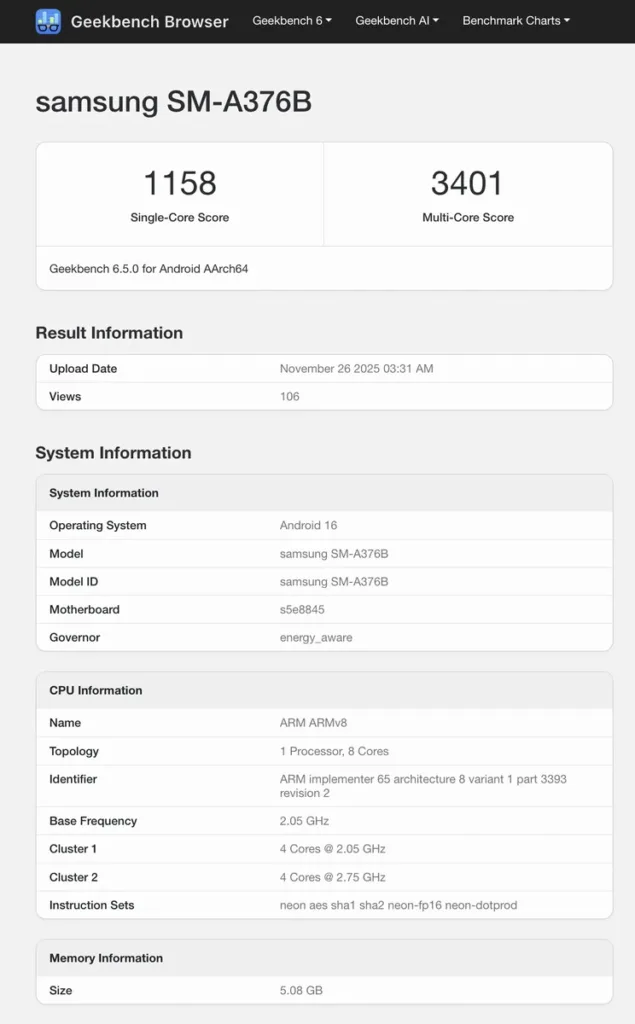
According to the benchmark listing, the Samsung Galaxy A37 is registered under the model number SM-A376B. The Geekbench test was conducted on a unit running Android 16 with 6GB of RAM. The presence of Android 16 suggests the device will ship with the latest Android iteration, ensuring updated software features and security enhancements out of the box.
The key highlight is the Exynos 1480 system-on-chip(SoC). This new mid-range processor features a more modern architecture and higher clock speeds than older models. For context, the Samsung Galaxy A36 runs on Qualcomm’s Snapdragon 6 Gen 3. Moving to the Exynos 1480 indicates Samsung is focusing on better efficiency and performance within its affordable lineup.
Geekbench scores confirm these improvements. The Galaxy A37 achieved a single-core score of 1,158 and a multi-core score of 3,401. By comparison, the Galaxy A36 delivered 1,007 and 2,917 in independent reviews. These results reflect smoother app performance, more responsive multitasking and improved handling of games and media.
What the Samsung Galaxy A37 Benchmark Score Means for Users
For potential buyers, the benchmark details highlight clear advantages over the A36. The stronger Exynos 1480 chip and updated software stack mean the Galaxy A37 should offer faster loading times, better multitasking and improved efficiency. This aligns with Samsung’s broader effort to raise performance in the mid-tier segment without significantly increasing prices.
The 6GB RAM model seen in the benchmark will meet the needs of most users. Samsung may also release additional configurations with more RAM or storage, matching current market trends and consumers who prefer more multitasking headroom.
Though the Samsung Galaxy A37’s design, camera specs, and battery capacity remain undisclosed, the performance data gives valuable insight into its potential. Samsung’s recent Galaxy A series models typically balance good photography capabilities with robust hardware, so the A37 may continue this tradition, integrating respectable cameras alongside the upgraded Exynos platform.
The combination of improved processing power and software updates also suggests better power management, which could result in enhanced battery life or faster charging support, two critical factors for daily smartphone users.
What to Expect Next From the Samsung Galaxy A37
At this stage, detailed specifications beyond the benchmark remain undisclosed. Current leaks focus primarily on internal hardware rather than design elements or additional features. We will continue tracking updates from Samsung as more reliable information appears in the weeks leading up to launch.
Based on typical product cycles, the Galaxy A37 will likely debut as a successor to the A36, targeting users who want affordable performance with modern software support. The shift to the Exynos 1480 chipset positions the A37 competitively within the mid-range space and could give it an advantage over similarly priced rivals.
Samsung is expected to share full specifications soon. Users can look forward to details on the display, camera setup, battery size, charging speed and any software enhancements unique to the A37. These factors will determine how well the device performs beyond benchmarks and how effectively it meets user expectations in a crowded smartphone market.
SquaredTech remains committed to clear and accurate reporting on early device leaks. This first look at the Galaxy A37’s core hardware suggests Samsung is strengthening its mid-range lineup with meaningful upgrades, setting the stage for a promising release.
Stay Updated: Gadgets