Table of Contents
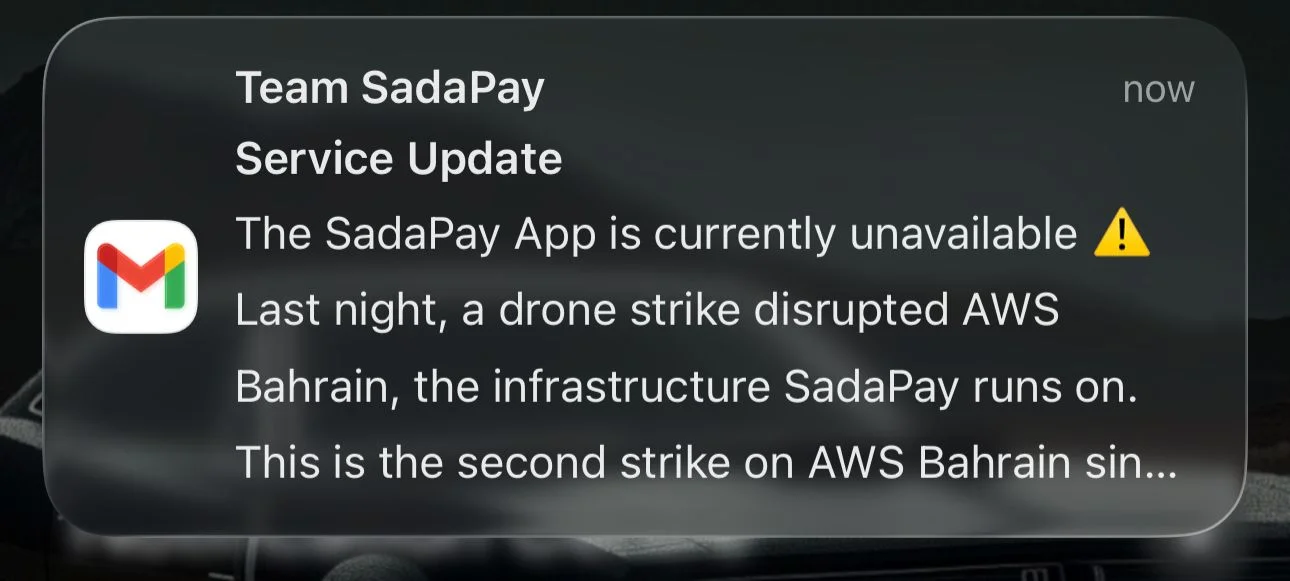
SadaPay confirmed that its application became unavailable after disruption in the Amazon Web Services Bahrain region. The outage occurred during escalating conflict in the Middle East, where drone activity has already affected critical infrastructure. Sadapay stated that its entire backend system depends on AWS Bahrain, which means any interruption in that region directly impacts its services. This connection between a regional conflict and a digital banking outage shows how dependent modern fintech platforms are on centralized cloud providers.
The Sadapay app outage also highlights how cloud systems operate behind the scenes. Most users do not interact with cloud platforms directly, but they rely on them every time they open an app or make a transaction. When AWS Bahrain experienced disruption, Sadapay could not maintain full access for users. The company explained that worsening conditions in the region led to a complete outage. While Sadapay assured users that funds remained safe and fully accounted for, the inability to access the app created immediate inconvenience. At the same time, essential services such as debit cards, ATM withdrawals, and point of sale payments continued to function. This indicates that some financial operations rely on separate systems that remain active even when core app infrastructure fails.
Sadapay App Outage and AWS Bahrain Dependency
The Sadapay app outage reflects a deeper issue related to infrastructure dependency. Sadapay acknowledged that the disruption was not unique to its platform but part of a broader problem affecting multiple financial services in the Gulf region. The root cause lies in physical damage to shared cloud infrastructure, which includes servers, power systems, and network connectivity. Earlier statements from AWS indicated that drone strikes in the region caused structural damage, disrupted electricity supply, and triggered emergency systems that further affected operations.
This situation shows that cloud infrastructure is still tied to physical locations. Even though cloud services distribute data across multiple servers, each region depends on local facilities. If a region experiences damage or instability, services hosted there can become unavailable. Sadapay relied heavily on AWS Bahrain without immediate failover to another region, which increased its exposure to this disruption. This approach is common among fintech startups that optimize for cost and latency rather than redundancy in early stages.
The Sadapay app outage also follows recent technical issues reported by users, including incorrect deductions and negative balances. The company attributed those issues to a temporary problem with a technology partner. While unrelated to the AWS disruption, these incidents together raise questions about system resilience and error handling. For fintech platforms, trust depends on both availability and accuracy. Any disruption or inconsistency can affect user confidence.
Sadapay App Outage Impact on Users and Financial Systems
The Sadapay app outage had immediate consequences for users who depend on mobile access for financial management. Many customers use fintech apps for balance checks, transfers, and payment tracking. When the app becomes unavailable, users lose visibility into their accounts, even if funds remain secure. This creates uncertainty, especially during periods of broader instability.
However, the continued operation of debit cards and payment systems provides an important insight. Financial infrastructure often includes multiple layers, where transaction processing systems operate independently from user interfaces. In this case, Sadapay’s card network and payment integrations remained functional, which allowed users to continue spending and withdrawing funds. This separation helps maintain basic financial activity even during outages.
The Sadapay app outage also highlights the role of AWS as a backbone for digital services. AWS supports a wide range of applications, including banking systems, government platforms, and enterprise tools. When a single region faces disruption, the effects can spread across industries. Amazon confirmed that the Bahrain region experienced disruption due to drone activity and advised customers to migrate workloads to other regions. This response reflects standard cloud recovery practices, but migration requires preparation and technical setup that not all companies have in place.
Outlook After Sadapay App Outage and AWS Disruption
The Sadapay app outage points to a need for stronger resilience strategies in fintech and cloud dependent services. In the near term, Sadapay will likely focus on restoring full application access and improving system stability. This may include adopting multi region deployment, where services run simultaneously in different locations. Such an approach allows systems to switch automatically if one region fails.
From our editorial perspective at SquaredTech.co, the Sadapay app outage serves as a case study for the risks associated with centralized infrastructure. Fintech platforms operate in environments where uptime and accuracy are critical. Any disruption can affect user trust and regulatory compliance. As a result, companies must invest in redundancy, monitoring, and rapid response systems.
The broader implication extends beyond Sadapay. As geopolitical tensions affect physical infrastructure, digital services will face indirect risks. Cloud providers may need to strengthen protection measures and improve communication with customers during incidents. At the same time, businesses must design systems that can adapt to unexpected disruptions.
In conclusion, the Sadapay app outage demonstrates how a regional event can impact digital financial services at scale. It shows that cloud reliability depends on both technology and external conditions. For users, the key takeaway is that while funds may remain secure, access to services can still be interrupted. For companies, the lesson is clear. Resilience requires planning, diversification, and the ability to respond quickly when infrastructure fails.
Stay Updated: Tech News