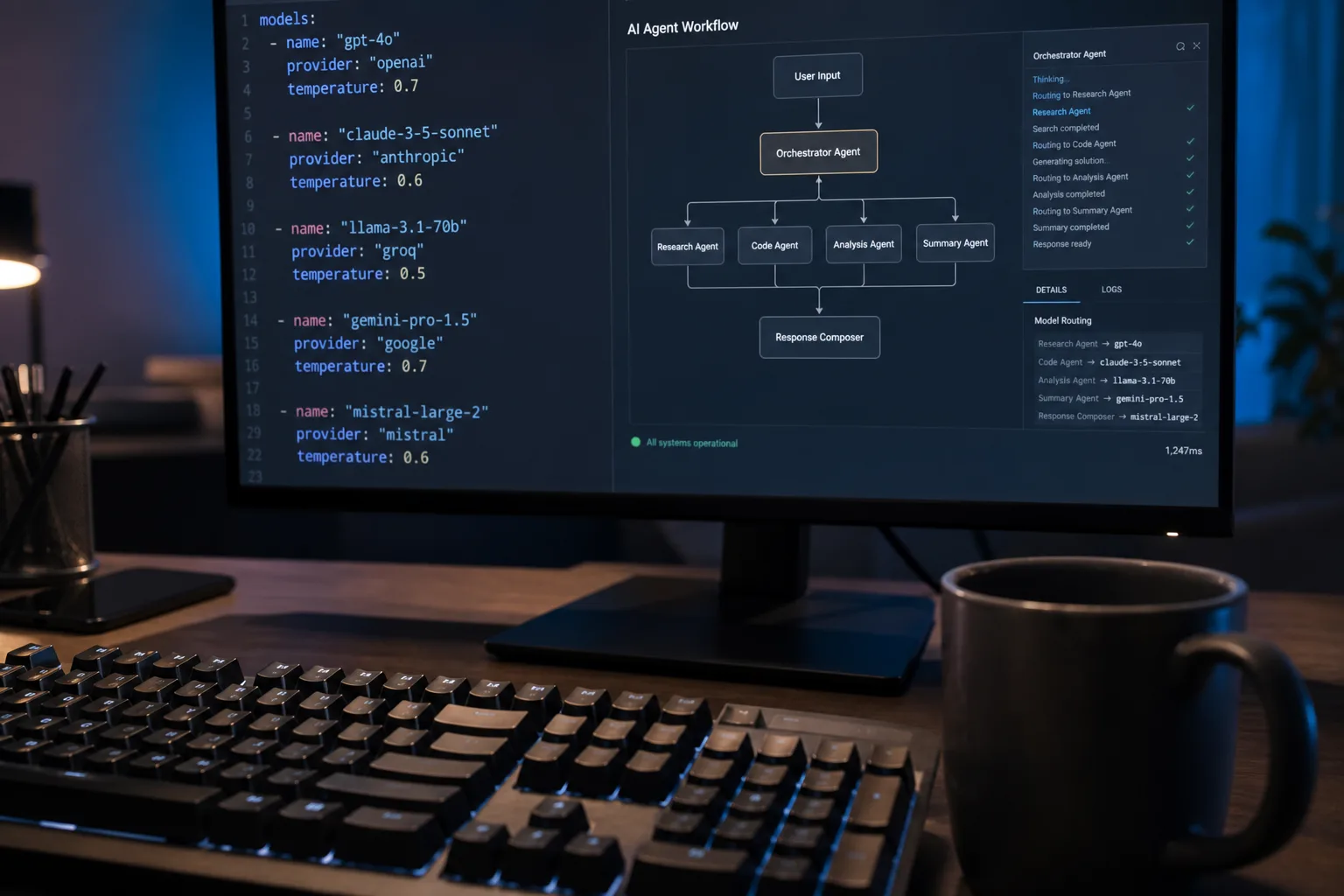
- The right model routing config for Oh My OpenAgent can stretch your budget by up to 36x without sacrificing output quality.
- A poor model routing config wastes premium API tokens on low-complexity tasks that cheaper models handle just as well.
- Oh My OpenAgent fans out a single complex task into 30–50 requests across five specialized agents, draining budgets fast.
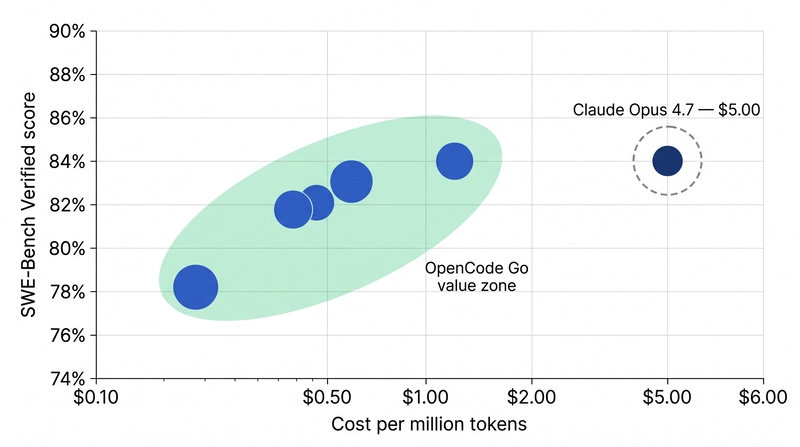
- Claude Opus 4.7 scores highest on coding benchmarks but costs 35x more per token than DeepSeek V4 Flash.
Table of Contents
Why Your Model Routing Config Is the Most Important Decision You’ll Make
Most developers using OpenCode Go spend their first week obsessing over which AI model is the best. That’s the wrong question. The right model routing config — meaning which model handles which task, and when to escalate — is what actually determines whether your budget lasts the month or evaporates in an afternoon. OpenCode Go charges $5 for the first month and $10/month after that. But the usage caps are what bite people: $12 per 5-hour window, $30 per week, $60 per month. Denominated in dollars, not requests. That detail changes everything about how you should approach your model routing config from day one.
Here’s the clearest way to see it. Spend your $12 five-hour window entirely on DeepSeek V4 Flash and you get roughly 31,650 requests. Spend that same $12 exclusively on GLM-5.1 and you get around 880. Same window, same dollar amount, 36x difference in volume. If you’re running a multi-agent system that fans out tasks automatically, that gap isn’t academic — it’s the difference between a productive afternoon and a hard budget wall at 2 PM.
The Problem Is the Fan-Out, Not the Model
Oh My OpenAgent v4.2.3 — currently sitting at 48,000+ GitHub stars as of May 2026 — uses a three-layer architecture that most users don’t fully appreciate until their budget is gone. The Planning Layer runs two agents: Prometheus, which decomposes tasks, and Metis, which synthesizes context from prior knowledge. The Orchestration Layer is Atlas, a sequencing manager that maintains a live to-do list and enforces order without doing the actual work. The Execution Layer is where Sisyphus runs as the default orchestrator, with a 32K extended thinking budget, supported by nine or more specialized agents.
When you submit a complex ticket, that architecture doesn’t fire one request. It fans out. A single non-trivial task can generate 30 to 50 API calls before you’ve touched a keyboard again. If every one of those calls is hitting DeepSeek V4 Pro — which gives you roughly 10,200 requests per 5-hour window — you’ll chew through your budget in a couple of hours of active work. The model routing config you choose at setup determines whether that fan-out is expensive or cheap. Getting this decision right before you start a session is far easier than diagnosing a blown budget after the fact.

Model Routing Config: The Community-Tested Assignment
What follows isn’t theory — it’s the agent-to-model assignment that the Oh My OpenAgent community has converged on through real-world trial and error. It’s based on matching the actual capability requirements of each agent role to the cheapest model that can meet them, with fallback chains for when cheaper models stall. Think of this model routing config as a starting point you can tune, not a rigid spec you must follow exactly.
Sisyphus → Kimi K2.6
Sisyphus is the execution orchestrator with a 32K extended thinking budget. You want your strongest reasoning model here. Kimi K2.6 is a 1-trillion-parameter mixture-of-experts model with 32 billion active parameters, scoring 80.2% on SWE-Bench Verified — placing it above Qwen3.6 Plus and within a whisker of DeepSeek V4 Pro. Its 256K context window handles long execution traces without truncation. Yes, it’s more expensive than Flash, but Sisyphus runs at lower volume than the lookup agents. Spend the money here.
Librarian and Explore → DeepSeek V4 Flash
These agents do doc reads, context fetches, and lookup work. None of that requires frontier reasoning. DeepSeek V4 Flash runs 284 billion total parameters with 13 billion active, scores 79.0% on SWE-Bench Verified, and costs roughly three times less per token than V4 Pro. Routing Librarian through V4 Pro is reportedly the single most common budget mistake in the community — you’re paying for capability you structurally cannot use in a doc-fetching context. Any solid model routing config should lock these two agents to Flash without exception.
Oracle and Prometheus → GLM-5.1
Planning agents need something with strong open-ended decomposition and enough context to hold a complex task map. GLM-5.1 has 744 billion total parameters with 40 billion active and a 200K context window — long enough for deep planning work. It’s not the cheapest model in the stack, but it’s not the most expensive either, and it earns its slot on the kinds of ambiguous, multi-step reasoning that Oracle and Prometheus handle. Mid-range cost, well-matched to the task.
Hephaestus → V4 Pro Primary, V4 Flash Fallback
Hephaestus is the primary coding agent. DeepSeek V4 Pro scores 80.6% on SWE-Bench Verified versus Flash’s 79.0% — a gap that’s real but usually invisible on routine tickets. V4 Pro runs 1.6 trillion total parameters with 49 billion active. The smart play is V4 Pro as primary with V4 Flash as fallback: when the task is straightforward, Flash handles it at a third of the cost and you won’t notice the difference. Worth flagging: V4 Pro’s promotional pricing of $0.435 per million tokens ends May 31, 2026. After that, the cost-per-window math shifts and the case for Flash-first routing gets even stronger. Revisiting your model routing config for this slot after that date is highly recommended.
Multimodal-Looker → MiMo-V2.5-Pro
This one is deliberate and often overlooked. MiMo-V2.5-Pro scored 78.9% on SWE-Bench Verified and is specifically architected for agentic workflows. Routing Multimodal-Looker through a general-purpose model wastes capability on the wrong axis. MiMo was designed for this use case.
The One Model Nobody Knows About
Before getting to the fallback strategy, there’s a model worth calling out separately: MiniMax M2.5. It activates roughly 10 billion parameters and is priced at 16.7 times cheaper than Claude Opus 4.6 on input tokens. It also has a hard cap of 100,000 requests per month regardless of what you spend. For high-volume, low-complexity work — the kind that makes up a large portion of any real project — it’s arguably the most cost-effective option in the stack. Most developers using OpenCode Go have never heard of it, and very few have factored it into their model routing config at all.
On the other end of the spectrum, Claude Opus 4.7 sits at 87.6% on SWE-Bench Verified, seven percentage points above V4 Pro and currently the strongest coding model available. But at $5 per million tokens, it costs 35 times more per token than DeepSeek V4 Flash. Within the $12 five-hour window, that translates to around 480 Opus 4.7 requests versus 17,000 Flash requests. Unless you’re hitting genuinely hard tickets that require Opus-level reasoning — and you’ll know when you are — this is not a model for everyday routing.
Model Routing Config Best Practice: Fail First, Then Escalate
The most important operational rule for any model routing config in an agentic context is this: don’t escalate preemptively. Route through V4 Flash first on any task expected to exceed 100 requests. If Flash handles it — and at 79.0% SWE-Bench Verified, it handles the majority of real-world coding tasks correctly — you’ve saved a significant fraction of your window budget. If it stalls, escalate to Kimi K2.6 or V4 Pro. That fallback chain costs you a little latency. It saves you a lot of money.
Preemptive escalation — sending every task to V4 Pro or Opus because you want the best possible output — is how developers burn through a 5-hour window in under an hour. The one-point gap between V4 Flash and V4 Pro is real. It almost never shows up in practice unless the ticket is genuinely hard. And on genuinely hard tickets, you want the escalation to happen because the model failed, not because you assumed it would. A well-structured model routing config enforces this discipline automatically so you don’t have to make the call manually under pressure.
One additional note: Kimi K2.6 was part of a series discontinued on May 25, 2026. The model itself remains available, but the series is no longer receiving updates. Keep that in mind when planning long-term configurations — it may make sense to start evaluating alternatives for the Sisyphus slot before deprecation pressures force a rushed switch.
What This Means for the Broader Agentic AI Market
The conversation happening in the Oh My OpenAgent community is a preview of a much larger shift. As multi-agent frameworks become standard infrastructure for software development — and the trajectory strongly suggests they will — the economics of model selection stop being a developer curiosity and start being an engineering discipline. The difference between a thoughtful model routing config and a naive one isn’t a rounding error. It’s a 36x swing in what you can actually build within a given budget.
API providers are watching this too. DeepSeek’s promotional pricing window, Anthropic’s premium positioning of Opus 4.7, and the emergence of task-specific models like MiMo-V2.5-Pro all reflect an industry moving toward a world where routing intelligence is a competitive advantage. The developers who learn to treat model selection as a cost-optimization problem — not just a quality problem — are going to build faster, cheaper, and more sustainably than those who don’t.