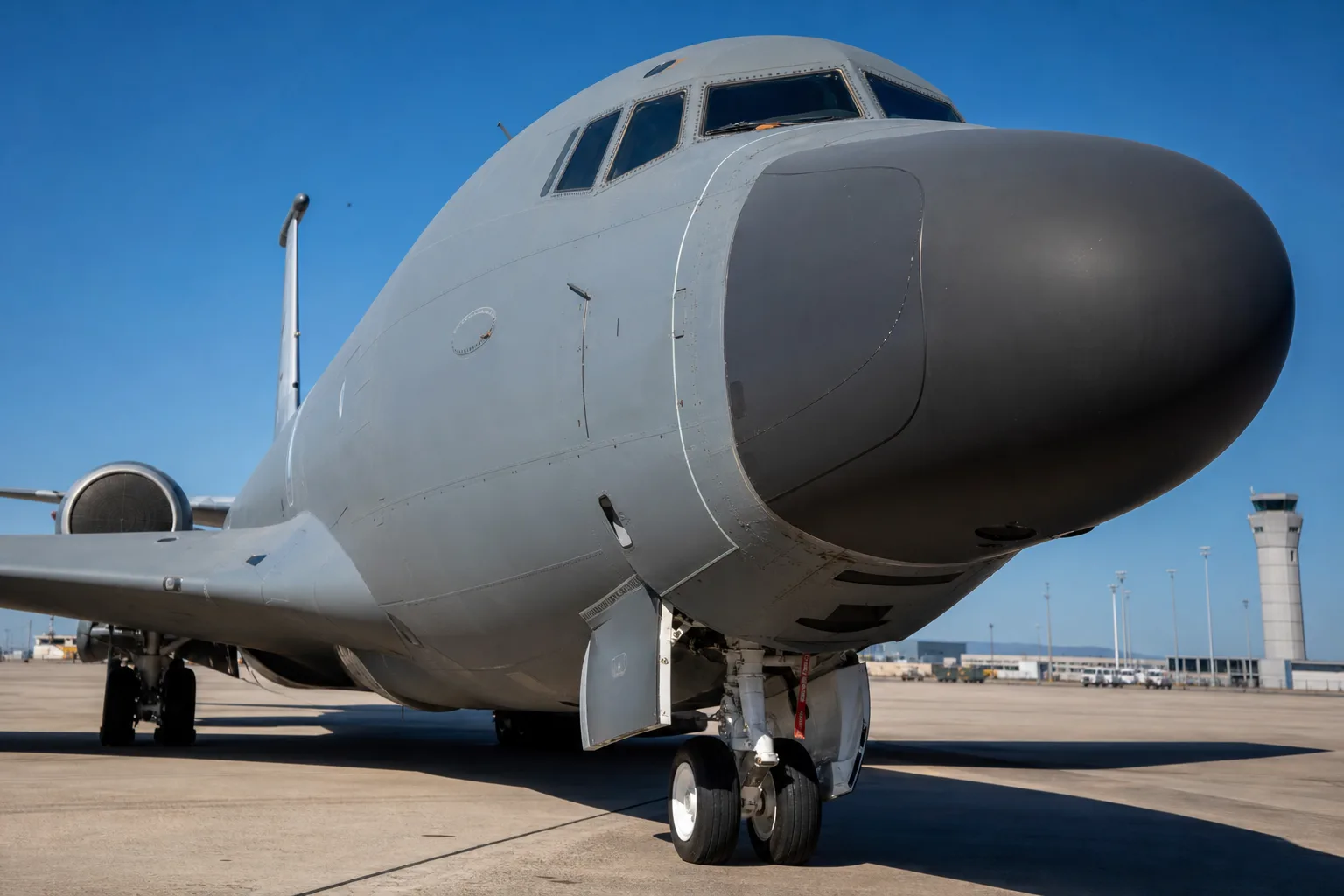
- Canada Saab GlobalEye deal marks Ottawa’s most visible break yet from decades of US-dominated defense procurement.
- The Canada Saab GlobalEye selection beats out Boeing’s E-7 Wedgetail, which had been plagued by delays and cost overruns.
- Canada wants six early warning aircraft to independently monitor over 4.4 million square kilometres of Arctic territory.
- Saab is also bidding to sell Canada Gripen fighters, putting more pressure on the existing 88-jet F-35 contract with Lockheed Martin.
Table of Contents
Canada Saab GlobalEye: A Deal That Sends a Clear Message
Canada has chosen the Canada Saab GlobalEye surveillance platform as its next-generation airborne early warning aircraft, Prime Minister Mark Carney confirmed at a defense conference in Ottawa on Wednesday. The decision snubs Boeing’s E-7 Wedgetail — a program that has repeatedly stumbled on delays and ballooning costs — and signals that Ottawa is serious about diversifying away from American defense contractors in a way that goes well beyond political rhetoric.
The Canada Saab GlobalEye is built on Saab’s proven surveillance architecture, but with a distinctly Canadian twist: the airframe itself is a Bombardier Global 6500 business jet, manufactured in Montreal. That’s not an incidental detail. It means Canada is, in part, buying its own industrial capacity back in a new form — a point that won’t be lost on voters or on the defence industry watchers who’ve been tracking this procurement for years.
Carney framed the acquisition in stark strategic terms. “With a suite of advanced sensors and mission systems, Saab’s GlobalEye will be a key resource for the Canadian armed forces to detect and deter threats across the Arctic,” he said. The Arctic angle matters enormously here. Canada’s northern territory spans more than 4.4 million square kilometres — a landmass larger than India — and for decades Ottawa has relied heavily on joint monitoring arrangements with Washington to keep watch over it. That arrangement is looking increasingly uncomfortable.
Why Boeing Lost and What That Means
Boeing’s E-7 Wedgetail wasn’t a long shot. It’s been selected by the US Air Force and several allied nations, and it carries the kind of brand recognition that typically wins procurement battles in Western defence circles. But the program has been a procurement nightmare in recent years, with cost overruns and schedule slippage that have frustrated buyers and given rivals an opening.
Saab walked right through that opening. The Canada Saab GlobalEye has a cleaner track record than the Wedgetail, and critically, the Global 6500 airframe connection gave it something the Wedgetail couldn’t match: a credible argument for Canadian industrial benefit. Saab has also committed to investing in Canadian research and development as part of the deal, which adds another layer of economic justification for a government that needs to sell this to a domestic audience.
Philippe Lagassé, associate director of international affairs at Carleton University in Ottawa, called the Canada Saab GlobalEye selection “an important test case for the Carney government’s policy of pivoting away from American military capability.” That’s a careful, academic way of saying what a lot of observers are thinking: Canada is explicitly restructuring its defence relationships in response to a deteriorating dynamic with Washington. The US imposing tariffs on Canadian exports — including on sectors tied to defence supply chains — accelerated a rethink that was already underway.
The Arctic Imperative Driving This Decision
Back in March, Carney made a pledge that raised eyebrows at the time: Canada would take full, independent responsibility for defending its Arctic territory. For a country that had comfortably leaned on the bilateral NORAD framework with the US for generations, that’s a significant commitment. It requires hardware to back it up.
Early warning aircraft are exactly the kind of capability that makes that pledge credible. They extend a military’s sensor horizon dramatically, allowing ground and naval commanders to see threats — whether aerial, maritime, or from space — long before they’re in striking range. For Arctic operations specifically, where radar coverage from fixed installations is limited by geography and extreme conditions, airborne platforms become even more critical. The Canada Saab GlobalEye is designed precisely for this kind of wide-area, all-domain surveillance in demanding environments.
Military officials had indicated before Wednesday’s announcement that Canada was looking to acquire six of these aircraft. No contract value was disclosed, but comparable procurements — the UK’s five E-7 Wedgetails, for instance, which came in at roughly £1.98 billion — suggest this will be a multi-billion dollar commitment over the program’s lifetime. Six Canada Saab GlobalEye aircraft at current market rates would likely sit somewhere in the C$3–5 billion range when support and sustainment are factored in, though official figures haven’t been confirmed.
A Pivot That Goes Beyond One Aircraft Contract
Read in isolation, buying six surveillance planes from Sweden might look like a tactical procurement call. In context, it’s part of something bigger. Canada has been steadily signalling that it wants to build deeper defence ties with Nordic nations — countries that share Canada’s concerns about Arctic sovereignty and that have their own reasons to hedge against over-dependence on a volatile US security posture.
Sweden only joined NATO in March 2024, making it one of the alliance’s newest members. But Saab was already well-embedded in NATO supply chains, and Sweden’s accession has made defence cooperation with Canadian officials significantly easier from a political and intelligence-sharing standpoint. Swedish Prime Minister Ulf Kristersson reinforced the bilateral dimension of the Canada Saab GlobalEye deal, posting that “GlobalEye is already creating jobs in Canada, and working with the Canadian supply chain. This decision ties our two nations even closer together.”
That kind of language from a head of government isn’t incidental. It’s a deliberate framing designed to position defence procurement as a nation-building exercise — and to contrast it with the transactional friction that now characterises the Canada-US relationship.
Gripen on the Table — and F-35 Under Pressure
The Canada Saab GlobalEye announcement doesn’t exist in a vacuum, and Saab knows it. The Swedish company is also actively competing to sell Canada its Gripen fighter jets — a prospect that would have seemed fanciful a few years ago, given Canada’s signed agreement to purchase 88 F-35s from Lockheed Martin.
That F-35 deal is now far less settled than it once appeared. After the US imposed tariffs on key Canadian imports last year, Carney publicly asked the Canadian Armed Forces to examine whether the F-35 order could be reduced, and whether an alternative supplier could fill part of the gap. It’s a politically charged ask — the F-35 program is deeply embedded in North American defence industrial logic — but it reflects just how much the bilateral relationship has shifted.
For Saab, the timing is ideal. A credible showing in the Canada Saab GlobalEye competition strengthens its hand in the fighter contest. If Canada is willing to trust Saab with sovereign Arctic surveillance, the argument for a partial Gripen order becomes easier to make in Ottawa’s halls. Watch that space closely over the next 18 months.
What’s unfolding in Canada is a live demonstration of something defence analysts have been theorising about for years: that sustained political friction between allies can genuinely redirect procurement decisions worth billions of dollars. Canada’s choices aren’t just about aircraft. They’re about who Canada wants to depend on — and increasingly, the answer isn’t automatically Washington.