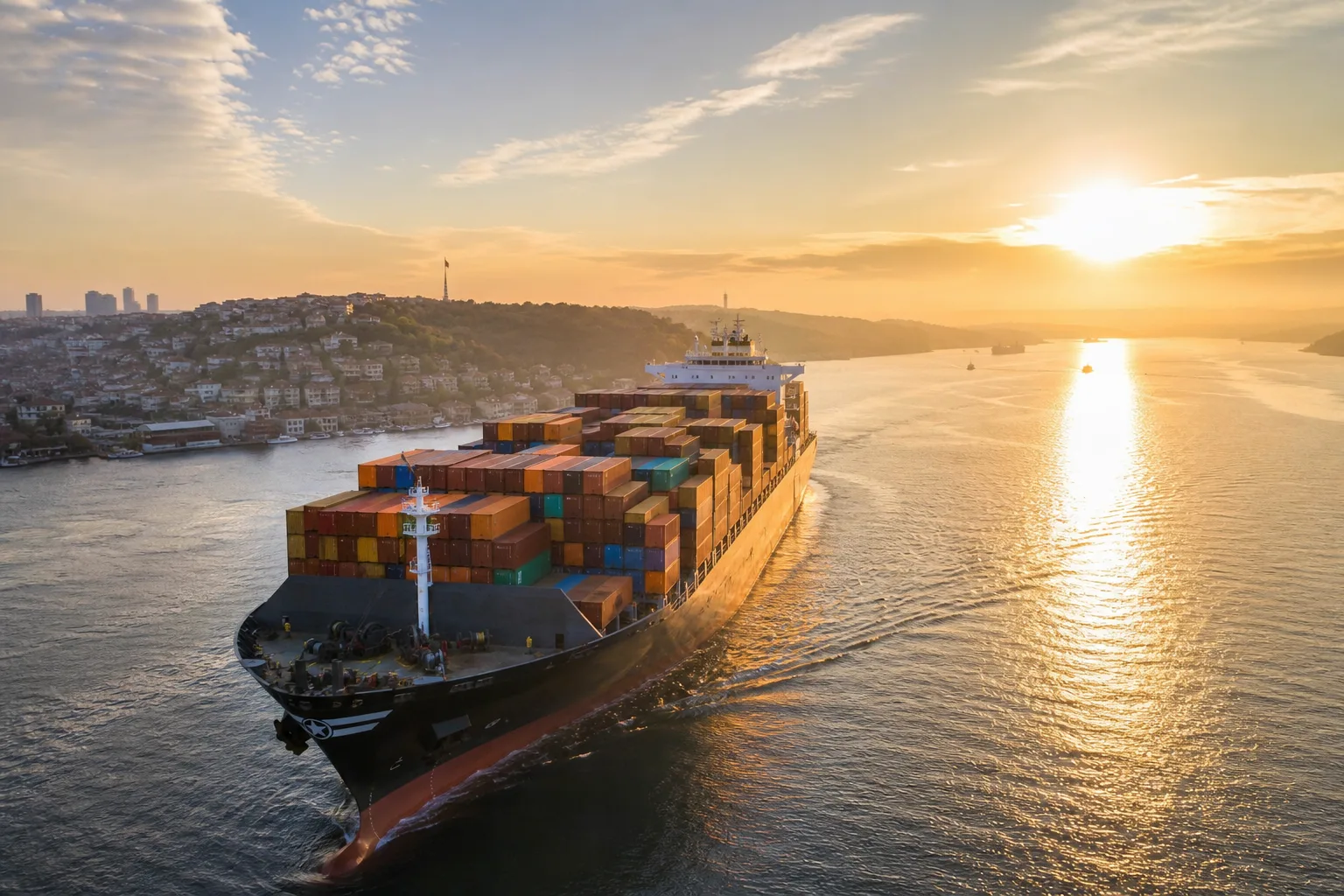
- Container shipping rates have nearly doubled since late February as the Hormuz crisis drives fuel costs sharply higher.
- Container shipping rates on the Shanghai–New York route are up 66%, with Asia-Europe lanes seeing similar jumps.
- Maersk is absorbing $500 million per month in extra fuel costs and is actively passing those costs on to shippers.
- Effective vessel capacity has dropped 19% due to rerouting, slow steaming, and port congestion, propping up carrier pricing power.
Table of Contents
Container Shipping Rates Are Climbing Fast — And It’s Getting Worse
Container shipping rates are rising at a pace that’s starting to feel uncomfortably familiar. The Shanghai Containerized Freight Index global composite hit 2,572 points in the week ending last Friday — up 16% in a single week and double what it was in late February. That’s the highest reading since September 2024, when the Red Sea crisis was in full swing. The cause this time is different, but the mechanism is the same: a major maritime chokepoint under threat, fuel costs spiralling, and ocean carriers successfully passing every dollar of that pain straight to importers.
The Strait of Hormuz — through which roughly 20% of the world’s oil flows — has been effectively closed as a result of the ongoing US-Iran conflict. That’s not a rerouting problem in the way the Red Sea was. It’s an energy price problem. And energy is the single biggest operating cost in container shipping.
The Fuel Bill Is Staggering
Let’s talk numbers. The average price of very low sulphur fuel oil (VLSFO) — the cleaner-burning fuel most major carriers now run on following the IMO 2020 sulphur cap — hit $856 per tonne last Thursday, according to Ship & Bunker data. That’s up 68% from mid-February. High sulphur fuel oil, still used by vessels with scrubbers fitted, wasn’t far behind at $736.50 per tonne, up 66% over the same period.
These aren’t abstract index numbers. They translate directly into hundreds of millions of dollars in monthly costs for the world’s biggest carriers. Maersk CEO Vincent Clerc said on a recent conference call that his company is now paying approximately $500 million per month in additional fuel costs because of the Hormuz crisis — money that, as he put it, they “must find a way to pass through.” Hapag-Lloyd’s CEO Rolf Habben Jansen put his company’s extra weekly bill at €50–60 million, equivalent to $250–300 million per month, and said container shipping rates have “been roughly in line with the cost increase we have faced.”
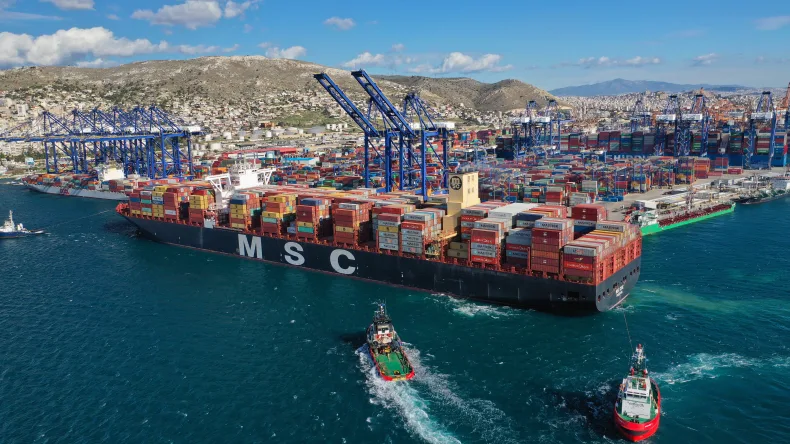
Habben Jansen offered a plain-spoken analogy for what’s happening to importers: it’s like pulling up to a petrol station and finding the price has jumped. You still need the fuel. You still pay. That’s exactly the position most shippers are in right now — they can’t simply stop importing goods, so they’re absorbing the higher freight costs and, ultimately, passing them down the supply chain to consumers.
How High Could This Go?
That depends almost entirely on what happens in the Strait of Hormuz over the next few weeks. VLSFO pricing tracks Brent crude closely, and Brent is in a precarious position. Neil Chapman, senior vice president at ExxonMobil, issued a stark public warning last Thursday: if the strait doesn’t reopen soon, dated Brent could spike to $150–160 per barrel. For context, Brent was trading around $65–70 before the conflict escalated. A jump of that magnitude would send bunker costs — and the fuel surcharges carriers impose on top of base rates — into genuinely uncharted territory for the post-pandemic era. Container shipping rates would almost certainly follow crude higher with little lag.
A peace agreement between the US and Iran would, conversely, push Brent lower and ease some of this pressure relatively quickly. But with no clear diplomatic off-ramp visible right now, the market is pricing in continued disruption.
Spot Rate Jumps Across Every Major Trade Lane
Container shipping rates have risen across every significant east-west trade route. On the transpacific — the corridor that matters most to US importers — Drewry’s World Container Index shows the Shanghai–Los Angeles rate up 59% versus late February, and Shanghai–New York up 66%. These are enormous moves in a matter of weeks.
Asia-Europe lanes tell a similar story. The SCFI’s Shanghai–Mediterranean index reached $7,500 per FEU this week, up 63% from pre-war levels and the highest since January 2025. The Shanghai–North Europe index hit $4,949 per FEU, up 74% over the same period. Different index providers — Drewry, Xeneta, SCFI — use different methodologies and produce different absolute rate figures, but they all point in the same direction: sharply up, with more to come.
Drewry is already flagging early peak season dynamics, noting that “demand is being pulled forward into June ahead of the expected July 1 bunker fuel adjustments.” Importers are front-loading shipments to get ahead of the next wave of surcharges, which is itself adding to demand pressure and supporting even higher container shipping rates in the near term. It’s a self-reinforcing cycle that carriers are, for now, quite happy to ride.
Why Carriers Have More Pricing Power Than the Orderbooks Suggest
Here’s the paradox that shipping analysts have been wrestling with all year: the global container fleet is genuinely oversupplied on paper. Shipyards have been delivering record numbers of new vessels since 2022, and the industry entered 2025 bracing for a capacity glut that should have crushed rates. So why are container shipping rates rising instead of falling?
Constantin Baack, CEO of boxship lessor MPC Container Ships, laid it out clearly on a recent quarterly call. Carriers’ continued reluctance to transit the Red Sea — still a live conflict zone — removes roughly 12% of effective global capacity, since ships are taking the longer route around the Cape of Good Hope. Slow steaming, a deliberate response to higher bunker costs, absorbs another 2%. Port congestion from disrupted schedules eats another 5%. Add it up and you get a 19% reduction in effective capacity — enough to completely offset the newbuilding flood and then some.
“On paper, supply and demand have been diverging since 2023. The market should be trending toward oversupply,