

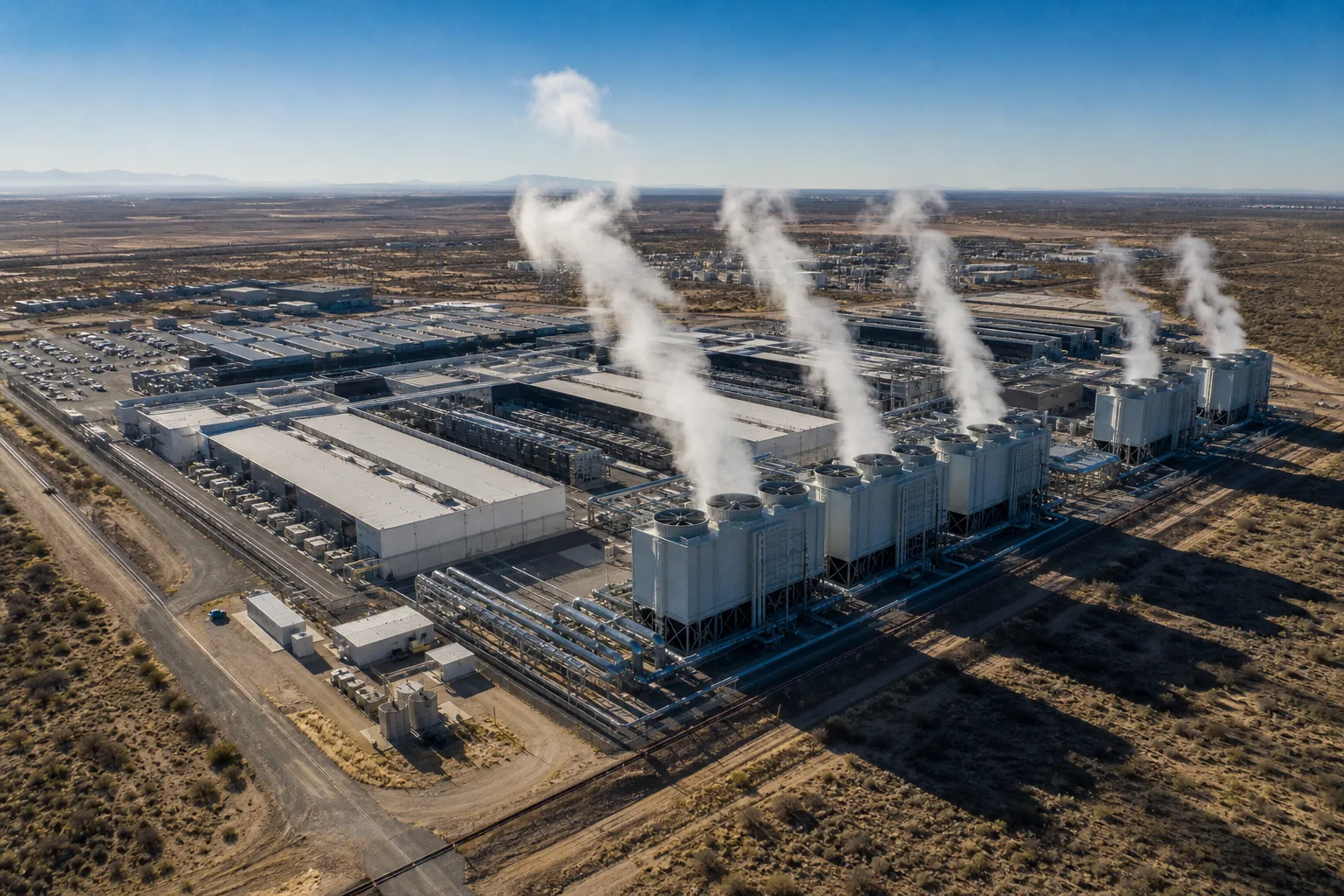
Everyone focused on the electricity bills. The power grids, the carbon footprints, the scramble for new generating capacity — that’s been the dominant narrative around AI’s environmental cost. But there’s a second resource quietly disappearing into the sky above every major data centre campus: water. AI data center water use in the United States has now climbed to nearly one trillion litres per year, and the number is still heading upward.
- AI data center water use in the U.S. has reached nearly one trillion litres annually, driven by cooling demands from AI workloads.
- AI data center water use is concentrated in evaporative cooling towers that shed heat by vaporising millions of litres of freshwater daily.
- Much of this consumption happens in water-stressed regions, raising serious concerns about local aquifer depletion and community supply.
- Tech giants including Google and Microsoft are facing growing pressure to disclose and reduce their facilities’ water footprints.
Table of Contents
Why AI Data Center Water Use Is a Different Problem Than Power
Electricity consumption is visible in a way water isn’t. It shows up on utility bills, gets reported to grid operators, and generates headlines when a new hyperscaler facility strains a regional network. Water evaporates silently. It disappears into cooling towers as invisible vapour, leaving no meter reading that the public can easily scrutinise.
The mechanism is straightforward: AI chips — GPUs and custom accelerators running large model inference and training — produce significantly more heat per rack than the general-purpose servers they’re displacing. That heat has to go somewhere. The dominant method for shedding it at scale remains evaporative cooling, where water is deliberately vaporised to carry thermal energy away from the building. The water that evaporates is gone. It doesn’t return to the local water table. In a region already under hydrological stress, that’s a meaningful extraction from a finite system. Understanding AI data center water use at this technical level is essential to appreciating why the problem is so hard to solve quickly.
One trillion litres sounds abstract. It’s not a rounding error.
The Geography Problem Nobody Wants to Talk About
If every data centre sat beside a reliably wet river in a temperate climate, this would still be a serious environmental issue — but a manageable one. The reality is messier. A significant portion of U.S. data centre capacity is concentrated in places like the desert Southwest, where cheap land and available power encouraged construction long before anyone was running trillion-parameter language models.
Northern Virginia, which hosts the largest cluster of data centres on Earth, draws from the Potomac River basin. The Carolinas, Texas, and Arizona all have substantial concentrations of facilities in areas with either seasonal water stress or chronic groundwater depletion. When a hyperscaler consumes tens of millions of litres a month from a local aquifer, it’s competing directly with agricultural users, municipalities, and ecosystems that have no alternative supply.
This geographic mismatch means that AI data center water use doesn’t land evenly across the country — its impacts are concentrated precisely where water is least abundant. This isn’t a hypothetical future tension. Water authorities in several U.S. states have already begun pushing back. Proposed data centre campuses in drought-prone areas have reportedly drawn public opposition partly over projected water withdrawals. That kind of community friction is going to become more common, not less.
How the Biggest Tech Companies Are Responding
Google and Microsoft both publish water stewardship reports, and both have committed to being ‘water positive’ — meaning they intend to replenish more water than they consume — by 2030. Microsoft has been particularly forthcoming with its numbers, acknowledging significant year-on-year increases in water consumption in its sustainability reporting. To its credit, Microsoft hasn’t buried the figures.
Google has similarly flagged rising water use in its environmental reports, tying the increases to data centre expansion. Both companies are investing in alternative cooling approaches and water recycling systems, but the pace of infrastructure buildout is outrunning the pace of efficiency gains. When you’re doubling your GPU capacity every 18 months, incremental improvements to cooling water efficiency don’t keep the total figure flat.
Amazon hasn’t been as forthcoming with granular water data for AWS facilities, which has drawn criticism from environmental groups. The lack of standardised disclosure requirements means the public picture of AI data center water use is patchier than it should be. Without mandatory reporting, comparing consumption across operators remains guesswork.
The Cooling Technology Gap
Here’s the real irony: the industry already has better options. Direct liquid cooling — where coolant circulates directly over chips rather than cooling the surrounding air — can reduce or eliminate the need for evaporative water entirely. Immersion cooling, where servers are submerged in dielectric fluid, goes further still. Both approaches are more energy-efficient and dramatically less water-intensive than conventional air-and-evaporation systems.
The problem is economics and inertia. Retrofitting an existing data centre for direct liquid cooling is expensive and disruptive. Many facilities built in the last decade weren’t designed for it. New builds are beginning to incorporate liquid cooling more systematically — Nvidia’s latest GPU architectures are specifically engineered to support it — but the legacy estate is enormous, and it’s not going anywhere for years.
There’s also a supply-chain dimension. The specialised cooling infrastructure for immersion systems has had lead times stretching into months, limiting how fast operators can actually deploy it even when they want to. Until adoption accelerates, AI data center water use tied to legacy evaporative systems will remain stubbornly high.
Regulation Is Coming — Eventually
Right now, U.S. data centres face no federal water disclosure requirements and very limited state-level mandates. That’s beginning to change at the margins. California has extended some of its water reporting frameworks to apply to large industrial water users in ways that can capture big data centre campuses. Other states with significant data centre concentrations are watching.
The European Union is moving faster, as it tends to on environmental tech regulation. The EU’s Energy Efficiency Directive now requires data centres above a certain capacity threshold to report sustainability metrics including water consumption. That’s creating a disclosure floor for any hyperscaler operating in Europe, and some of those reporting practices are likely to migrate back to U.S. operations simply because of internal consistency pressures.
The deeper issue is that the AI infrastructure boom happened faster than regulators, water authorities, or local communities could respond. The facilities are already built. The water is already being consumed. Future regulation will have to contend with the locked-in nature of that infrastructure while trying to shape what gets built next. Meaningful rules around AI data center water use disclosure would at minimum give communities the information they need to push back.
What Comes Next for AI Data Center Water Use
The trajectory of AI data center water use depends heavily on two variables: how aggressively the industry adopts low-water cooling technologies, and how quickly regulators force transparency and accountability. Neither is moving fast enough right now to bend the consumption curve meaningfully in the near term.
What could accelerate change is water pricing. In most parts of the United States, industrial water is remarkably cheap. When the true scarcity cost of water in an arid region isn’t reflected in the price data centres pay, there’s little financial incentive to invest heavily in conservation. If water authorities in stressed regions begin repricing industrial allocations to reflect actual scarcity — which some economists have been advocating for years — the business case for liquid cooling upgrades sharpens considerably.
The AI industry spent years arguing that its environmental footprint was manageable, that efficiency gains would keep pace with growth. The electricity numbers already made that case difficult. The water numbers make it harder still. At some point, ‘we’re working on it’ stops being a sufficient answer for communities watching their reservoirs drop.
Frequently Asked Questions
Why does AI data center water use keep climbing?
AI workloads push processors harder than conventional computing, generating substantially more heat. Cooling that heat away — particularly with evaporative cooling towers — requires enormous volumes of water. As AI infrastructure scales up, the water bill scales with it.
How does evaporative cooling in data centers actually work?
Evaporative cooling systems pass warm air or water over a wet medium. As the moisture evaporates, it carries heat away from the facility. It’s highly effective but consumes freshwater continuously — the evaporated water is lost to the atmosphere and can’t be recaptured on-site.
Which companies have the biggest water footprints from AI infrastructure?
Various major technology companies have faced scrutiny over rising water consumption tied to AI infrastructure expansion. The source does not identify specific companies or disclose specific figures, so comparisons between individual firms cannot be drawn from available information.
Are there alternatives to water-intensive cooling for AI data centers?
Yes. Direct liquid cooling, immersion cooling, and air-side economisers can dramatically reduce or even eliminate freshwater consumption. Adoption is growing but retrofitting existing facilities is expensive, and new builds don’t always prioritise water efficiency over upfront cost.

