
Crypto exchanges are quietly expanding into territory that traditional brokerages have spent decades building. This week, Bitget launched US stock options for eligible users — and it already sells over 500 tokenized stocks within the same app. The exchange claims no other major crypto platform currently offers stock options. Whether or not that’s true is almost secondary to the bigger question sitting underneath all of it: when crypto traders buy tokenized stocks or stock options through a crypto exchange, do they actually own what they think they own?
- Bitget launched US stock options this week, claiming no other major crypto exchange currently offers the product to eligible users.
- Tokenized stocks may not grant real share ownership — the legal rights depend entirely on how the issuing platform structured the token.
- The SEC has confirmed that tokenized stocks are regulated based on what they actually do, not what they’re called or marketed as.
- US listed options volume hit a record 15.2 billion contracts in 2025, up 26% year-over-year, making the market impossible for crypto exchanges to ignore.
Table of Contents
Why Exchanges Want a Piece of the Options Market Now
The timing isn’t accidental. The US listed options market just posted its sixth consecutive annual record, with Cboe data showing 15.2 billion contracts traded in 2025 — a 26% jump from the prior year. Around 61 million contracts changed hands every single trading day. That kind of volume makes it one of the most active corners of traditional finance, and it’s been growing steadily while crypto exchanges have watched from the sideline. The growing demand for tokenized stocks reflects a similar appetite: traders want access to equity exposure without leaving their preferred platform.
Short-dated contracts have been a particular driver. Same-day options — contracts that expire the very day they’re purchased — now account for 24.1% of total US volume. These aren’t the tools of patient, long-term investors. They’re the product of a retail trading culture that wants fast, leveraged exposure to price movements, which is a culture crypto exchanges know extremely well. In January, the total value of open Bitcoin options contracts surpassed Bitcoin futures for the first time. The appetite for this kind of structured bet is clearly crossing asset classes, and tokenized stocks are part of the same cross-asset expansion trend.
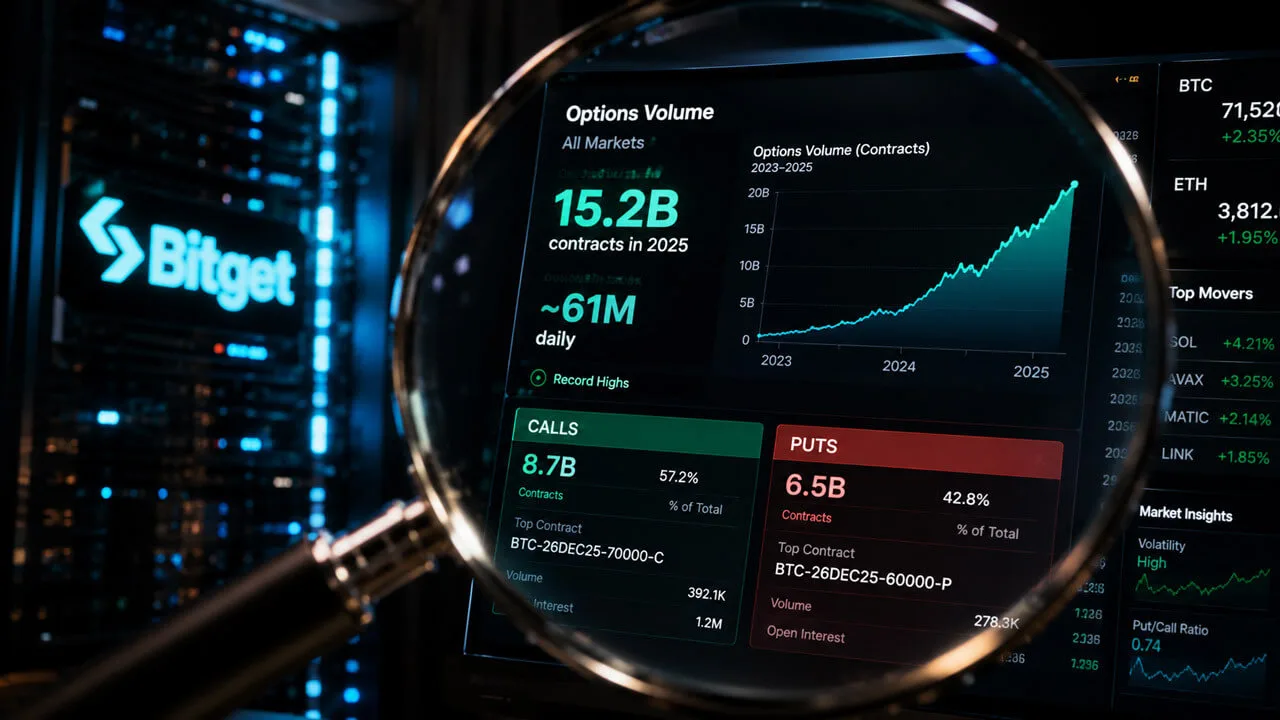
Bitget’s entry starts conservatively. Users can buy single call or put contracts — the basic building blocks of options trading — with more complex multi-leg strategies planned for later. Keeping it to buying only isn’t just a beginner-friendly design choice; it’s a smart risk management decision. Options sellers face potentially unlimited losses, which is why traditional brokerages require approval processes before letting anyone sell a contract. Starting with buyers only caps user downside at the premium paid and keeps Bitget out of the thornier compliance territory — for now.
What a Stock Option Actually Gives You
Before comparing these products, it helps to be precise about what a stock option is. The SEC defines options as contracts giving the purchaser the right, but not the obligation, to buy or sell a security at a fixed price within a set time period. You pay a premium upfront for that right. If you’re right about the direction the stock moves and it happens in time, the option gains value. If you’re wrong, or right but too early, the option expires worthless and you lose what you paid. That’s the full extent of your downside as a buyer.
A call option is a bet that a stock rises above a set price — called the strike — before the contract expires. A put is a bet it falls below it, or a hedge against shares you already hold. The attraction is straightforward: options let a trader control exposure to a large stock position for a fraction of what buying the shares outright would cost. A stock trading at $100 can be controlled through an option costing a few dollars. The leverage is real, and so are the ways a trader can be correct in direction and still lose money — if the move is too small, arrives too late, or doesn’t account for the steady daily erosion in an option’s value as it approaches expiration.
What options don’t give you is any ownership stake in the underlying company. There are no dividends, no voting rights, no claim on assets. An option is purely a contract derived from a stock’s price. The entire traditional options infrastructure — the exchanges, brokers, and clearinghouses that guarantee trades actually settle — exists precisely to make that contractual relationship trustworthy. This distinction matters especially when comparing options to tokenized stocks, where the ownership question is even less straightforward.
Tokenized Stocks and the Ownership Question
Tokenized stocks are a different proposition entirely, and the word ‘stock’ in the name does a lot of misleading work. A tokenized stock is a blockchain-based token that’s supposed to represent some relationship to an underlying equity. But the nature of that relationship varies enormously depending on who created it and how.
In the best case, the token represents a real share held in custody by a third party on the token holder’s behalf. In other configurations, tokenized stocks simply track a stock’s price without granting any of the legal rights that come with actual share ownership — no dividends, no voting, no claim in a bankruptcy. Some structures are closer to private contracts that copy price movements, and some are official records of share ownership maintained on a blockchain rather than a traditional clearing system. Bitget offers over 500 of these tokenized stocks, but the platform hasn’t disclosed precisely how each is structured.

The SEC addressed this directly in a January 28 statement, describing tokenized securities as ‘regular securities recorded, in whole or in part, on a blockchain.’ The agency’s core message was that what a product does — not what it’s called — determines how it’s regulated. A real share is a real share whether it lives in a brokerage account or on a blockchain. But tokenized stocks created by a third party that only mimic a stock’s price could be classified as a security-based swap, a category that US regulators treat with particular caution.
This is where the user experience and the legal reality diverge in ways that matter. A retail trader buying a ‘Tesla tokenized stock’ on a crypto exchange might reasonably assume they’re getting exposure similar to holding Tesla shares. They might be. Or they might be holding a price-tracking instrument with none of the legal protections or rights attached to the underlying equity. The token’s name doesn’t tell you which one. Understanding how specific tokenized stocks are structured is the only way to know what you’re actually buying.
Bitget’s Disclosure Problem
What makes Bitget’s launch worth scrutinizing isn’t the novelty of the product — it’s what the company hasn’t said. The exchange hasn’t disclosed which specific stocks are available in the options product, which countries can access it, or how clearing is handled. In a traditional brokerage setting, those aren’t minor details. Clearing infrastructure is what ensures that when an option is exercised or expires, the settlement actually happens. Options clearing in the US runs through the Options Clearing Corporation, a central counterparty that backstops every listed contract. If Bitget’s product doesn’t connect to that infrastructure — and it’s not clear it does — the protections traders assume are present may simply not exist.
This isn’t a unique problem to Bitget. It’s a structural tension that runs through every crypto exchange that’s tried to offer equity-adjacent products, including tokenized stocks. FTX infamously offered tokenized stocks before its collapse, and the fate of those holdings became part of the broader disaster. The lesson the industry was supposed to learn is that crypto-native wrappers around traditional financial assets create ambiguity about custody, ownership, and recourse that plain-vanilla brokerage accounts don’t have.

What This Means for Where Crypto Exchanges Are Headed
The underlying direction here is obvious. Crypto exchanges built their user bases on 24/7 trading, low friction onboarding, and access to volatile assets. Now they want to become the single platform where those users can also trade equities, commodities, and derivatives — essentially competing with Robinhood, tastytrade, and Interactive Brokers on their own turf. Adding tokenized stocks and now stock options is a direct play for that wallet share.
That ambition isn’t inherently problematic. Multi-asset trading platforms are genuinely useful, and there’s a real argument that some of the friction in traditional brokerage access is unnecessary. But the product quality — and the legal substance underneath it — has to match the pitch. Right now, the marketing around tokenized stocks tends to run well ahead of the disclosures. Traders deserve to know exactly what they’re buying before they buy it, not after they try to exercise a claim or recover funds in a platform failure.
As regulators in the US and Europe increasingly turn their attention to how crypto platforms handle equity-adjacent products, exchanges that can’t clearly articulate the structure and protections of what they’re selling are going to face mounting pressure. The scrutiny is particularly sharp around tokenized stocks, where questions of custody, legal ownership, and investor recourse remain largely unresolved across the industry. The ones that get ahead of that scrutiny — with genuine transparency about custody arrangements, clearing, and legal rights — will be in a far stronger position than those treating disclosure as an afterthought. Bitget’s options launch is a meaningful step into traditional finance. Whether the infrastructure underneath it is built to match is the part that still needs answering.
Frequently Asked Questions
What are tokenized stocks and do they give you real ownership?
Tokenized stocks are blockchain-based tokens that represent either real shares held by a custodian or simply track a stock’s price. Whether you get actual ownership rights depends entirely on how the token was built. Some grant true share ownership; others are just price-tracking instruments with no legal claim to the underlying company.
How do tokenized stocks differ from stock options?
Tokenized stocks wrap real or synthetic equity in a blockchain token. Stock options are contracts giving you the right to buy or sell a stock at a set price before a deadline — no ownership involved at all. Options are one additional step removed from the underlying company, regulated under a strict US clearinghouse system.
Is Bitget’s stock options product regulated like a traditional brokerage?
Bitget hasn’t disclosed which stocks are supported, which countries are eligible, or how clearing is handled. Traditional US stock options trade through a tightly supervised network of exchanges, brokers, and clearinghouses. Until Bitget clarifies its structure, the regulatory protections available to users remain genuinely unclear.
Why are same-day options becoming so popular in 2025?
Same-day options — contracts that expire the day they’re traded — made up 24.1% of total US options volume in 2025, according to Cboe and OCC data. They appeal to short-term traders because they’re cheap and move fast, though they carry substantial risk since there’s almost no time for a trade to recover.