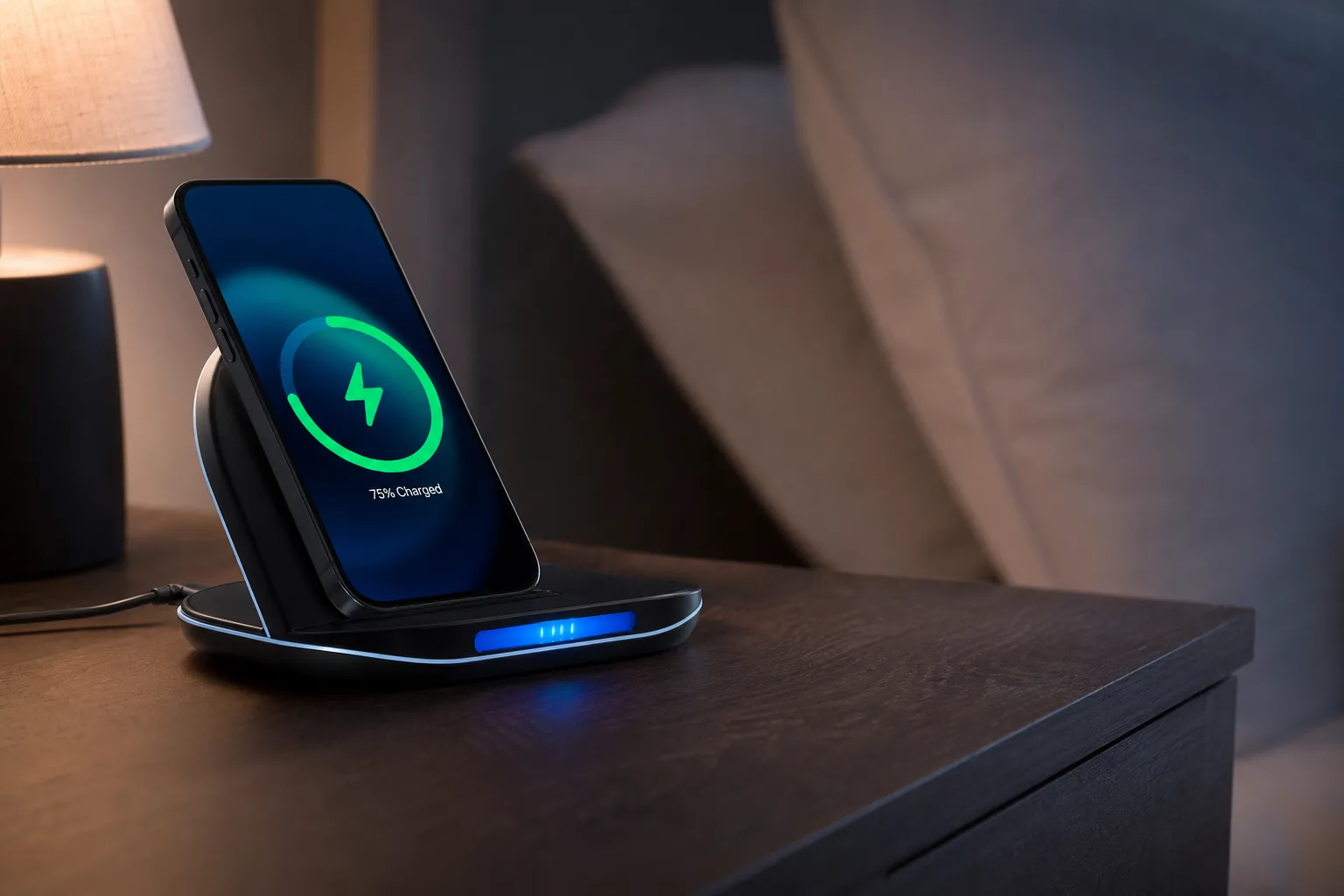
Wireless charging is one of those features that sounds better than it often feels in practice. Slow speeds, warm phones, and batteries that seem to age faster than they should — these are the trade-offs most people quietly accept. But Qi2 active cooling chargers, which embed small fans and heat sinks directly into the charging dock, are making a serious case that the whole category deserves a rethink.
- Qi2 active cooling chargers use tiny fans and heat sinks to keep phone temperatures significantly lower during wireless charging.
- The $59.99 Kuxiu D5 delivers up to 25W via Qi2.2 and proves Qi2 active cooling genuinely prevents thermal throttling.
- Heat from wireless charging accelerates lithium-ion battery degradation, making thermal management critical for long-term phone health.
- The Wireless Power Consortium is targeting a global 50W Qi standard by 2028, and active cooling will likely be essential to reach it.
Table of Contents
The Real Cost of a Hot Phone
Before writing off fan-equipped chargers as a gimmick, it’s worth understanding exactly what’s at stake when your phone gets warm on a charging pad. Lithium-ion batteries are chemically sensitive to heat. Elevated temperatures accelerate the breakdown of electrode materials and electrolytes, permanently reducing the cell’s capacity over time. That sluggish battery on your two-year-old phone isn’t just age — it’s likely the accumulated effect of hundreds of charging cycles at higher-than-ideal temperatures.
Wireless charging makes this worse by design. Electromagnetic induction, the technology behind every Qi charger on the market, wastes a significant portion of energy as heat during the transfer process. A wired cable moves electrons far more efficiently. The result is that even a mid-speed Qi charger can leave the back of your phone noticeably warm after an hour, and some phones respond by throttling their charging speed to protect the battery — which defeats half the point of fast wireless charging in the first place. This is precisely the problem that Qi2 active cooling is designed to solve.
One Journalist’s €660 Lesson
This isn’t purely theoretical. Overheating phones cause real damage. Writing for The Verge, senior editor Thomas Ricker described frying the logic board on his iPhone 15 Pro — a titanium model — while editing 4K video on a sweltering train with a Qi power bank magnetically attached to the back. The screen went blank and never came back. The repair bill came to €660.33 (over $750). Ricker was just inside Apple’s two-year warranty window and paid nothing, but the experience left a mark. Apple’s technician declined to confirm overheating as the cause, but the sequence of events is hard to interpret any other way.
It’s a scenario that’s easy to dismiss as an edge case until it happens to you. Wireless charging during intensive CPU tasks, in a warm environment, is genuinely risky territory — and most people don’t think twice about it. A dock with Qi2 active cooling addresses this vulnerability directly, keeping temperatures in check even during demanding use.
Qi2 Active Cooling: How It Actually Works
Enter Qi2 active cooling. Manufacturers including Anker, Aukey, ESR, and Kuxiu have been building chargers with tiny internal fans and heat sinks that pull heat away from the contact point between the phone and the charging pad. The approach is straightforward in concept but meaningful in practice: instead of letting heat build up between the charger’s transmitter coil and your phone’s receiver coil, the fan disperses it continuously. Powerful magnets ensure the two coils stay in precise alignment, which maximises efficiency and reduces the amount of waste heat generated in the first place — a double benefit.
The Wireless Power Consortium’s Qi2 standard, which underpins these newer chargers, already mandates magnetic alignment akin to Apple’s MagSafe implementation. That foundation makes Qi2 active cooling a natural next step rather than a bolt-on feature.

The Kuxiu D5: A Capable, Imperfect Test Case
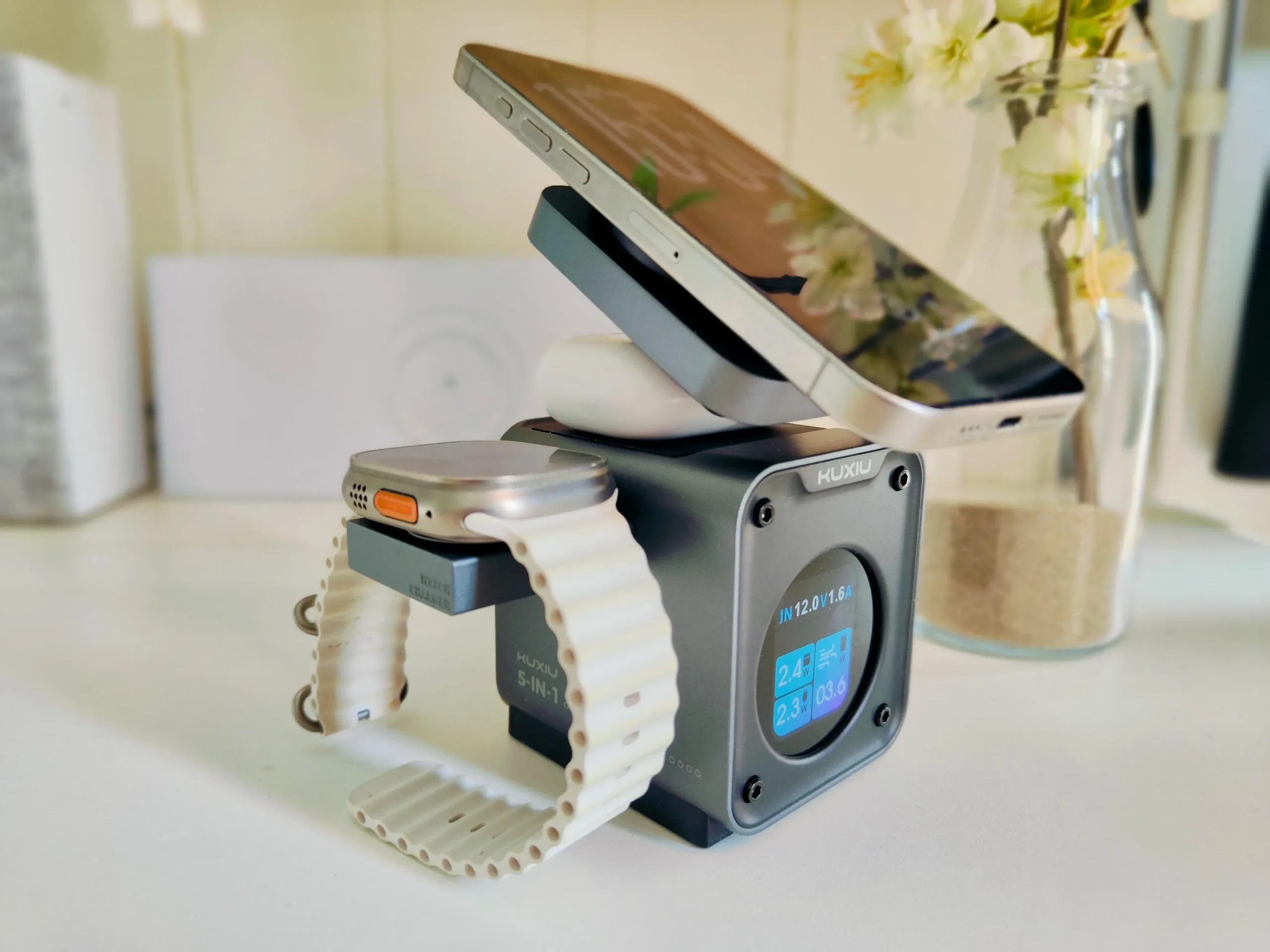
The Kuxiu D5 Qi2.2 charging dock, priced at $59.99, is one of the more fully featured examples of Qi2 active cooling available right now. It supports up to 25W for Qi2.2-compatible phones, 2.5W for Qi-compatible watches, and 5W for earbuds, and it ships with a 45W USB-C PD charger in the box — a small but genuinely useful inclusion, since guessing whether your existing brick can power a multi-device dock is its own minor headache. It’s compatible with recent devices from both Apple and Samsung, covering several generations of phones, watches, and earbuds.
Ricker spent a week with the D5 and came away convinced that Qi2 active cooling works. His phone stayed notably cooler than it had on any previous wireless charger he’d tested — a meaningful result given his history with an overheated iPhone. The fan itself runs silently enough to be a non-issue and can be switched off entirely with a single button press for those who want it completely quiet at night.
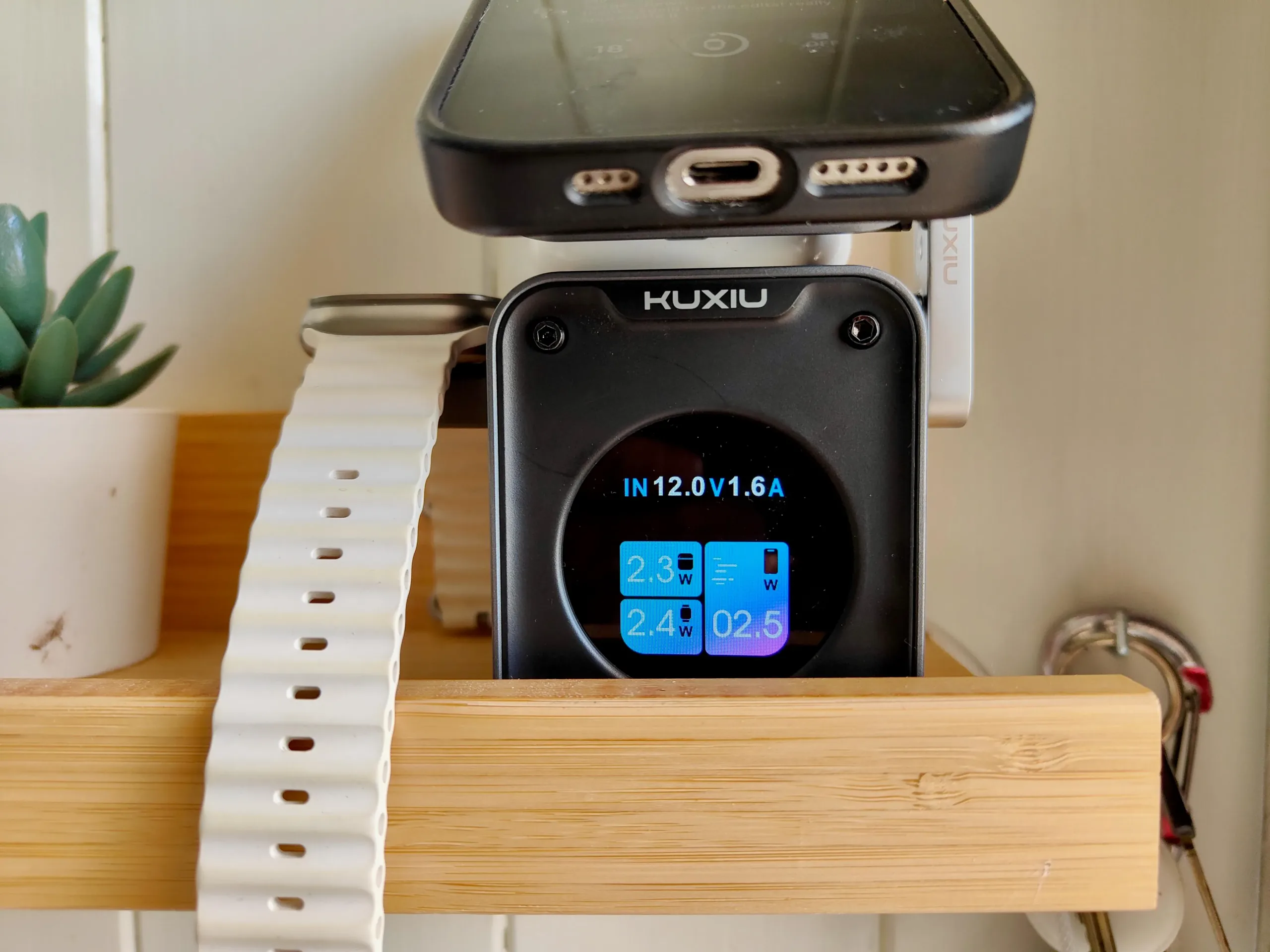
The dock also features a small display showing the current time and per-device power draw — information that’s genuinely useful — but it comes with an animated screensaver face that Ricker found distracting, and the display can be too bright for a bedside table. Fortunately, a tap of the same button turns it off completely. These are small complaints, but they point to a broader pattern in the multi-device charging dock category: manufacturers keep adding features that sound good in a spec sheet without asking whether users actually want them.
The watch charger is a good example. A long press on the dock’s button activates a small motor that slowly pushes the watch mount out from the side of the unit. It’s designed to improve durability during travel, and it can only be retracted when the dock is plugged in. It’s clever engineering in search of a real problem. Kuxiu also brands the D5 as a ‘five-in-one’ charger, which is generous — it charges three devices simultaneously. The display and fan are apparently counted in that total, which feels like marketing maths.
The Road to 50W Wireless Charging
Zoom out, and Qi2 active cooling starts to look less like a niche product feature and more like a necessary precondition for where wireless charging is heading. Chinese smartphone makers — Huawei, Xiaomi, and Oppo among them — have offered wireless charging speeds of 50W and above for years. The catch is that those speeds are only achievable on proprietary charging docks purpose-built to handle the accompanying heat. They don’t work cross-platform, and they don’t conform to any global interoperability standard.
The Wireless Power Consortium is now working to change that, with a 50W global Qi standard in development and targeted for release by 2028. Getting there will almost certainly require Qi2 active cooling to be built into compliant chargers as a baseline requirement. You simply can’t push that much power through an inductive connection without generating heat that needs to go somewhere. Passive chargers will hit a wall. Active cooling chargers — already proven to work at lower wattages — have a natural path forward.
At $59.99, the Kuxiu D5 sits below comparable docks from Anker and ESR, and it delivers on the core promise: your phone charges faster and stays cooler. The extra features are a mixed bag, but the underlying technology is sound. If the broader industry is moving toward 50W wireless charging by the end of the decade, the chargers that get us there are going to look a lot like this one — fans and all.
Frequently Asked Questions
Does Qi2 active cooling actually keep phones cooler during wireless charging?
Yes. Chargers with built-in fans and heat sinks, like the Kuxiu D5, actively blow heat away from the back of your phone while it charges. This keeps the battery significantly cooler and allows for faster charging speeds compared to passive Qi chargers.
How loud is the fan on an active cooling Qi charger?
On the Kuxiu D5, the internal fan operates silently and can be turned off entirely if you prefer — so it won’t disturb you on a nightstand.
Why does wireless charging produce more heat than wired charging?
Wireless charging uses electromagnetic induction, which is inherently less efficient than a direct wired connection. More energy is lost as heat during the transfer process, which raises temperatures at the back of the phone and inside the battery.
When will a 50W global wireless charging standard arrive?
The body responsible for Qi is working on a global 50W wireless charging standard targeted for release by 2028. Manufacturers will likely need to incorporate active cooling to reliably sustain those higher charging rates.