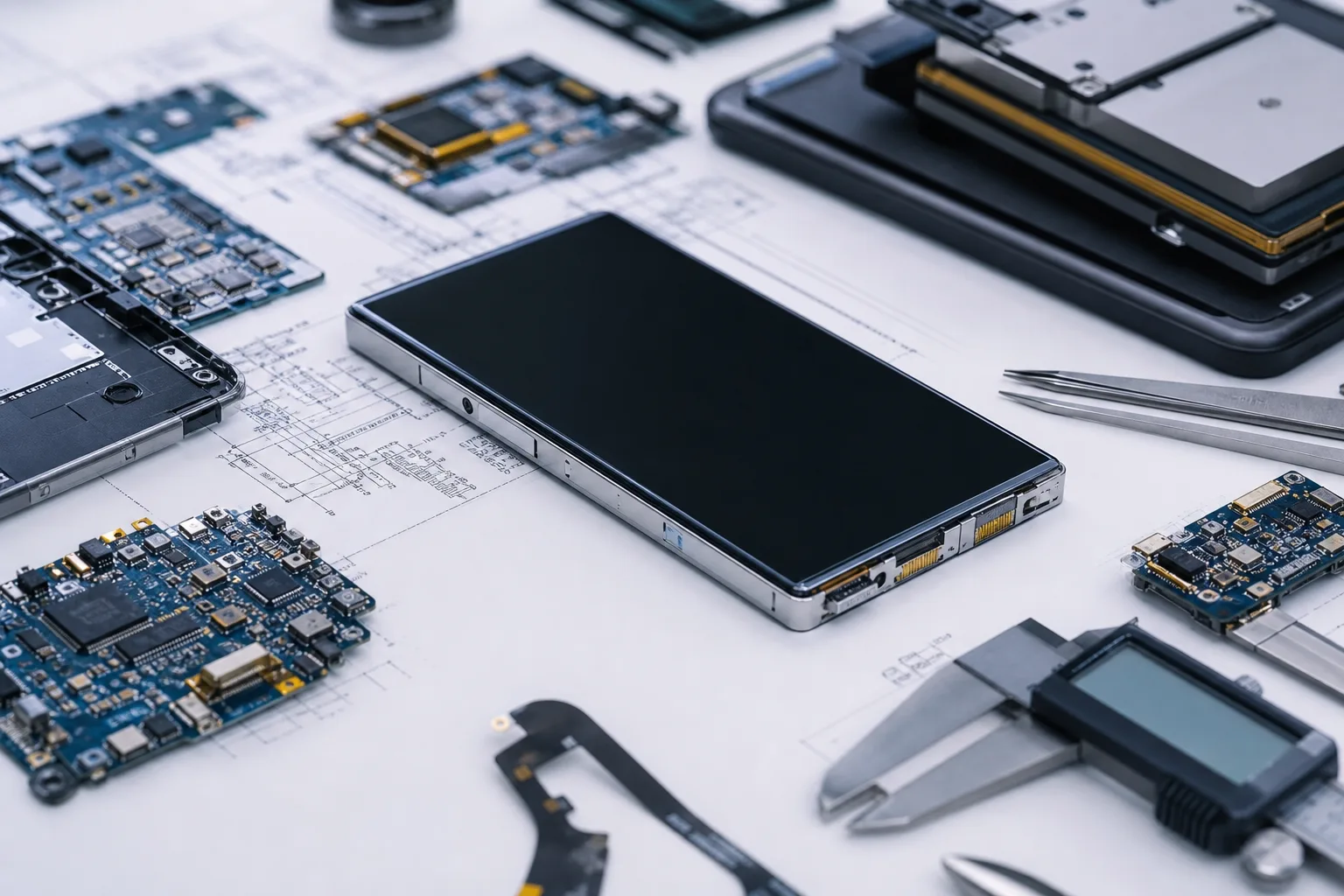
A ransomware attack on one of Apple’s key manufacturing partners has produced the most detailed look yet at the iPhone 18 Pro — and what it’s revealed is a device that’s shaping up to be both technically interesting and uncomfortably expensive. The breach of Tata Electronics, which assembles iPhones at its India facility, reportedly exposed over 200,000 internal files, including component lists, supplier documentation, and images of test hardware. Apple’s supply chain has leaked before, but rarely at this scale or this early.
- iPhone 18 Pro leaks from a Tata Electronics ransomware attack reveal component lists, supplier data, and images of test units.
- The iPhone 18 Pro may use Qualcomm modems in the US and Apple’s C2 modem internationally, due to mmWave 5G requirements.
- A starting price of $1,399 is being floated — a $300 jump over the iPhone 17 Pro — amid a broader Apple pricing wave.
- New color options include Dark Cherry, Light Blue, Dark Gray, and Silver, with no black model expected this cycle.
Table of Contents
The Ransomware Breach That Changed the Conversation
Tata Electronics has been central to Apple’s India manufacturing push — a strategy Apple has been accelerating to reduce its dependence on Chinese production. The irony is hard to miss: Apple’s bid to diversify its supply chain has now produced one of its biggest pre-launch leaks in recent memory. The stolen data was posted online by the attackers, and while outlets including MacRumors have confirmed the existence of the leak, most have stopped short of publishing the stolen files directly, given the clearly illegal circumstances of their release.
Still, the details that have emerged are significant. Component bills of materials, internal part classifications, and physical images of what appear to be iPhone 18 Pro engineering samples have collectively painted a clearer picture of the device than any number of analyst notes typically would this far out. And a few of those details have already upended what the rumor community thought it knew.

iPhone 18 Pro’s Modem Question: A US-International Split
Perhaps the most technically significant detail in the leaked materials is a potential modem divide between US and international iPhone 18 Pro models. Apple’s C2 modem — the successor to the C1 and C1X chips already shipping in the iPhone Air, iPhone 17e, and M5 iPad Pro — appears to be headed exclusively to international variants. The US bill of materials, by contrast, lists Qualcomm components, including what looks like the SDX80M, a chip associated with mmWave 5G support.
This isn’t a surprising technical limitation so much as an economic and infrastructure one. American carriers like Verizon and AT&T have spent years and billions of dollars building out mmWave 5G networks, which deliver extremely fast speeds across short distances — think stadiums, airports, and dense urban grids. Apple’s C-series modems, as good as they’ve become in terms of power efficiency, haven’t cracked mmWave yet. Dropping that capability from the US iPhone 18 Pro would be a hard sell in a market where carrier partners actively market mmWave availability. That’s a very different situation from the iPad Pro or the rumored cellular MacBook, where sacrificing mmWave support was a trade-off the market could absorb.
The result would be two versions of the same phone with meaningfully different silicon — not unprecedented in Apple history, but a signal that the C-series modem program still has significant ground to cover before it can fully displace Qualcomm in Apple’s most important market.

Design, Colors, and the Camera Upgrade Apple Is Betting On
Beyond the modem story, the leaks have confirmed several design details that align with what had already been circulating among reliable sources. The iPhone 18 Pro is expected to move away from the two-tone rear finish introduced on the iPhone 17 Pro, returning to a more uniform look across the back panel. The camera plateau — already a defining visual element of the Pro lineup — reportedly features lenses that protrude further than before, which typically signals a larger sensor or optical assembly underneath.
Color options are also crystallizing. A leaked SIM tray offers a concrete look at what appears to be a Dark Cherry finish — a deep, warm red that would be new to the Pro lineup. That’s expected to sit alongside Light Blue, Dark Gray, and Silver. The notable absence: no black option, which will surprise buyers who’ve come to expect it as a perennial Pro staple.
The headline camera upgrade is a variable aperture system on the main lens — the ability to mechanically shift between aperture settings to control depth of field and light intake in a way current fixed-aperture iPhone cameras simply can’t. It’s a feature that high-end Android flagships, including select Samsung Galaxy S models, have explored before. Whether Apple’s implementation actually moves the needle for most users is genuinely uncertain. The jump to a 48-megapixel sensor on the iPhone 14 Pro was immediately visible to anyone who used it. The 8x telephoto on the iPhone 17 Pro expanded what the phone could physically reach. Variable aperture is subtler — the kind of improvement that shows up in controlled tests and specific shooting scenarios more than everyday snaps.
The Price Problem: $1,399 and a Credibility Test for Apple
Whatever you think of the hardware, the pricing picture surrounding the iPhone 18 Pro is where the conversation gets uncomfortable for Apple. Current estimates put the starting price at $1,399 — a $300 increase over the iPhone 17 Pro’s $1,099 entry point. That’s not a rounding error. That’s a 27% price hike on what is already Apple’s most expensive standard iPhone line.
Apple’s stated reason for the broader price increases sweeping its lineup — a global memory chip shortage driven largely by AI data center demand — has some legitimacy to it. AI infrastructure buildouts have created genuine supply pressure on high-bandwidth memory. But the framing has drawn scrutiny, and from an unexpected direction. Micron’s chief business officer has suggested that Apple’s own aggressive negotiating tactics with suppliers may have contributed to the very shortage now being used to justify higher prices. That’s a remarkable dynamic: the company that pressured suppliers hardest on cost is now passing higher costs on to consumers, in part because of the market distortions those negotiations helped create.
The Apple TV and HomePod price increases — applied to products that haven’t received hardware updates — have already drawn significant criticism. Charging more for hardware that hasn’t changed is a different proposition from pricing a new device higher. But it sets a pattern that makes the iPhone 18 Pro’s rumored price feel less like an outlier and more like part of a deliberate recalibration of where Apple thinks it can set its floor.
What buyers would get for that extra $300 is modest on paper: a RAM bump, some battery improvements, a smaller Dynamic Island, and Apple’s N2 chip — which should deliver the performance gains that chip generations reliably do. There’s also a rumored 5G-via-satellite feature, though the realistic scope of it appears limited to specific services like Siri or Maps lookups rather than anything approaching full internet access. That’s a useful emergency feature, but not a compelling $300 justification on its own.
What the Leaks Tell Us About Where Apple Is Heading
Taken together, the iPhone 18 Pro story so far is one of a company managing competing pressures — supply chain politics, modem technology gaps, pricing strategy, and the perpetual challenge of making an already-excellent camera system feel new. The Tata breach is an embarrassment for Apple’s India ambitions, but the information it’s released has done something the company would never do voluntarily: made the trade-offs explicit before the marketing machine gets to frame them.
The modem split, if confirmed, will be a real conversation about what American buyers are actually paying for and whether Apple’s chip ambitions are serving them or the company’s margins. The variable aperture camera might genuinely impress — or it might be a year where the spec sheet looks more exciting than the results. And at $1,399, the iPhone 18 Pro will need to answer a question Apple hasn’t had to answer as directly in years: is it worth it?
Frequently Asked Questions
Why might the iPhone 18 Pro use different modems in the US vs internationally?
US carriers have invested heavily in mmWave 5G networks, a technology Apple’s in-house C-series modems don’t yet support. To avoid stripping that capability from American buyers, Apple may use Qualcomm’s SDX80M for the US model while deploying its own C2 modem in international variants.
What colors will the iPhone 18 Pro come in?
Based on the Tata leak and corroborating rumors, the iPhone 18 Pro lineup is expected to include Dark Cherry, Light Blue, Dark Gray, and Silver. No black model is anticipated this year, which marks a notable departure from recent cycles.
How much could the iPhone 18 Pro cost at launch?
Estimates put the iPhone 18 Pro starting price as high as $1,399 — up from $1,099 for the iPhone 17 Pro. Apple has cited a global memory chip shortage driven by AI data center demand as a contributing factor to price increases across its lineup.
What is the main camera upgrade on the iPhone 18 Pro?
The headline camera feature is a variable aperture main lens, which can mechanically adjust how much light it lets in. Whether this delivers meaningful real-world improvement — compared to past leaps like the 8x telephoto on the iPhone 17 Pro — remains an open question.