

YouTube TV has finally started delivering the sports sweetener it promised after last year’s ugly Disney carriage fight: ESPN Unlimited. Some subscribers are now receiving emails explaining how to activate the service, which has a standalone price of $30 per month. It’s a meaningful add-on for the right household, although Google is making people take an extra lap through the ESPN app before the experience becomes properly integrated.
- ESPN Unlimited is reaching YouTube TV subscribers in stages, with initial activation handled through ESPN’s standalone streaming app.
- The ESPN Unlimited benefit carries a listed $30 monthly value, though the package matters far more to committed sports viewers.
- YouTube TV’s prior Disney blackout made subscribers collateral damage, and this perk is part of the eventual settlement.
- Live ESPN content is expected to arrive within YouTube TV later, leaving customers to juggle apps for now.
Table of Contents
ESPN Unlimited arrives, but not entirely inside YouTube TV
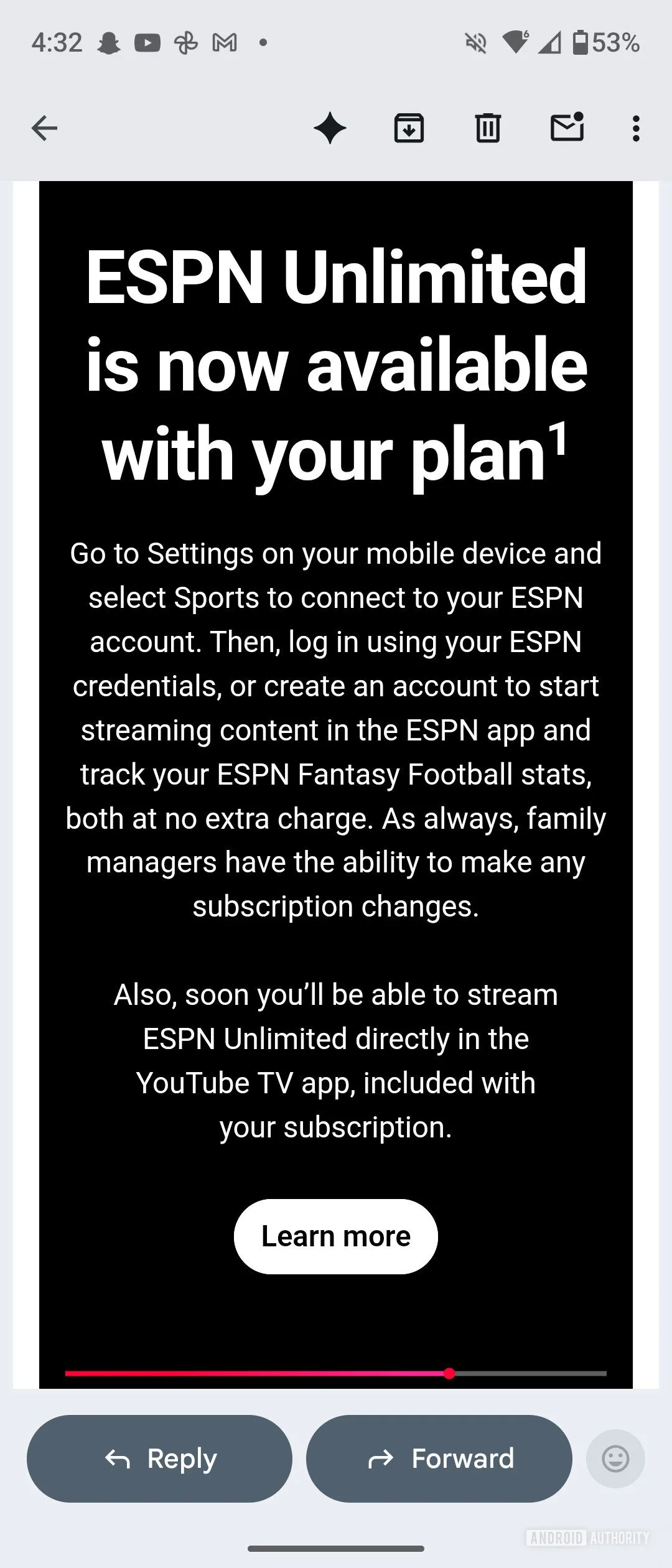
The rollout is happening in stages. Subscribers say Google has been sending activation notices over the past week instead of flipping the switch for every account at once. If your inbox is still empty, your plan probably hasn’t been skipped; the rollout simply hasn’t reached your account yet.
The immediate catch is that ESPN Unlimited access begins in ESPN’s own app, not directly in the YouTube TV interface. Subscribers will need to follow the activation instructions tied to their YouTube TV account and use ESPN’s app for the service initially. Google says live programming will reach the YouTube TV experience later.
That distinction sounds minor on a product roadmap. In a living room, it can be irritating. One of YouTube TV’s strongest selling points is that it puts a large live-TV bundle, cloud DVR, recommendations, and channel guide in one place. Sending viewers out to a second app adds friction precisely when they are trying to find a game five minutes before kickoff. Anyone who has bounced among ESPN, Paramount+, Peacock, and a cable-style TV app during a big sports weekend knows the drill.
Still, the basic economics are hard to dismiss. A $30 monthly service included with an already-expensive TV package has real value for sports-first customers. For viewers who barely touch ESPN outside the occasional college football game, it is more like being handed a nice restaurant voucher for a place they never planned to visit.
The delayed payoff from a very public Disney dispute
This perk traces back to the Disney and YouTube TV contract dispute that temporarily knocked out channels including ABC, ESPN, National Geographic, and Disney Channel for YouTube TV customers. The blackout was a familiar piece of modern media theater: two giant companies negotiating in public while the people paying the bill lost access to programming they thought they had bought.
Google issued subscribers a credit during the disruption, then announced that its renewed arrangement with Disney would bring the new ESPN offering to the platform. The current arrival of ESPN Unlimited is the first tangible evidence of that promise landing in customers’ hands.
Carriage battles used to feel like a cable-TV problem, complete with passive-aggressive messages on a channel that had suddenly gone dark. Streaming was supposed to offer an escape hatch. Instead, virtual distributors such as YouTube TV, Hulu + Live TV, Fubo, and Sling have inherited the same expensive rights negotiations, because the underlying problem never went away: sports networks command enormous fees, and somebody has to pay them.
Disney has particularly strong bargaining power. ESPN remains one of the central pillars of the traditional TV bundle, even as its audience shifts toward streaming. That makes ESPN Unlimited strategically useful beyond its sticker price. Disney gets its streaming product in front of millions of potential regular users, while Google can tell sports fans that YouTube TV now includes more than a conventional channel lineup. ESPN details its direct-to-consumer offering on its official streaming page.
What YouTube TV subscribers should actually expect
Subscribers who receive the email should read the activation details rather than assume an existing ESPN login will automatically unlock everything. These bundled streaming entitlements often require account linking, and the process can be confusing if an ESPN account already has a paid subscription attached to it. The sensible move is to check billing before activating anything new; no one wants to accidentally pay twice for a perk that is meant to be included.
The service is not a replacement for every sport or every television channel. Rights remain fragmented, as they do across the entire streaming market. The exact value of ESPN Unlimited will depend on the events and programming a particular fan follows, plus whether they are comfortable watching through ESPN’s separate interface until YouTube TV integration arrives.
Live content from the offering will appear in YouTube TV later. That matters. A promise of future integration is useful, but it is not the same as opening YouTube TV and seeing the game in the guide, with recordings and recommendations handled exactly as customers expect.
The bigger question is whether bundles can still feel like a deal
For all the attention around ESPN Unlimited, the more interesting development may be YouTube TV’s effort to offer more flexible packages. Google introduced new bundle options earlier this year, giving subscribers greater ability to choose channel groups rather than accept one monolithic slate of programming. That is a welcome direction. Frankly, forcing every household to subsidize every sports network, movie channel, and reality-TV franchise has always been the weakest logic behind pay TV.
But sports remain the exception that tests every attempt at unbundling. Live games are still appointment viewing, advertisers still want them, and distributors still need them to keep customers from leaving. ESPN knows it. Disney knows it. Google definitely knows it.
My read is that this free ESPN Unlimited access is less a victory lap than a peace offering from a deal both companies needed to repair. It gives YouTube TV a useful differentiator today, while giving Disney another path to turn ESPN from a cable staple into a direct streaming habit. The real test comes when the perk is fully integrated—and when the next carriage contract lands on the negotiating table.

