

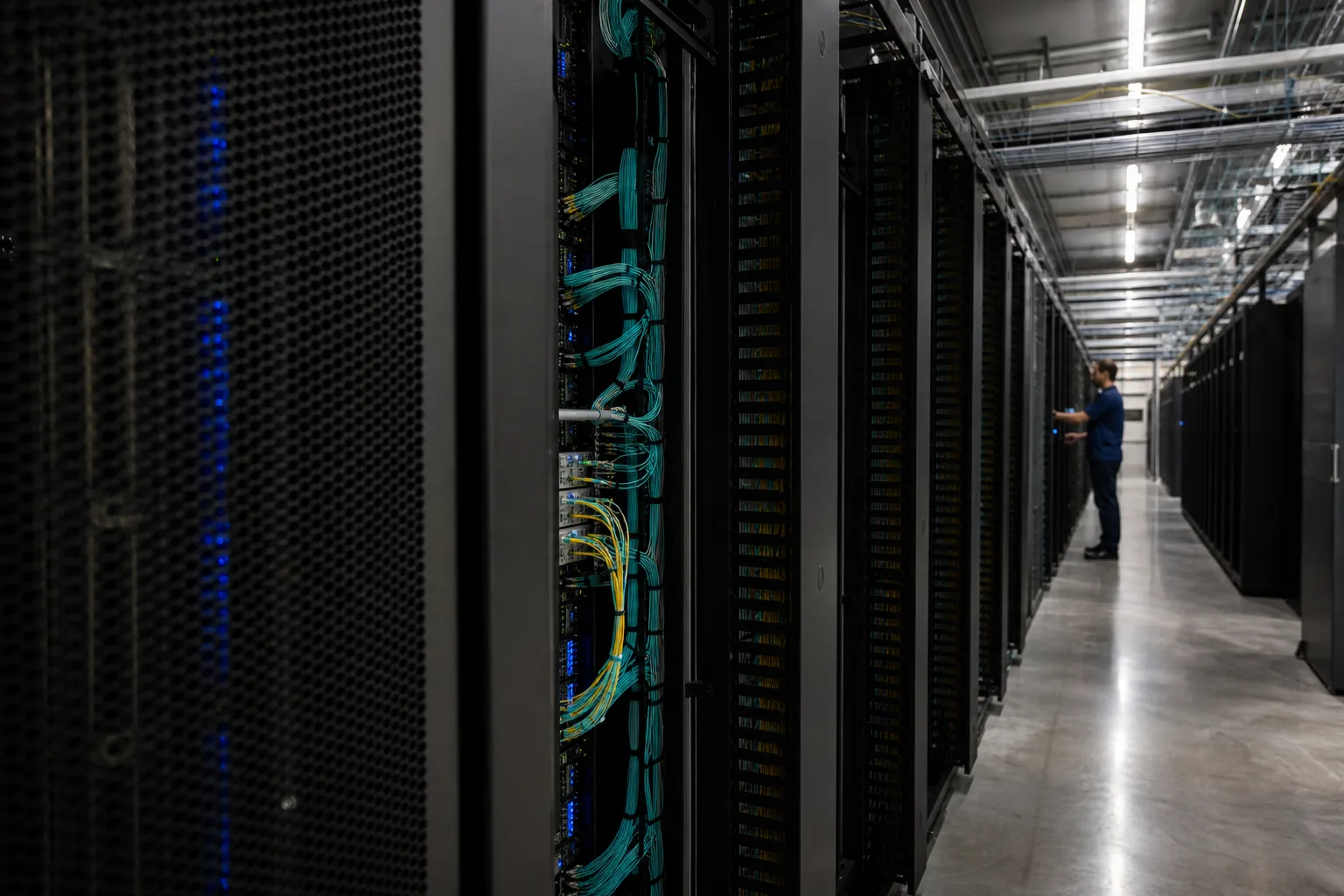
Nvidia data center demand has become one of the market’s bluntest instruments for judging the health of the AI boom. Forget chatbots with cute names and keynote demos for a moment: Nvidia’s racks of GPUs are where the industry’s enormous promises turn into purchase orders, construction projects, electricity bills, and, eventually, revenue. That makes Jim Cramer’s latest focus on Nvidia and its data-center business a useful test of what really matters.
Can the spending continue at anything close to this scale?
Cramer’s attention to Nvidia and its data-center business reflects the obvious importance of the company’s data-center results. Nvidia’s business has shifted dramatically from a company best known for gaming graphics cards into the primary supplier of accelerated computing hardware for the world’s biggest cloud operators. It is a remarkable turn, though not a magical one. The company sells the picks and shovels during a very expensive digital gold rush.
- Nvidia data center demand has become a practical proxy for whether the AI investment boom is translating into real infrastructure purchases.
- Jim Cramer’s attention to Nvidia data center demand reflects Wall Street’s focus on cloud spending rather than consumer GPU sales.
- Blackwell shipments, customer deployment speed, and power availability will matter more than broad AI enthusiasm in the next phase.
- Nvidia still leads AI computing, but investors should separate durable enterprise use from costly experimentation by cloud platforms.
Table of Contents
Nvidia data center demand is Wall Street’s AI reality check
When analysts talk about Nvidia data center demand, they are really talking about a small group of buyers with outsized influence: Microsoft, Amazon, Alphabet, Meta, Oracle and the large sovereign or enterprise customers building their own AI capacity. Those firms are buying GPUs, networking gear, servers and whole rack-scale systems to train large language models and serve AI features to millions of users.
Nvidia’s data-center business is central to the company’s story. This is not a routine semiconductor cycle. It is an infrastructure buildout that has quickly become one of the largest capital-spending stories in technology.
A giant revenue figure still does not settle the debate. It raises the stakes. The market now wants proof that cloud companies can earn attractive returns from all this equipment. Training frontier models is expensive; running them for customers can be expensive too. Every token generated by an AI assistant consumes compute, and someone has to pay for the power and servers behind it.
My read is that Cramer is right to keep the focus on demand rather than treating Nvidia as a pure momentum ticker. The company’s stock price will react to product schedules, margins and guidance, of course. But the durable story rests on whether customers keep expanding their fleets after the first wave of AI capacity is installed.
The Blackwell transition has changed the question
Nvidia’s newest Blackwell platform is supposed to push the market beyond individual GPU purchases toward integrated AI systems. That includes the company’s GPUs, NVLink interconnect, networking and software stack. In practical terms, buyers are no longer just ordering chips in boxes. They are planning data halls around a computing architecture.
Blackwell gives the company a fresh growth engine, but it also creates a familiar hazard for investors: transitions can make quarterly figures messy. Nvidia data center demand may be harder to read during the shift as customers pause or adjust orders while moving from Hopper-based systems to newer Blackwell equipment. Supply constraints can cloud the picture as well.
That does not automatically signal trouble. Major platform changes rarely happen cleanly. Think of it like replacing the kitchen in a busy restaurant: the new equipment may increase capacity, but installation is disruptive and the timing matters. A delayed delivery, a cooling issue or a missing power connection can turn an expected deployment into a quarter that slips.
Nvidia data center demand needs to be judged on more than headline revenue. Watch management’s comments about supply, system deployments and customer acceptance. Watch whether cloud providers describe AI capacity as constrained. And watch capital-expenditure plans from Microsoft, Meta, Alphabet and Amazon. Those companies are not perfect transparent windows into Nvidia’s order book, but they are about as close as outsiders get.
Demand is real, but the spending cycle has risks
The bull case is straightforward. Generative AI is moving from model training toward inference, the everyday process of answering prompts, generating code, ranking content and powering business software. If AI becomes a standard feature inside search, productivity suites, customer service tools and enterprise systems, Nvidia data center demand could remain high even after the initial model-training frenzy cools.
Nvidia has also built an advantage that goes beyond silicon. CUDA, its software ecosystem, remains deeply embedded in AI development. Switching to another accelerator can require work that customers would rather avoid, especially when they are racing to ship products. AMD, custom chips from Google and Amazon, and a growing field of specialist hardware makers will compete aggressively, but Nvidia starts from a position of unusual strength.
There is a real bear case, and it should not be waved away. Hyperscalers may eventually decide they have built enough capacity for a while. They may direct more work to their own chips. Enterprises may adopt AI more slowly than the optimistic forecasts suggest. And the physical limits are severe: data centers need land, transformers, transmission capacity, water in some locations, and vast quantities of electricity.
AI infrastructure is a long-term buildout rather than a one-quarter event. The company’s fiscal 2025 earnings release is another focal point, while investors continue to parse whether demand reflects lasting use cases or a fear of being left behind by rivals.
What to watch next
For now, Nvidia data center demand looks far more solid than the skeptics expected two years ago. The company has converted AI excitement into sales at a scale few believed possible. Cramer’s broader point holds up: if you want to understand the market’s AI conviction, Nvidia remains a useful place to look.
Nvidia is also becoming a victim of its own success. Expectations are immense. A merely good quarter can be treated as a disappointment when investors have priced in extraordinary growth, and every delay in Blackwell deployments will attract scrutiny.
The more revealing signal will come after the first rush for capacity. If cloud providers show that AI services are becoming useful, profitable and sticky, Nvidia’s position may prove more durable than today’s critics think. If they cannot, the industry could discover that buying the world’s best shovels is much easier than finding enough gold.

