

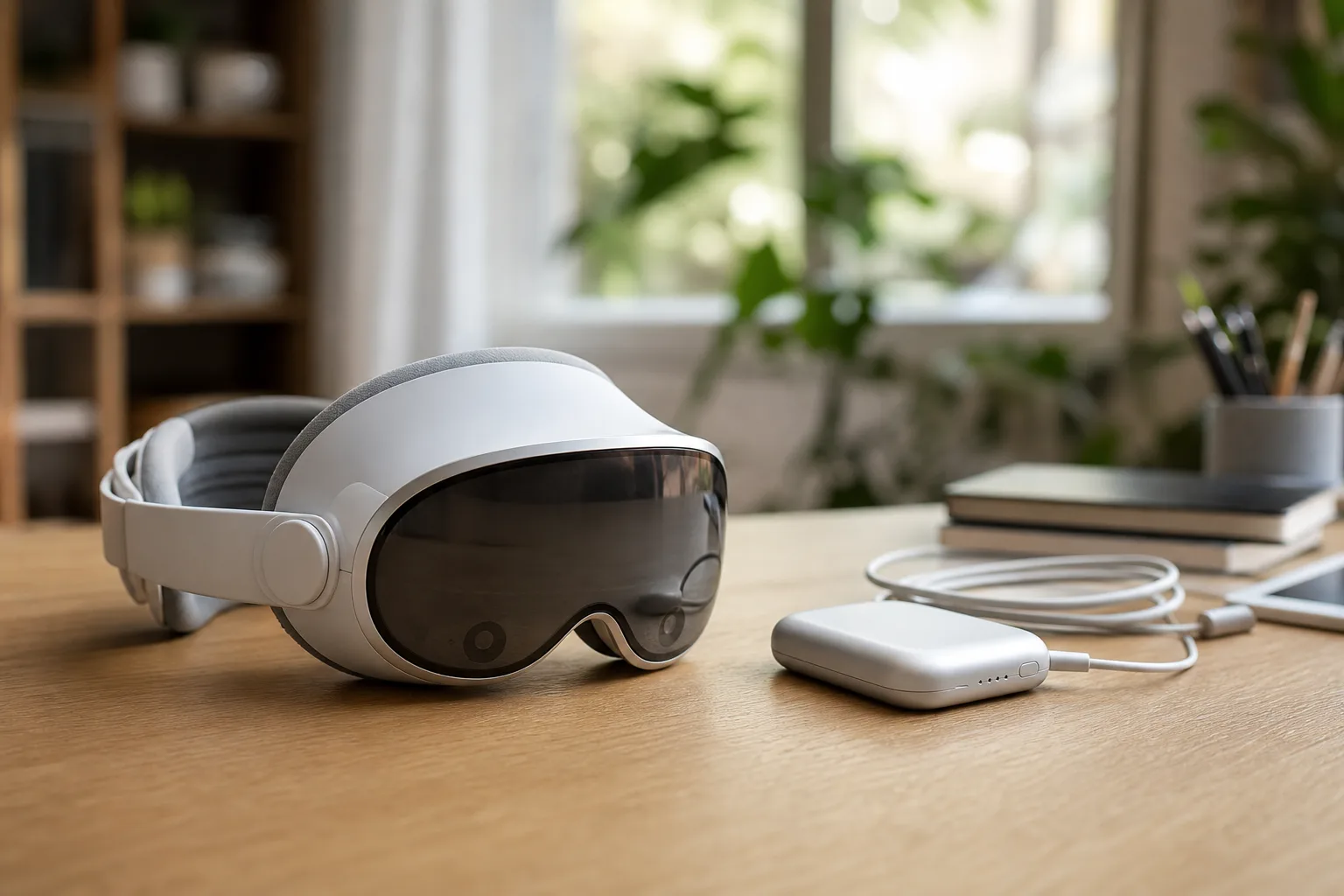
- Apple’s reported Vision Pro successor work includes four concepts, with a possible launch window stretching into late 2028 or early 2029.
- A lighter Vision Pro successor could rely on new materials—or move its computing and battery hardware into an external puck.
- Apple appears more interested in improving comfort and thermal efficiency than in building the cheapest possible headset.
- Meta’s lightweight glasses have made the external-compute approach harder for Apple to dismiss, even with resistance from some of its designers.
Table of Contents
The Vision Pro successor has one problem to solve first: your face
Apple’s Vision Pro successor is reportedly still years away, but the company’s design debate already gets to the heart of why its first spatial computer remains such a strange product. Vision Pro can be technically dazzling and still feel like a piece of expensive luggage strapped to your forehead. The display fidelity, eye tracking, hand controls, and interface ambition were never the only story. Weight, heat, battery management, and plain old social awkwardness mattered just as much.
According to Bloomberg reporting cited by 9to5Mac, Apple is exploring as many as four directions for a future headset under the internal project name N224. The reported target is late 2028 or early 2029. That is a long runway, even by Apple standards, and it suggests the company is not treating this as a routine annual hardware refresh.
That makes sense. The next Vision Pro successor cannot merely be a little faster or marginally less bulky. Apple needs to answer a far more basic question: what form of wearable computer will people actually put on voluntarily, for more than a movie or a work demo?
Why Apple shelved the obvious answer
For a while, the expected Vision Pro successor path was a lower-cost, lighter headset often described in reports as a Vision Air, codenamed N100. That effort was reportedly shelved last year. The new N224 work seems to inherit some of the same ambitions, particularly around reducing physical burden, without necessarily being positioned as a budget product.
Frankly, that is the right instinct. Price is a glaring problem with Vision Pro, but a cheaper version that remains large, front-heavy, and isolating would not suddenly create a mass market. Apple learned a version of this lesson with the original Apple Watch: the product did not find its footing simply because the company packed in more technology. It found a clearer job as a health and fitness device. Vision Pro still lacks that everyday reason to exist.
A Vision Pro successor built with plastic, titanium, other metals, or a different internal architecture could reduce weight substantially. Material choices matter, but they are not magic. Plastic might save grams; titanium can offer strength without the heft of stainless steel. The far bigger issue is where Apple puts the hot, power-hungry computing hardware that currently lives behind the user’s eyes.
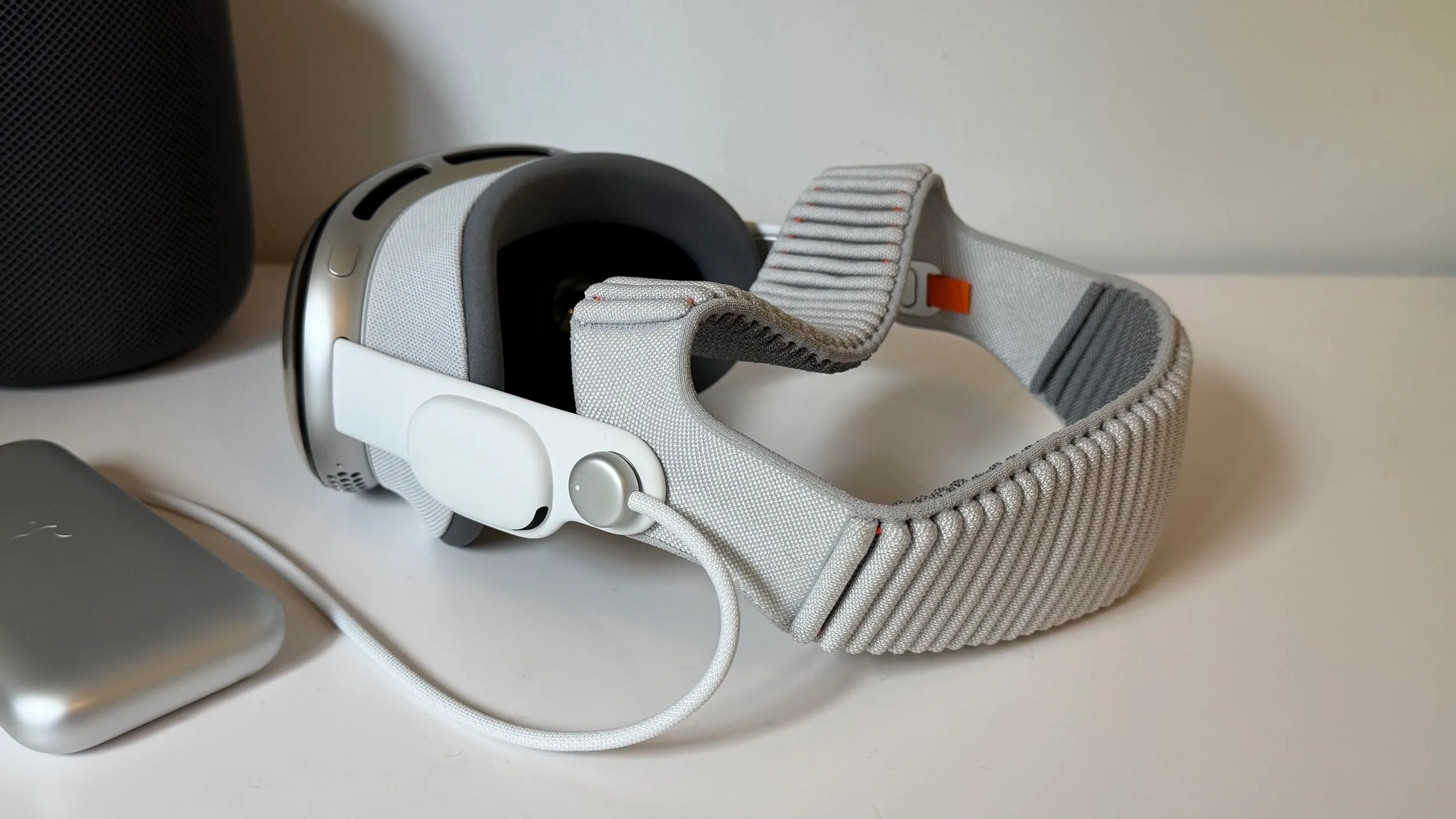
Apple’s present design already makes one compromise by placing its battery in an external pack connected by cable. That battery can be tucked into a pocket, though the wire is hardly elegant. Moving compute off the headset as well would make the face-worn portion lighter, potentially cooler, and closer to ordinary glasses. But it would also turn Apple’s polished self-contained device into a system with another thing to carry, charge, and possibly lose on the sofa.
The Meta-style puck is the most interesting option
One N224 concept reportedly resembles Meta’s recent VR glasses approach, combining the battery and computing components in an external puck. Some Apple executives are said to prefer a design closer to an all-in-one headset, which is not hard to understand. Apple has spent decades making devices feel complete: the iPhone is the computer, camera, screen, and network connection in one object. A puck makes the experience more modular, but also more complicated.
Still, my read is that Apple should not dismiss the puck too quickly. A headset is not a phone. You hold a phone in your hand; every gram of a headset sits on your nose, cheeks, and neck. Offloading components is like moving a heavy backpack from your shoulders onto a rolling suitcase. It may not be perfect, but you immediately feel the difference.
Meta has been much more willing to accept visual and architectural compromises in pursuit of wearability. Apple’s current approach has the opposite personality: remarkable hardware trying to prove that uncompromising engineering can create a new computing category. The problem is that human heads are uncompromising too.
The chip road map may give Apple more room to maneuver. Its A-series silicon has become notably capable at low power, while the M-series chips offer the performance profile Apple wanted for Vision Pro’s demanding real-time rendering. By 2028, an iPhone-class processor may be able to handle more of visionOS without the cooling and battery demands associated with a laptop-style chip. That is speculation, not a promise, but Apple’s silicon team has earned the benefit of the doubt.
The central challenge for any Vision Pro successor will be maintaining the responsiveness that makes eye-and-hand input feel convincing. Mixed reality fails fast when the digital layer lags the real world. Nobody wants their virtual windows drifting around the room like a shopping cart with a bad wheel.
Apple needs a product category, not another impressive demo
Apple has not abandoned spatial computing. Its official Vision Pro page still frames the device as a new kind of personal computer, one capable of turning a room into a private theater, workspace, or immersive canvas. That pitch is aspirational, and parts of it genuinely work. Watching 3D video or using a massive virtual display can be terrific.
But the current product remains better suited to enthusiasts, developers, affluent frequent travelers, and people who enjoy testing the edges of consumer technology. That is not a failure by itself. The original Macintosh was not initially a mass-market machine either. Yet Apple cannot keep asking people to pay laptop-and-a-half money for something they use intermittently.
The rumored 2028 or 2029 timing gives Apple room to wait for displays, batteries, cameras, and chips to improve together. It also gives competitors more time. Meta is pushing hard on lightweight wearable hardware; Samsung and Google have their own extended-reality ambitions; and the broader market remains skeptical after years of VR promises that rarely escaped the enthusiast bubble.
A Vision Pro successor with a lower price would help, obviously. But lower cost should be the outcome of a better design, not the whole strategy. If Apple can make a headset that feels as easy to wear as premium headphones, lasts through a meaningful chunk of a day, and offers one or two killer uses people return to weekly, then the company may finally have something bigger than a lavish demo.
Until then, the puck-versus-all-in-one argument is more than an engineering footnote. It is Apple deciding what the Vision Pro successor should be: a computer on your face, or technology that gets out of your way enough to be worn in the first place.

