
Bitcoin climbed back above $62,000 on Friday after a notably soft US jobs report handed crypto bulls exactly the macro cover they needed heading into a long holiday weekend. The Bitcoin weekend rally looks real enough on the spot chart — but the derivatives market is telling a more cautious story, one shaped by a specific options structure sitting between $66,000 and $68,000 that could cap just how far this bounce actually runs.
- The Bitcoin weekend rally cleared $62,000 after a soft US jobs report reduced Federal Reserve rate hike expectations significantly.
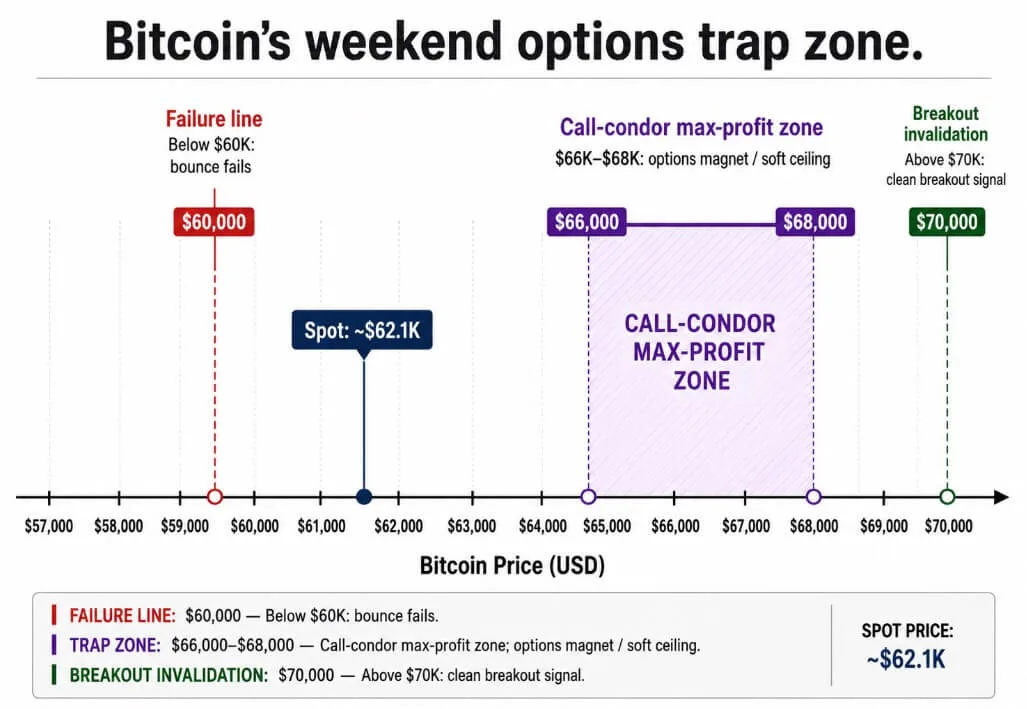
- Options data shows the Bitcoin weekend rally faces a hard ceiling between $66,000 and $68,000 due to a large call condor structure.
- Deribit’s one-week put-call skew remains elevated at 16%, signalling traders are still hedging against a potential downside reversal.
- Thin Independence Day liquidity means price moves in either direction could be sharper and faster than normal weekend sessions.
Table of Contents
A Jobs Report That Changed the Fed Calculus
The catalyst was straightforward. The US Bureau of Labor Statistics reported that the American economy added just 57,000 payroll jobs in June — roughly half the 110,000 economists had expected. That’s a miss that matters. The BLS also revised April and May payrolls down by a combined 74,000, labor-force participation slipped to 61.5%, and unemployment held at 4.2%. On its own, any one of those figures might have been shrugged off. Together, they painted a picture of a labor market that’s cooling faster than the Federal Reserve anticipated.
Markets repriced quickly. The dollar was on track for its sharpest weekly decline since early April, and CME FedWatch data dropped the probability of a September rate hike to around 45%. That’s the combination Bitcoin needed: a weaker dollar reduces the opportunity cost of holding non-yielding assets, and softer rate-hike odds remove one of the key macro headwinds that had been pressing on crypto valuations through the second quarter. The Bitcoin weekend rally felt justified heading into the July 4 long weekend, with the bid under spot looking genuinely supported by macro fundamentals rather than pure speculation.
What the Bitcoin Weekend Rally Is Running Into
Here’s where the story gets more interesting than a simple macro bounce. Options desks are not sharing the spot market’s optimism — at least not fully. On Deribit, the dominant venue for Bitcoin options volume, put options are still trading at a premium to equivalent call options. The one-week 25-delta put-call skew was sitting near 16% after the jobs report. That’s down meaningfully from around 25% ten days prior, which does suggest some of the acute fear has unwound. But a 16% skew still represents real money paying a premium for downside protection. The panic has eased; it hasn’t gone away.
What that skew tells you is that professional traders are still hedged for another leg lower even while Bitcoin bounces. They haven’t aggressively flipped to buying calls. The positioning looks more like cautious relief than conviction buying — and that matters for how far the Bitcoin weekend rally can extend before it starts running into supply from traders who are willing to sell the rip.
The $66K–$68K Trap: How the Condor Works
The most concrete piece of options intelligence this weekend comes from Laevitas data, which flagged a large block trade tied to the July 17 expiry. The structure is a long call condor: long positions at $64,000 and $70,000, short strikes at $66,000 and $68,000. If you’re unfamiliar with the mechanics, here’s what it means in practice.
A call condor earns its maximum profit when the underlying — Bitcoin — expires inside the inner strike range. In this case, that means landing between $66,000 and $68,000 by July 17. The position loses value if Bitcoin either stalls below $66,000 or blasts cleanly through $68,000. The entity that sold the $66,000 and $68,000 calls will be motivated to defend those levels, effectively putting a soft ceiling on the Bitcoin weekend rally as price approaches that band. It’s someone else’s profit-and-loss working against the upside momentum.

That band sits roughly 6% to 9% above where Bitcoin was trading near $62,100 when the jobs data dropped. It’s not an unreachable distance — thin holiday liquidity can compress the time it takes to get there — but it’s also not a free ride. The condor creates a visible price ceiling baked into institutional options math, and that’s the kind of resistance that doesn’t move just because spot buyers are enthusiastic. Whether the Bitcoin weekend rally stalls at this band or powers through it will be one of the clearest reads on whether institutional conviction is building or absent.
Why Holiday Liquidity Cuts Both Ways
US equity markets closed July 3 for Independence Day, and most desks on Wall Street won’t be fully staffed again until Monday at the earliest. That matters for Bitcoin more than it might seem. The correlation between crypto and equities has tightened considerably over the past two years as institutional participation deepened, and several of the mechanisms that normally anchor Bitcoin moves — ETF volume flows, equity-market correlation signals, deep futures books from traditional finance participants — go quiet when the NYSE calendar goes dark.
Crypto, of course, never closes. It trades through every holiday, every weekend, every time zone. But when the traditional-market checks go offline, the remaining price discovery falls more heavily on whatever positioning is already in the options market. This weekend, that means the call condor at $66,000–$68,000 is carrying disproportionate weight in framing where Bitcoin goes next.
The two-sided nature of thin liquidity is worth taking seriously. If Bitcoin holds above $62,000 through Saturday and Sunday, a low-volume tape can amplify the move upward — fewer sellers needed to absorb, fewer large orders to navigate. That dynamic could push spot cleanly toward the condor band faster than anyone expects. But the same thin books that fuel a squeeze higher will accelerate a drop if sentiment flips. Stop orders clearing in a market with no depth can produce outsized candles in either direction, and the Bitcoin weekend rally has relatively little technical support between $60,000 and the current spot.

The Scenarios Worth Watching Through Sunday Night
There are really three distinct outcomes to track as the weekend plays out.
- Bitcoin moves into the $66K–$68K band and stalls. This is the scenario the condor is built for. It would confirm that large options positioning is effectively capping the bounce, and Monday’s return of full liquidity would bring the test of whether buyers have enough real conviction to push through. A stall here leaves the Bitcoin weekend rally as a relief move rather than a trend reversal.
- Bitcoin breaks convincingly above $68,000 on volume. This would invalidate the condor’s ceiling and flip the script entirely. A clean break on genuine volume — not just a wick during thin weekend hours — would force short-sellers to cover, flush protective puts, and likely kick off a momentum chase. That’s how a squeeze becomes an actual trend shift, and how the Bitcoin weekend rally graduates from a macro relief bounce into something with real structural legs.
- Bitcoin rejects near $66,000 or cracks below $60,000. Either move would validate what the elevated put-call skew had been pricing all along. Losing $60,000 matters technically — it reopens the low-$57,000 zone that Bitcoin already visited during its second-quarter pullback. That’s about 8% below where spot was trading when the jobs numbers landed, and in thin holiday markets, the distance can close faster than anyone is comfortable with.
The Bigger Picture: Options Markets as the Real Signal
There’s a broader point here that goes beyond this specific weekend. The growing sophistication of Bitcoin’s options market — and Deribit’s dominance within it, handling the overwhelming majority of institutional BTC options flow — means that single large trades can now visibly shape short-term price behavior in a way that wasn’t true three or four years ago. A call condor placed by one well-capitalised desk sets a de facto range that spot traders then navigate around, often without fully realising why price is sticky at certain levels.
For retail traders watching the Bitcoin weekend rally unfold over Independence Day weekend, that’s a genuinely useful framework. The macro catalyst was real. The Fed softening is meaningful. But the ceiling above current spot isn’t arbitrary — it’s someone’s carefully structured trade, and it’ll remain in place until expiry on July 17 unless spot price moves decisively enough to make defending it too expensive. Whichever way Bitcoin closes Sunday night, the outcome will say more about who hedged correctly than about whether the macro thesis was right.
Frequently Asked Questions
What is driving the Bitcoin weekend rally right now?
The Bitcoin weekend rally was triggered by a weaker-than-expected US jobs report for June, which showed just 57,000 new payrolls against a forecast of 110,000. That cooled expectations for a Federal Reserve rate hike, softened the dollar, and gave crypto buyers the macro green light they needed.
What is a call condor options structure and why does it matter for Bitcoin’s price?
A long call condor is built by buying options at two outer strike prices and selling at two inner strikes. The Bitcoin condor flagged by Laevitas data is long at $64,000 and $70,000 while short at $66,000 and $68,000, meaning the position profits most if Bitcoin lands inside that band by the July 17 expiry.
What happens to Bitcoin if it breaks above $68,000 this weekend?
A clean break above $68,000 on real volume would convert the current squeeze into an actual breakout and clear the ceiling built into the large options structure. Anything short of that, such as a stall inside the band or a fade once order books thicken on Monday, leaves the rebound as just a squeeze.
Why does the Independence Day holiday make Bitcoin moves more volatile?
US equity markets closed on July 3 for Independence Day, taking with them ETF volume flows, deep futures books, and correlated equity signals that traders normally use to confirm Bitcoin moves. With those checks offline, options positioning carries disproportionate weight in dictating where price goes.