
America’s 250th birthday landed on July 4th, 2026, and Google marked it with something that’s already dividing the internet: a Google AI ad that places Gemini and Google Workspace squarely in the middle of the American Revolution. The premise is simple, the execution is slick, and the reaction — depending on which platform you’re scrolling — ranges from charmed to furious.
- Google’s new AI ad reimagines the Founding Fathers drafting the Declaration of Independence using Gemini and Google Workspace tools.
- The Google AI ad is relatively restrained compared to past campaigns, avoiding any suggestion that AI improved the actual text of the Declaration.
- Historian Angus Johnston noted the commercial uses surprisingly little AI, calling out how thin the actual use cases look in practice.
- Backlash on Bluesky was sharp, with users calling the spot tone-deaf — even as YouTube and Instagram audiences reacted more warmly.
Table of Contents
The Pitch: ‘Group Project, But Make It 1776’
The commercial opens on a largely unseen Thomas Jefferson, mid-draft, interrupted by a nagging text from Benjamin Franklin. From there, it’s a full Google Workspace fantasy: edits appear in Google Docs, a meeting gets scheduled in Google Calendar, and the Continental Congress convenes remotely via Google Meet — with, apparently, every single attendee keeping their camera off. Relatable, honestly.
The whole thing gets wrapped up with e-signatures, and then it’s fireworks. The tone is knowingly absurd. At one point Sam Adams pipes up: ‘Can we settle this over beers?’ It’s the kind of line that signals the ad knows exactly how ridiculous it is, and it’s leaning in rather than pretending otherwise.
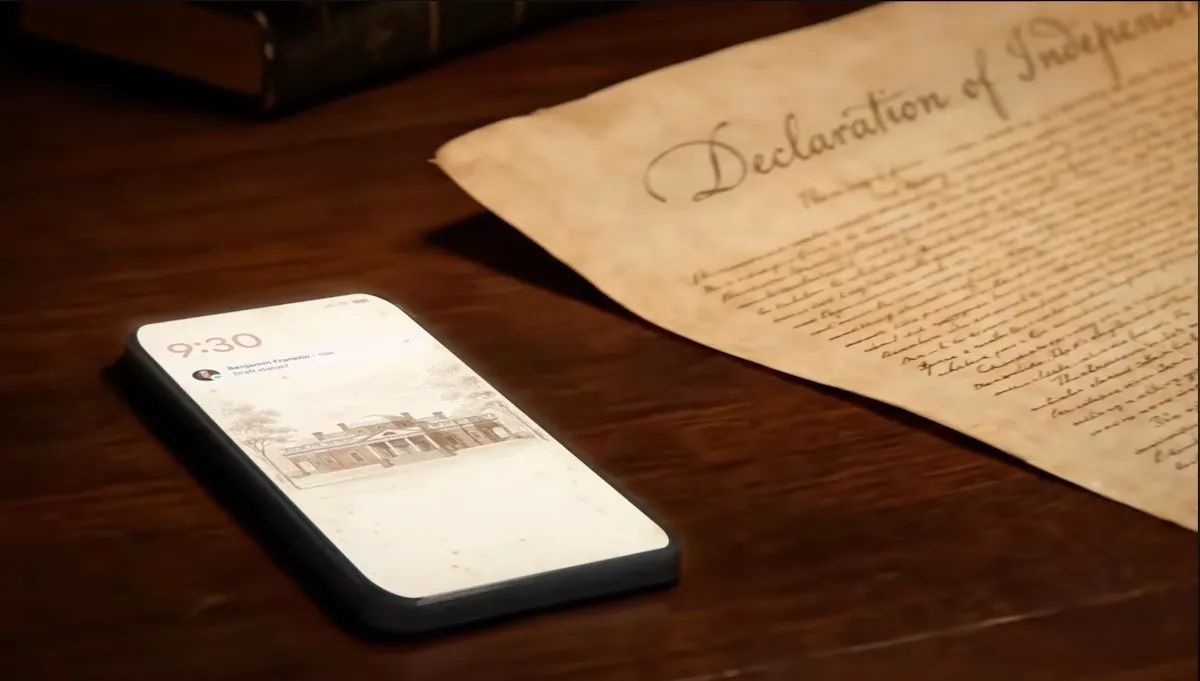
What makes this Google AI ad interesting is how carefully Google placed Gemini in the background rather than the foreground. The fictionalized founders use the ‘help me visualize’ AI tool to audition different animals for the national seal — so, no eagles yet, apparently — Gemini takes notes on the meeting, and the chatbot gets consulted before the founders decline King George III’s request for document access. That last one is genuinely funny if you’re in the right mood.
What Google Learned From Its Last Big AI Misstep
Context matters here. Google has been visibly cautious about its AI advertising since the backlash to a Paris Olympics commercial, in which a father used Gemini to write a fan letter on behalf of his daughter. That ad struck a nerve because it seemed to suggest AI should replace a deeply personal, human act of expression. The criticism was swift and pointed, and Google clearly absorbed the lesson.
This new Google AI ad takes a noticeably different approach. There’s no implication that Gemini wrote — or could have improved — a single word of the Declaration of Independence. The actual text is treated as untouchable. The AI tools are positioned as organisational scaffolding, not creative substitutes. For a company that has sometimes oversold what its AI can and should do for people, that’s a meaningful course correction.
It’s also worth placing this Google AI ad in the broader context of how tech companies are currently navigating AI marketing. Pew Research data shows that public trust in AI remains deeply divided, with a large share of Americans expressing concern about its expanding role in daily life. Ads that present AI as a quiet helper rather than a transformative force tend to land better — which is exactly the register this commercial is aiming for.
The Backlash: Platform Matters More Than You Think
Here’s where it gets genuinely interesting. Audience response to the Google AI ad splits almost perfectly along platform lines. On YouTube and Instagram, comments skew positive — people seem to appreciate the humor, the historical hook, and the relatively light touch on the AI evangelism. On Bluesky, the reaction was considerably more hostile.
Users on Bluesky called the commercial ‘cringey’ and ‘stunningly tone deaf.’ The AI angle drew the most fire, which isn’t surprising given that Bluesky’s user base skews heavily toward people who’ve actively opted out of algorithmic platforms and tend to be more skeptical of Big Tech’s self-promotional instincts. What is surprising — and genuinely telling — is one of the more measured critiques that emerged from that conversation.
Historian Angus Johnston remarked that it’s amazing how little of the ad is actually AI, and separately observed that even in a corny fantasy joke, it’s impossible to make the case that AI is a useful tool for political organizing, writing, or human collaboration.
Johnston’s observation cuts to something real. Strip away the brand presentation and the Gemini branding, and what you’re left with is a Google AI ad where the AI tools are mostly decorative. Note-taking, visual brainstorming, a chatbot consultation about one document request — none of these are capabilities that would have shifted the course of history, even in the ad’s own fictional terms. If the goal was to demonstrate AI’s power, the commercial inadvertently demonstrates its limits.
The Footage Itself May Be the Most AI-Forward Thing in the Ad
There’s one detail about the Google AI ad that hasn’t attracted as much commentary as it probably should. The visual aesthetic of the footage itself carries what’s become a recognisable signature: that slightly uncanny, too-smooth quality associated with AI-generated video. If that’s what’s happening here — and the texture strongly suggests it — then the most significant AI contribution to the ad isn’t Gemini or ‘help me visualize.’ It’s the production itself.
That’s a genuinely interesting creative choice, even if it reads as unintentional. A commercial celebrating the tools of human collaboration may have been partly assembled by the same generative systems it’s quietly promoting. Whether that’s ironic, efficient, or both probably depends on your priors about AI in creative work.
Google AI Ad Strategy: Helpful Tool or Hollow Symbol?
The broader challenge Google faces with ads like this one is structural. Gemini is a capable product, but its most compelling use cases — coding assistance, document summarisation, research acceleration — are genuinely hard to dramatise in a 60-second spot set in 1776. So instead, you get note-taking and a seal-design brainstorm. It’s enough to check the ‘AI was here’ box without giving anyone a reason to open the app.
Compare that to how Apple has historically marketed its products: through specific, tangible moments of human achievement enabled by technology. The emotional logic of those ads is clear. Google’s approach in this Google AI ad is more diffuse. The Founding Fathers are charming proxies, but ‘Gemini helped us not forget to schedule the meeting’ isn’t quite the vision of the future the company probably wants to sell.
What this Google AI ad ultimately reveals — perhaps more than Google intended — is how difficult it still is to communicate what AI is actually good for to a general audience. The ad sidesteps the hard question entirely, opting for whimsy instead of clarity. That might be the smart move commercially. It’s not a particularly honest account of where AI capabilities sit in 2026. And given that American consumers are increasingly sophisticated about the gap between AI hype and AI reality, Google may find that the Bluesky crowd is less of an outlier than it currently appears.