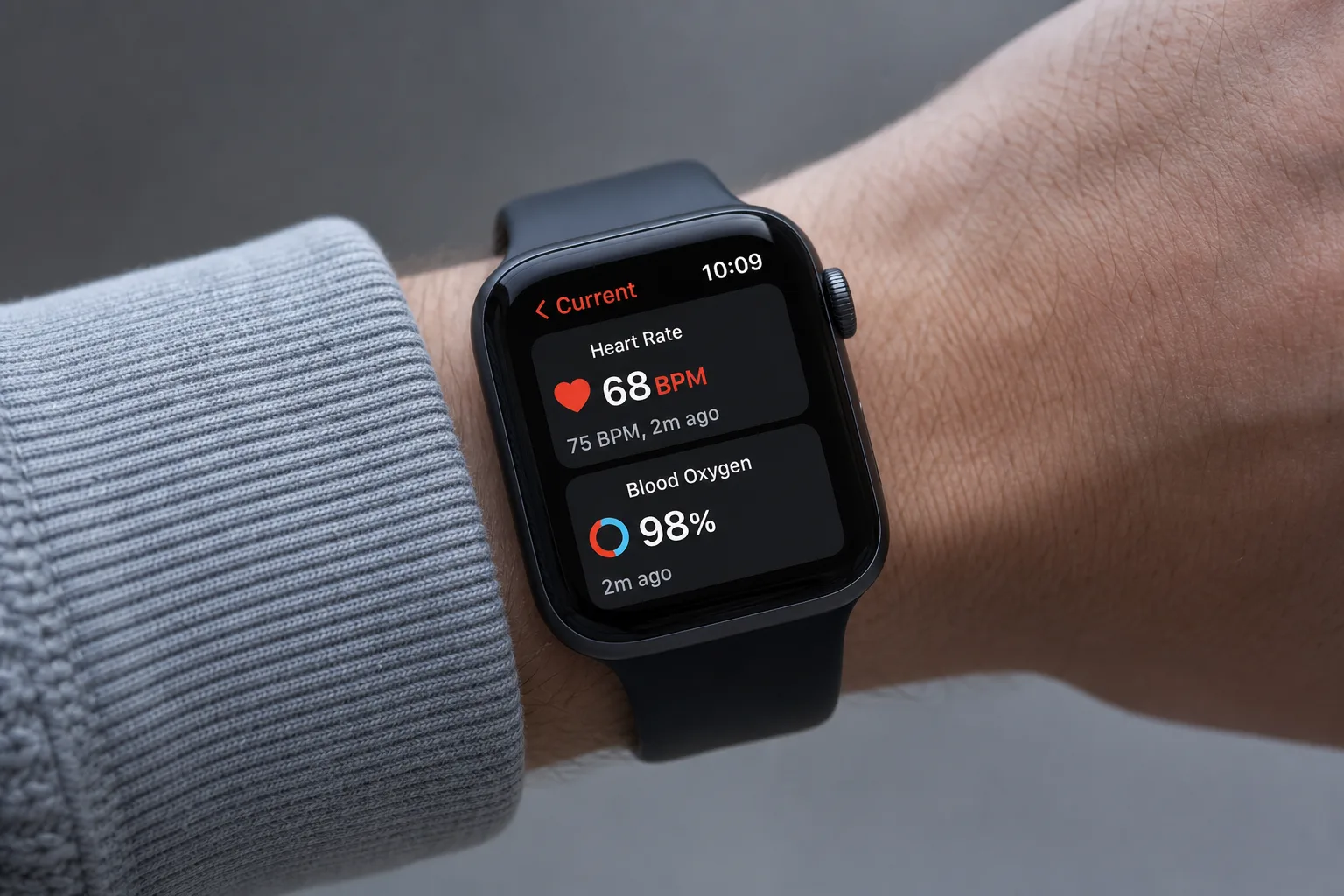
When it comes to edge AI smartwatches, Apple isn’t just leading the market — it essentially is the market. A new report from Counterpoint Research shows that Apple Watch accounted for roughly 90% of all edge AI-capable smartwatch shipments in Q1 2026, even as the broader category posted explosive growth of 70% year over year. That’s a remarkable degree of concentration in what’s supposed to be an increasingly competitive wearables space.
- Edge AI smartwatches grew 70% year over year in Q1 2026, reaching 25% market penetration globally.
- Apple dominated edge AI smartwatches with roughly 90% of all shipments in Q1 2026, per Counterpoint Research.
- Blood pressure monitoring doubled and sleep apnea detection tripled among smartwatches between Q1 2025 and Q1 2026.
- Counterpoint projects edge AI smartwatch penetration will approach 32% across all of 2026.
Table of Contents
What Edge AI Smartwatches Actually Are
Before unpacking the numbers, it’s worth being precise about what Counterpoint means by ‘edge AI smartwatches,’ because the definition matters a lot here. The research firm isn’t counting any watch that runs a machine learning model in some vague, hand-wavy sense. Their criteria are specific: the device must contain a dedicated neural engine or NPU, and at least one health, safety, or interaction feature must have its primary inference path executing locally on that hardware — not offloaded to the cloud.
That’s a meaningful bar. It rules out smartwatches that simply stream sensor data to cloud servers for processing, or that bolt on a chatbot integration without local compute to back it up. Under this definition, edge AI smartwatches are really about the architecture of intelligence — where the thinking happens, not just whether AI branding appears on the box.
For the Apple Watch, that local processing runs through its built-in Neural Engine, the same family of dedicated AI silicon that Apple has shipped across its iPhone and Mac lineups for years. Features like gesture recognition, Siri responses, fall detection, and certain health monitoring signals all draw on that hardware to avoid sending raw biometric data to Apple’s servers. It’s an architecture Apple has been building toward since the Neural Engine first appeared in the A11 Bionic chip back in 2017 — it’s taken almost a decade for the wearable version to emerge as a defined market category in its own right.
The Numbers Behind Apple’s Edge AI Smartwatch Dominance
The headline figures from Counterpoint’s Q1 2026 report are striking on two levels. First, the overall market: global edge AI smartwatch shipments grew 70% year over year, reaching a market penetration of 25%. Put simply, one in every four smartwatches that shipped in Q1 was an edge AI device. Just twelve months ago, that figure was nowhere near that scale.
Second, Apple’s share within that growing segment: approximately nine out of every ten edge AI smartwatches shipped during the quarter came from Cupertino. That’s not a comfortable lead — that’s near-total dominance of a category that’s supposed to represent the next wave of wearable computing.
To put this in perspective, Apple typically commands around 30% of overall smartwatch unit shipments globally when you include all tiers and competitors. Its share of the edge AI smartwatch subsegment being three times that figure tells you something important: everyone else is either shipping watches without the necessary on-device AI hardware, or they’re shipping it but not qualifying under Counterpoint’s inference criteria. Either way, the gap is enormous.
Health Features Are Accelerating Across the Board
One of the more compelling findings in Counterpoint’s report isn’t about Apple specifically — it’s about what’s happening to health monitoring features across all edge AI smartwatches. The growth rates here are striking.
- Blood pressure monitoring rose from 11% of shipments in Q1 2025 to 23% in Q1 2026 — more than doubling in a year.
- Sleep apnea detection jumped from 5% to 18% of shipments over the same period — more than tripling.
- ECG capability climbed from 31% to 34%, a more modest but still meaningful expansion given its already-established base.
These aren’t trivial increments. Blood pressure monitoring at nearly a quarter of all smartwatch shipments represents a significant shift in what consumers expect from a wrist-worn device. Sleep apnea detection going from a niche feature to nearly one in five watches in a single year is frankly rapid by any hardware adoption standard.
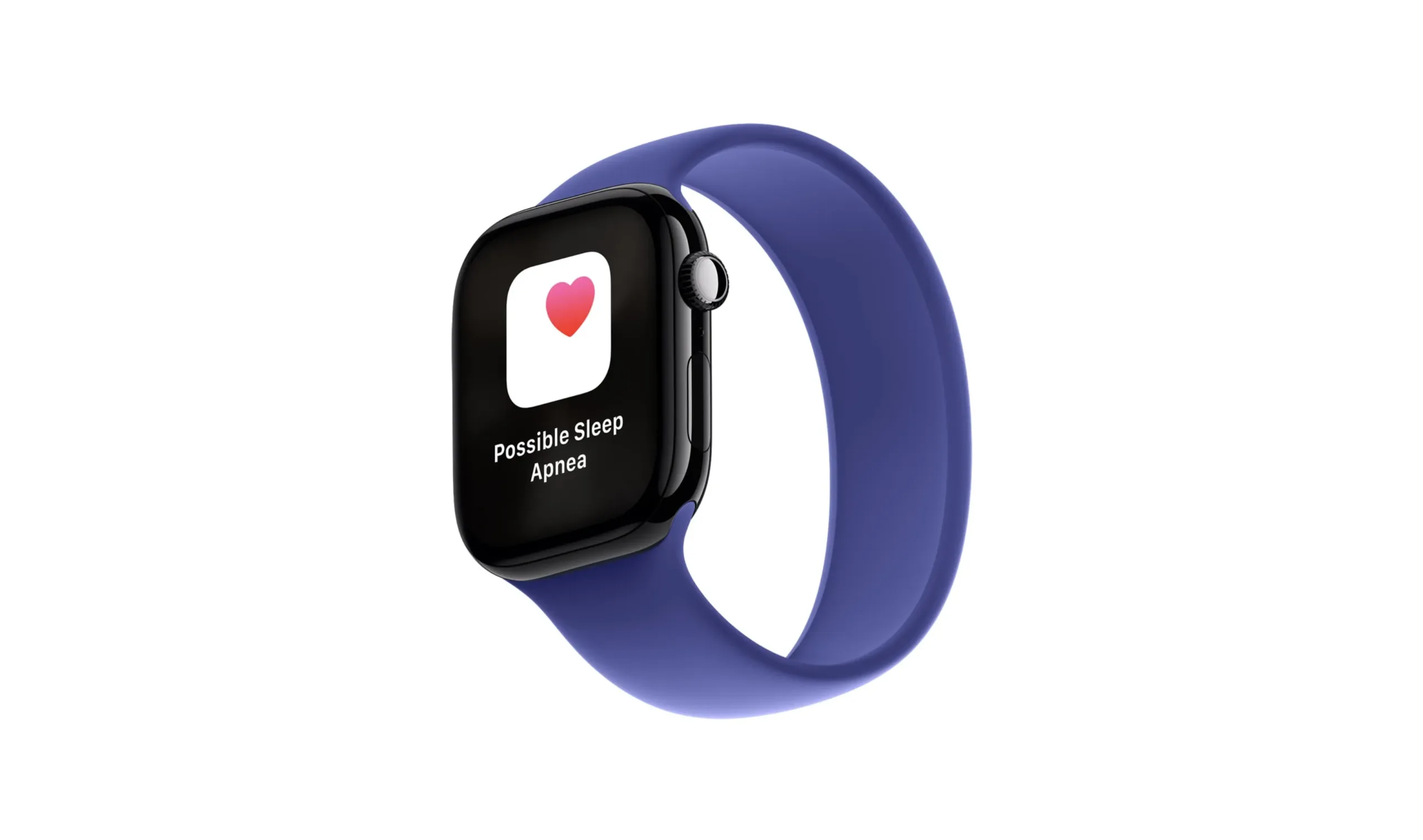
It also aligns with Apple’s own moves. The company received FDA clearance for sleep apnea detection on Apple Watch Series 10 in late 2024, and blood pressure monitoring — albeit in an indirect ‘blood pressure trends’ form — arrived with Apple Watch Series 10 as well. When Apple adds a health feature to its edge AI smartwatches, the sheer scale of its install base tends to move category-wide adoption numbers in a way no other wearable maker can match right now.
The Software Layer Is Now the Real Battleground
Counterpoint Research Director Mohit Agrawal offered some useful framing on where the edge AI wearables market is heading:
‘Edge AI in smartwatches is shifting from primarily a hardware integration to one that also includes software optimization. The real unlock is smaller, more efficient models and OS-level access that lets any app run inference locally. AI needs to turn from a single application into a personal layer that works on personal data.’
That framing is important. The first phase of edge AI smartwatches was really about chip design — getting an NPU onto a device small enough to sit on your wrist without destroying battery life. Apple cracked that problem earlier than most, which is a big reason it owns this market today. But the next phase, as Agrawal describes it, is about democratising access to that hardware through the operating system and developer tools.
This is actually where Apple faces its most credible long-term competitive threat. The company controls watchOS tightly, and while it opens some on-device inference capabilities to third-party developers through Core ML and the Create ML framework, it doesn’t expose everything. If Google and Qualcomm can build Wear OS and chipset combinations that give app developers open, flexible access to on-device AI inference — and if Samsung’s Galaxy Watch lineup matures its health sensor suite — the current 90% concentration among edge AI smartwatches could erode faster than the raw hardware numbers might suggest.
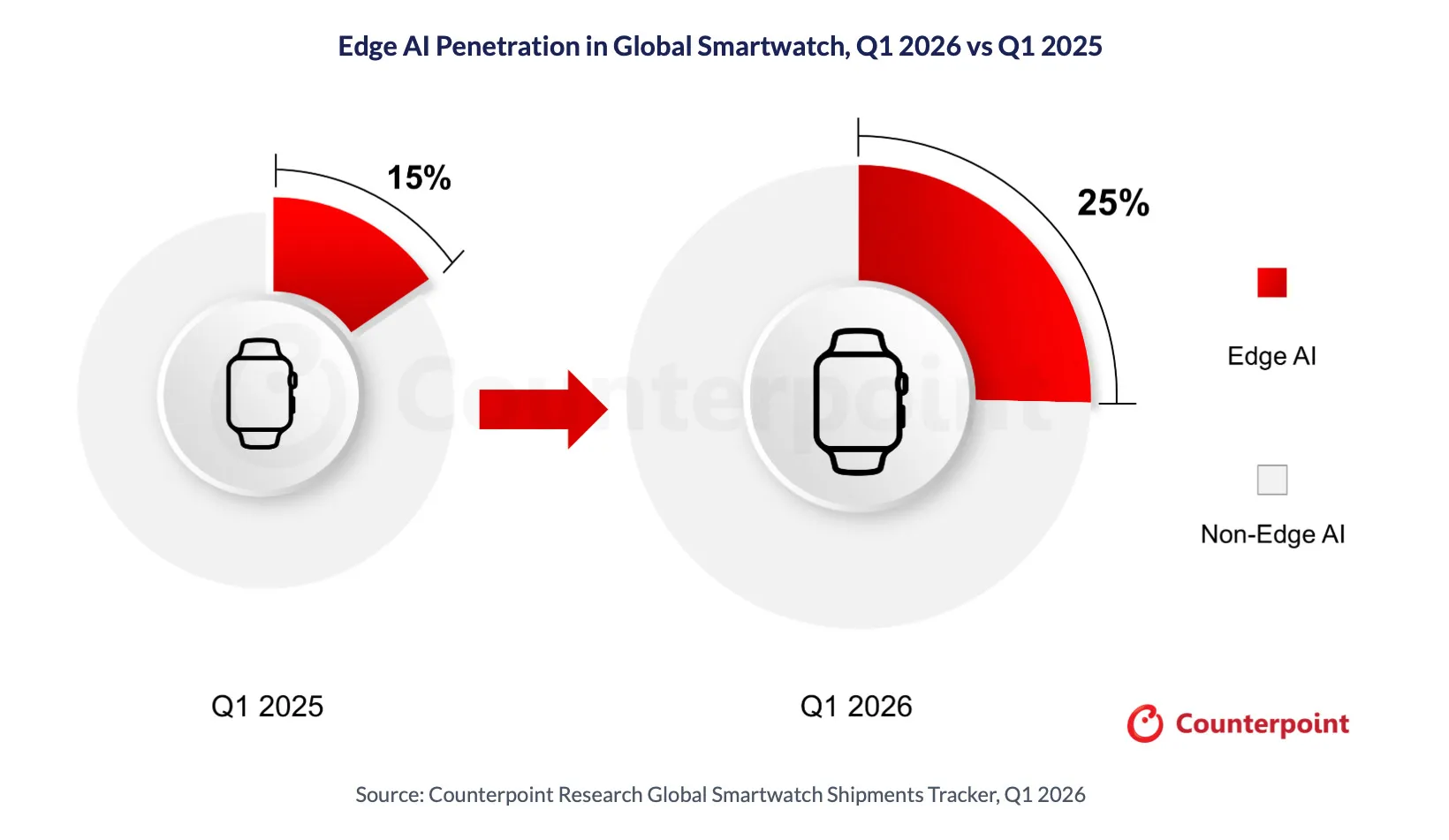
Agrawal’s projection is that edge AI smartwatch penetration across all smartwatches will approach 32% by the end of 2026, up from 25% in Q1. That’s a meaningful jump in a single year, and it implies that competitors are shipping more NPU-equipped hardware even if they’re not yet closing the gap on Apple’s software integration.
Why This Matters Beyond the Wearables Market
The edge AI smartwatch story is really a microcosm of a larger shift in how AI infrastructure is being thought about across the tech industry. The dominant model of the past five years — train models in massive data centres, serve inference via API calls — is being quietly supplemented by a different approach where capable, efficient models run locally on personal devices.
For consumers, the practical difference is real. On-device inference means your health data doesn’t need to leave your wrist for processing. It means features can respond in milliseconds rather than waiting on a network round trip. And it means some features keep working when you’re on a run in a dead zone with no signal — which is, inconveniently, exactly when health and safety features matter most.
Apple understood this earlier than most and built the silicon to match. The result is a 90% market share in a category that didn’t really exist as a defined segment eighteen months ago. If Counterpoint’s 32% penetration projection holds, edge AI smartwatches will ship in significant volumes through 2026 — and whoever closes the gap on Apple will have to win on software, not just chips.
Frequently Asked Questions
What are edge AI smartwatches and how do they work?
Edge AI smartwatches use a dedicated neural engine or NPU to run machine learning tasks directly on the device rather than sending data to the cloud. To qualify, at least one health, safety, or interaction feature must execute its primary AI inference locally on that hardware accelerator.
Which companies make edge AI smartwatches besides Apple?
Apple overwhelmingly dominates the category, accounting for roughly 90% of edge AI smartwatch shipments in Q1 2026 according to Counterpoint Research. The report does not detail which specific brands make up the remaining share.
How fast is the edge AI smartwatch market growing?
Global edge AI smartwatch shipments grew 70% year over year in Q1 2026, reaching 25% market penetration. Counterpoint Research expects that figure to climb toward 32% penetration by the end of 2026 as software optimisation and smaller AI models mature.
Does Apple Watch process all AI features on the device itself?
Not entirely. Apple Watch uses its built-in Neural Engine to process features like gestures, Siri requests, and certain health and safety signals on-device or on the paired iPhone. Some tasks still route to the cloud, but the primary inference path for qualifying features runs locally.