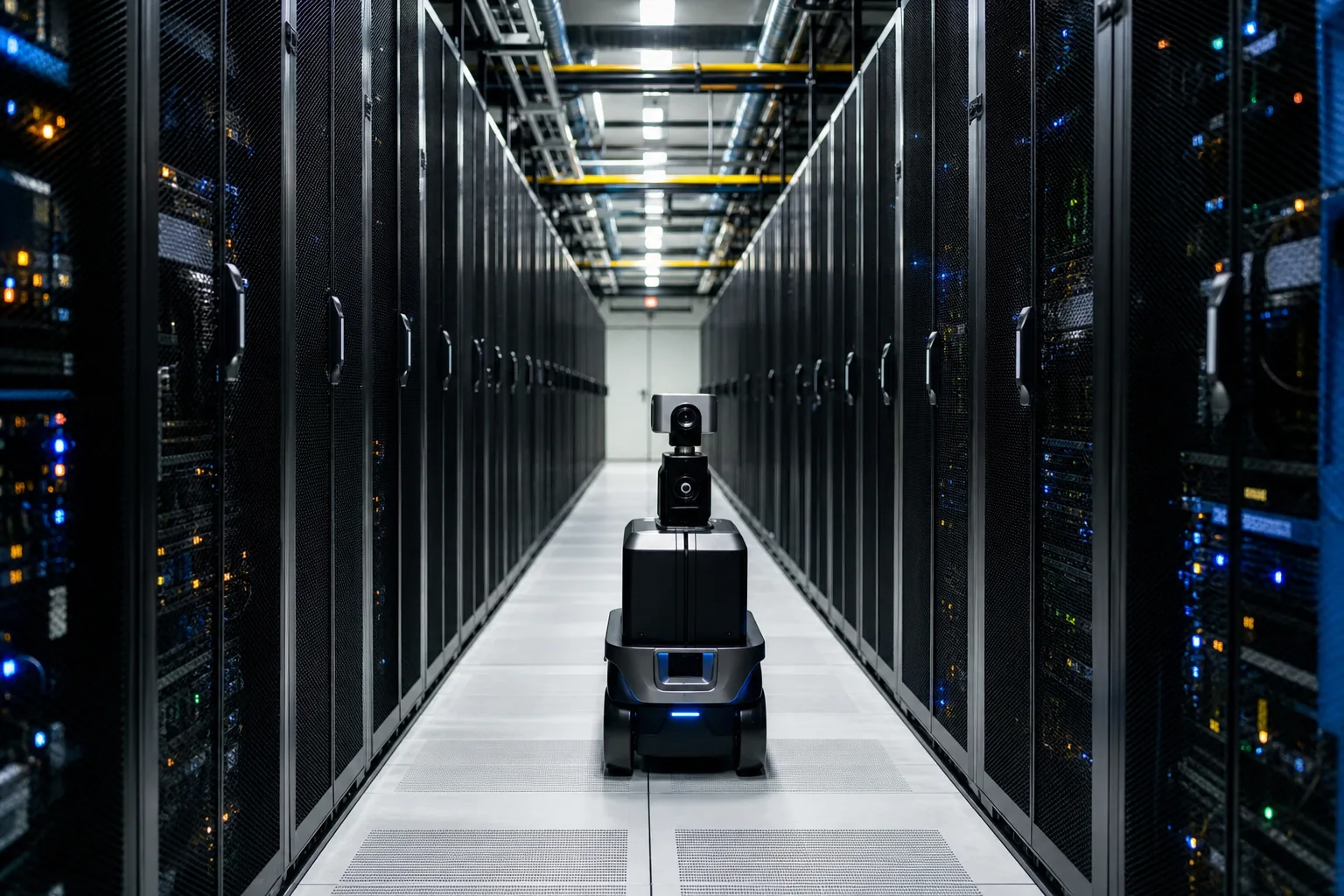
- Data center robotics is projected by DC Market Insights to become a $113.4 billion market by 2035.
- The data center robotics opportunity depends on whether operators can prove meaningful reliability and labor savings at scale.
- AI demand is accelerating construction, power planning, maintenance workloads, and the appetite for automated operations.
- Robots are most useful for repetitive inspection and logistics work, not for replacing experienced infrastructure engineers.
Table of Contents
Data Center Robotics Has a Big Number Attached to It
The data center robotics market could reach US$113.43 billion by 2035, according to a forecast from DC Market Insights. That number is enormous enough to demand a little skepticism. It also points at a very real change underway inside the warehouses that now power cloud computing, streaming, enterprise software, and the AI boom.
For years, a modern data center was sold as a dark, mostly hands-off facility: rows of servers, sophisticated cooling, remote monitoring, and a relatively small crew keeping everything upright. That picture was always slightly romanticized. Somebody still has to walk the floor, inspect equipment, move failed hardware, manage cables, check for hot spots, audit inventory, and respond when an alert turns into a 3 a.m. problem.
AI has made that operational burden heavier. Training and serving large models requires immense clusters of GPUs, dense racks, elaborate networking, and far more power and cooling than the industry was accustomed to planning around. Hyperscalers are racing to build capacity, while colocation providers are trying to squeeze more useful compute out of existing sites. In that environment, the appeal of a machine that can patrol an aisle, read gauges, capture thermal imagery, or ferry equipment between rooms is fairly obvious.
But a market forecast is not a deployment schedule. My read is that the headline figure says more about the expanding definition of automation than about fleets of humanoid robots roaming server halls anytime soon.
What Data Center Robotics Actually Means
When people hear data center robotics, they may picture a humanoid technician unplugging servers with the precision of a surgeon. That is the flashy version, and it is not where most practical spending will land first.
The near-term market is likely to include autonomous mobile robots that map facilities and perform visual inspections; robotic arms for repetitive handling; automated storage and retrieval systems for spare parts; sensors and camera systems tied into facility-management software; and specialized machines that inspect cooling infrastructure or operate in areas people should not enter casually.
Some of this is already familiar industrial automation wearing a data-center badge. A robot that transports replacement drives is not magic. It is an expensive cart with sensors, software, and a safety plan. Yet those seemingly mundane jobs matter when a campus has thousands of racks, tight security rules, and a growing shortage of technicians with both IT and facilities expertise.
Robotic inspection may be the clearest early use case. Cameras, microphones, and thermal sensors can catch visual anomalies, unusual fan noise, leaks, or temperature issues before a technician arrives. The robot does not need to solve every problem. It just needs to give the human on call better information than a vague alert from a dashboard.
That distinction matters. The best data center robotics deployments will probably look less like replacement labor and more like better eyes, hands, and logistics for the people already responsible for uptime.
AI Is Creating the Pressure Behind the Forecast
The forecast arrives as the data-center business confronts a brutally physical AI era. Software has transformed the world, but AI is eating electricity, real estate, transformers, cooling capacity, and very expensive accelerators.
That rush creates two pressures that favor automation. Operators need to stand up new capacity quickly, while increasingly dense hardware must keep running with very little room for error. A failed component in a conventional enterprise server is annoying. A failure in a tightly coupled AI cluster can leave expensive compute capacity sitting idle while teams diagnose the fault.
Electricity use from data centers, AI, and cryptocurrency is rising, driven largely by the expansion of data centers and AI workloads. The broader infrastructure challenge is stark. See the Electricity 2024 report. Robots will not solve the grid constraint, obviously. They may help operators monitor and maintain the machinery around those power-hungry deployments.
There is also a security angle. Data centers are controlled environments for good reason. Fewer routine human trips through sensitive areas can reduce access complexity and make audit trails cleaner. A machine can log where it went, what it scanned, and when it encountered an anomaly. Of course, it also creates a new attack surface. A compromised robot with physical access is a far worse problem than a stuck office Roomba.
The Forecast Needs a Reality Check
DC Market Insights puts the data center robotics market at US$113,432.96 million by 2035. The report’s premise tracks with the growth of hyperscale facilities and AI-driven operations, but forecasts over a decade should be treated as directional rather than prophetic. Market-research estimates often bundle hardware, software, integration work, and adjacent automation products under one growing label. That can make a category appear more mature than the day-to-day buying behavior suggests.
The hard part is integration. Data centers are built around strict procedures, redundant systems, vendor certifications, and an understandable fear of introducing anything unpredictable. A robot needs to work around raised floors, narrow aisles, cables, doors, security controls, people, and equipment from multiple generations. It must not clip a network cable, block an emergency route, or misread a harmless temperature variation as a crisis.
Then comes the economic test. The case for data center robotics gets stronger when a facility is large, repetitive, and short on staff. It is weaker in smaller sites where an experienced technician can handle the work cheaply and respond to unexpected problems with judgment that a machine does not have. This is one reason hyperscalers and giant colocation operators matter so much: they have enough standardized real estate to justify custom workflows and large upfront investments.
Frankly, many facilities will buy more software and sensors before they buy sophisticated physical robots. Predictive maintenance tools, digital twins, automated incident workflows, and machine-vision systems can provide a lot of value without asking operators to trust a mobile machine around high-value hardware. The robotics market may grow rapidly anyway, but the route will be incremental.
The Winners Will Be Boringly Reliable
That is not an insult. In infrastructure, boring is the highest compliment. The vendors that win in data center robotics will be the ones that fit into existing operational systems, work with established equipment, produce useful logs, and fail safely. A dazzling demo is nice. A machine that completes the same inspection route every night for three years without becoming another ticket in the maintenance queue is much nicer.
There is a temptation to frame every AI-related infrastructure investment as a land grab. Sometimes it is. But this particular market will be decided by plain operational questions: Does the robot reduce truck rolls? Can it spot faults earlier? Does it let a smaller team operate a larger site without compromising uptime? Can it be serviced without calling three vendors and a lawyer?
If the answer becomes yes at hyperscale volumes, the US$113 billion projection will look less audacious. If not, data center robotics may remain a compelling category on presentation slides while human operators keep doing the difficult parts. The coming test is not whether robots can enter the server room. It is whether data-center owners trust them when the server room is where every minute of downtime has a price.