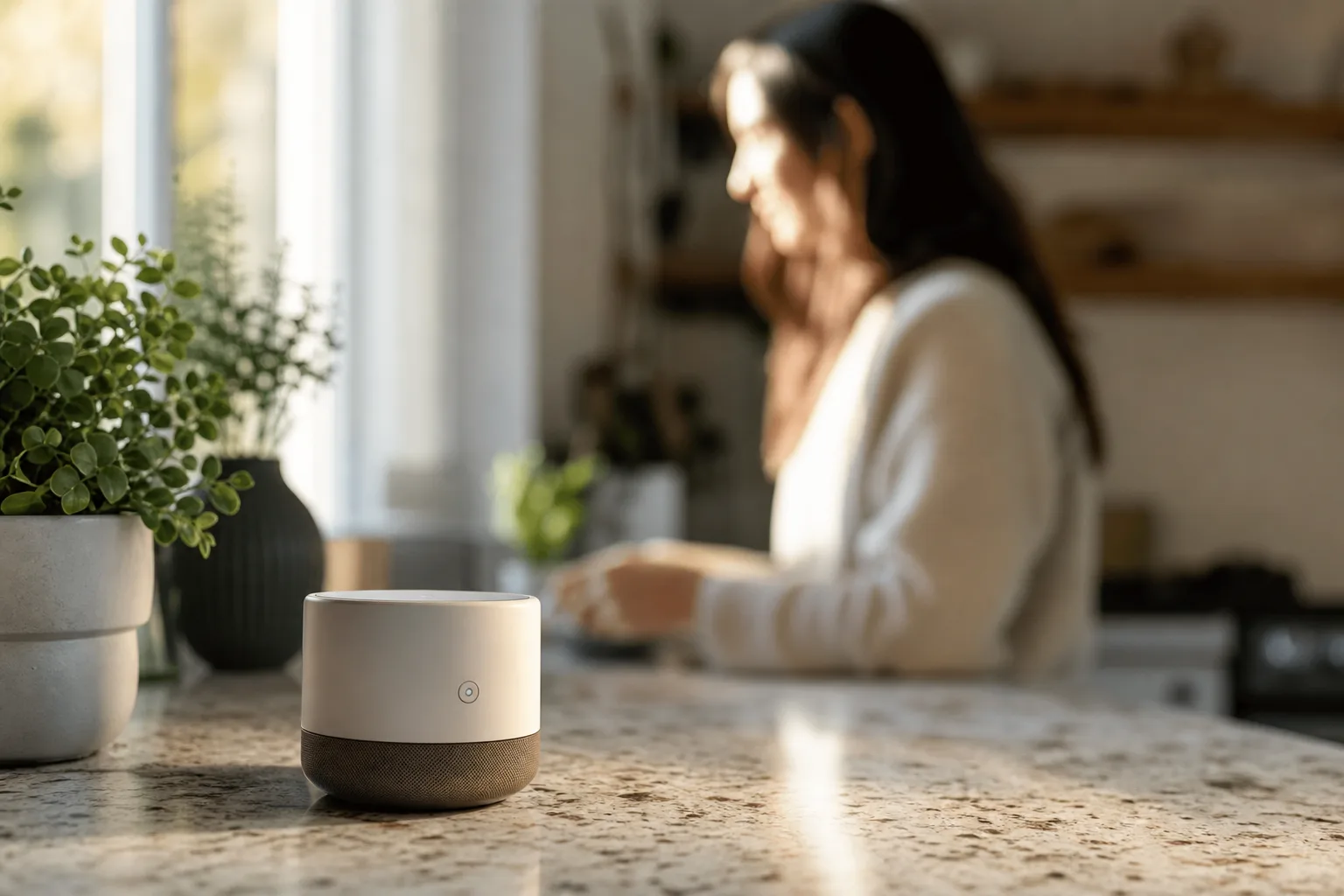
OpenAI has spent years putting ChatGPT inside everyone else’s devices. Now it reportedly wants to put ChatGPT on the kitchen counter. The OpenAI AI speaker said to be in development sounds less like another Alexa clone and more like Sam Altman’s long-running attempt to make AI feel like a presence in the room.
According to Bloomberg reporting, OpenAI’s first consumer hardware product could be a portable, screenless speaker with a rechargeable battery, cameras, environmental sensors, and a more conversational version of its voice technology. It would play music, control connected home gear, answer questions, manage messages, and draw on the wider ChatGPT service.
On paper, that’s a familiar feature list. Amazon, Google, Apple, and Sonos have all sold some version of the connected speaker. The difference is the ambition: OpenAI reportedly wants this object to become proactive, personal, and, in a very deliberate sense, alive.

- The OpenAI AI speaker is reportedly a portable, screen-free ChatGPT companion built to manage media, messages, and smart-home tasks.
- OpenAI wants its AI speaker to feel more personal through cameras, sensors, proactive suggestions, and reportedly moving mechanical components.
- Apple’s trade-secrets lawsuit could complicate OpenAI’s reported plan to unveil the device this year and ship it in 2027.
- The speaker reportedly begins a wider hardware effort that may also include a phone alternative, wearable pendant, and home robots.
Table of Contents
Why the OpenAI AI speaker is aiming beyond Alexa
The smart-speaker market is littered with evidence that voice control alone is not enough. People use Alexa to set timers, check the weather, and turn off lamps; they generally do not treat it as a trusted household confidant. Google Assistant was more capable in spots, yet Google steadily pulled back from the expensive consumer-assistant race. Apple’s Siri, meanwhile, has been famously uneven despite the company owning the premium hardware audience.
The reported OpenAI AI speaker pitch stands apart because ChatGPT is already built to sustain a conversation, retain preferences when memory is enabled, and generate answers rather than retrieve one narrow command. OpenAI recently introduced GPT-4o voice capabilities designed for more natural back-and-forth exchange. Bloomberg says the device would use an expanded voice system called GPT-Live, allowing it to listen and speak at the same time.
That last detail matters. Traditional assistants make conversation feel like using a walkie-talkie: speak, wait, hear a response, repeat. An assistant that can recognize interruption, hesitation, and changing context may feel considerably less mechanical. It may also feel more intrusive. Those are two sides of the same coin.
OpenAI is reportedly describing the product internally as a new kind of home computer for the AI era. I’d argue that phrase reveals the real strategy. The company is not chasing speaker revenue. It is trying to own the interface between a household and an AI service, the same way the smartphone became the interface between people and the internet.

The OpenAI AI speaker has a privacy problem to solve
An OpenAI AI speaker equipped with cameras that moves from room to room raises obvious questions before anyone gets to the fun part. OpenAI reportedly wants the product to understand its surroundings and access highly personal information, potentially including email. That could make it genuinely useful: a device that notices you are heading out and reminds you about an unanswered message may save time. It could also turn a speaker into a surveillance appliance with a charming voice.
Consumers have seen this movie before. Amazon faced intense criticism over Ring’s relationships with police departments and over how voice recordings were handled. Google and Amazon have both had to explain human review of assistant recordings. The lesson is plain: people might accept always-available AI, but only if companies make the boundaries legible.
For an OpenAI AI speaker, those boundaries should be physical as well as legal. A real camera shutter, an unmistakable microphone mute switch, clear local indicators, and granular controls over what data leaves the home would be table stakes. A vague privacy dashboard buried in an app won’t cut it. Frankly, if OpenAI wants users to let this thing see their living rooms, it needs to make privacy controls as easy to understand as a light switch.
There is also the emotional design. Bloomberg reports that the device may include moving parts intended to make it appear more lifelike. That is a fascinating choice, and perhaps a risky one. The industry has learned that people readily project intention and empathy onto chatbots, particularly when those bots flatter them or act emotionally dependent. OpenAI itself had to roll back a version of GPT-4o after users found its behavior excessively agreeable.
A speaker that swivels, reacts, remembers, and volunteers advice could be delightful. It could also encourage users to mistake product behavior for care. The distinction sounds academic until a lonely user is discussing health, money, or a family crisis with an always-on machine.
Apple could turn a product launch into a courtroom fight
The reported 2027 release target may be shaped as much by legal calendars as engineering work. Apple has sued OpenAI over alleged theft of trade secrets tied in part to Tang Tan, OpenAI’s chief hardware officer and an io Products co-founder. Tan previously ran iPhone product design at Apple.
Apple alleges that Tan coordinated efforts to obtain confidential material about future Apple products, including claims involving a former iPhone engineer’s access to internal systems. Apple has described OpenAI’s hardware effort as “rotten at the core.” OpenAI disputes the allegations and says its product plans are distinct from Apple’s work. As with most trade-secrets cases, the public accusations are only the opening act; discovery is where documents, timelines, and testimony start to matter.
Apple is seeking an injunction, which is why this is more than corporate mudslinging. An injunction could delay an OpenAI AI speaker even if the underlying case takes years to resolve. OpenAI has plenty of cash and public momentum, but hardware schedules are brittle. Supply chains, component sourcing, certification, industrial design, and retail planning all dislike uncertainty.
A speaker may only be the first OpenAI hardware experiment
Bloomberg reports that OpenAI’s hardware group has roughly five projects underway, including a portable device intended as a phone replacement, a wearable pendant, and home robotics. That breadth suggests the OpenAI AI speaker is a beachhead rather than a one-off gadget.
The company’s advantage is clear: ChatGPT has a huge installed audience and a recognizable personality, for better and worse. Its weakness is equally clear: hardware is unforgiving. Humane’s Ai Pin became a cautionary tale because voice-first ambition collided with price, latency, battery limits, and a very basic question: why not use a phone? Remember when Google killed Stadia? Great cloud technology did not compensate for a product that never found enough everyday believers.
OpenAI has to answer that same practical question. If the OpenAI AI speaker mainly tells jokes, controls lights, and reads calendar entries, a phone or existing smart display will do. If it can reliably handle the messy, contextual work of home life without acting creepy, pushy, or wrong, it could become the first AI gadget people keep around after the novelty fades.
My read is that the reported OpenAI AI speaker is less a bet on audio hardware than a bet that people are ready to invite an AI relationship into physical space. That is a much bigger ask than downloading an app. We will see whether OpenAI can make the object useful enough to earn that invitation.