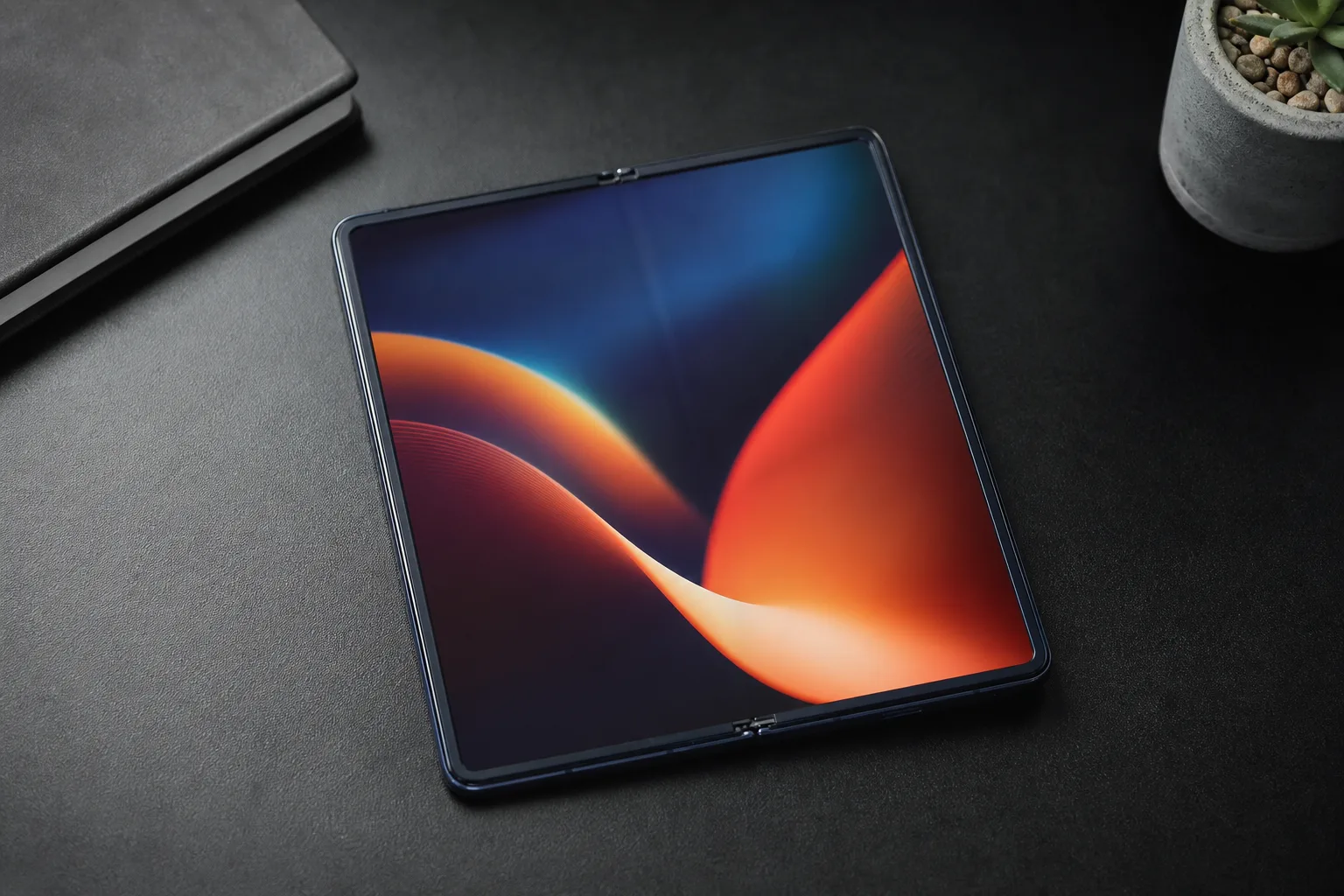
- Samsung Flex Titanium uses a thin titanium-alloy film and a perforated metal support plate beneath the OLED panel.
- Samsung Flex Titanium could make the Galaxy Z Fold 8’s central display crease far less visible and tangible.
- Samsung is targeting a difficult balance: a flatter screen, repeatable folding motion, thin hardware, and long-term display durability.
- The technology matters because foldables still need to feel less like fragile experiments and more like ordinary flagship phones.
Table of Contents
Samsung Flex Titanium targets foldables’ most obvious flaw
Every foldable-phone maker has spent years trying to make us ignore the crease. Samsung Flex Titanium is Samsung Display’s latest attempt to do the opposite: reduce that crease enough that buyers may finally stop thinking about it every time they scroll through a bright webpage. Ahead of Samsung’s July 22 Unpacked event, the company has outlined the display-stack technology expected to arrive in its next crop of foldables, including the widely anticipated Galaxy Z Fold 8 and Galaxy Z Flip 8.
Samsung’s pitch is fairly straightforward, though the engineering underneath it is not. The company is placing an extremely thin titanium-alloy foil directly beneath the OLED display, then pairing it with a titanium support plate below. At the fold, that plate uses a pattern of microscopic holes, allowing the assembly to bend where it needs to bend while remaining stiff across the rest of the screen.
The stated goal is a display that looks flatter, feels firmer under a finger, and holds up over years of opening and closing. In practical terms, Samsung Flex Titanium is meant to make the inner screen feel less like a delicate flexible panel and more like a conventional premium display. That last bit is the part that matters. A foldable can survive a showroom demo with a nearly invisible crease; the real test is whether it still looks composed after thousands of folds, a summer in a pocket, and the occasional accidental squeeze in a bag.
Samsung says the titanium foil is about one-third the diameter of a human hair. That’s a useful mental image, even if it doesn’t tell us everything about its mechanical properties. Thin materials are often the cleverest parts of modern electronics: invisible, fussy to manufacture, and doing the unglamorous structural work that lets the visible hardware look effortless.
Why Samsung Flex Titanium takes a different route
Previous foldable display designs have leaned heavily on polymer layers and carefully shaped hinges to spread stress around the bend. Those approaches have improved steadily, but they come with compromises. Polymers can be flexible and light, yet they do not provide the same rigidity as metal. Add too much support, meanwhile, and the device gets thicker or the panel becomes harder to fold.
Samsung Flex Titanium appears designed to split the difference. The alloy foil gives the display a more stable foundation without taking up much vertical space, while the micro-perforated titanium plate acts like a reinforced bridge with a deliberate weak point exactly where it has to flex. Think of a hardcover book spine engineered to bend at one narrow line without making the covers feel floppy. That’s broadly the job here.
Samsung claims the patterned support structure can remain tightly attached to the display while preserving folding flexibility. If that bond is as secure as the company suggests, it could help limit one of the less visible but more worrying foldable problems: layers gradually separating, deforming, or developing an uneven feel after repeated stress.
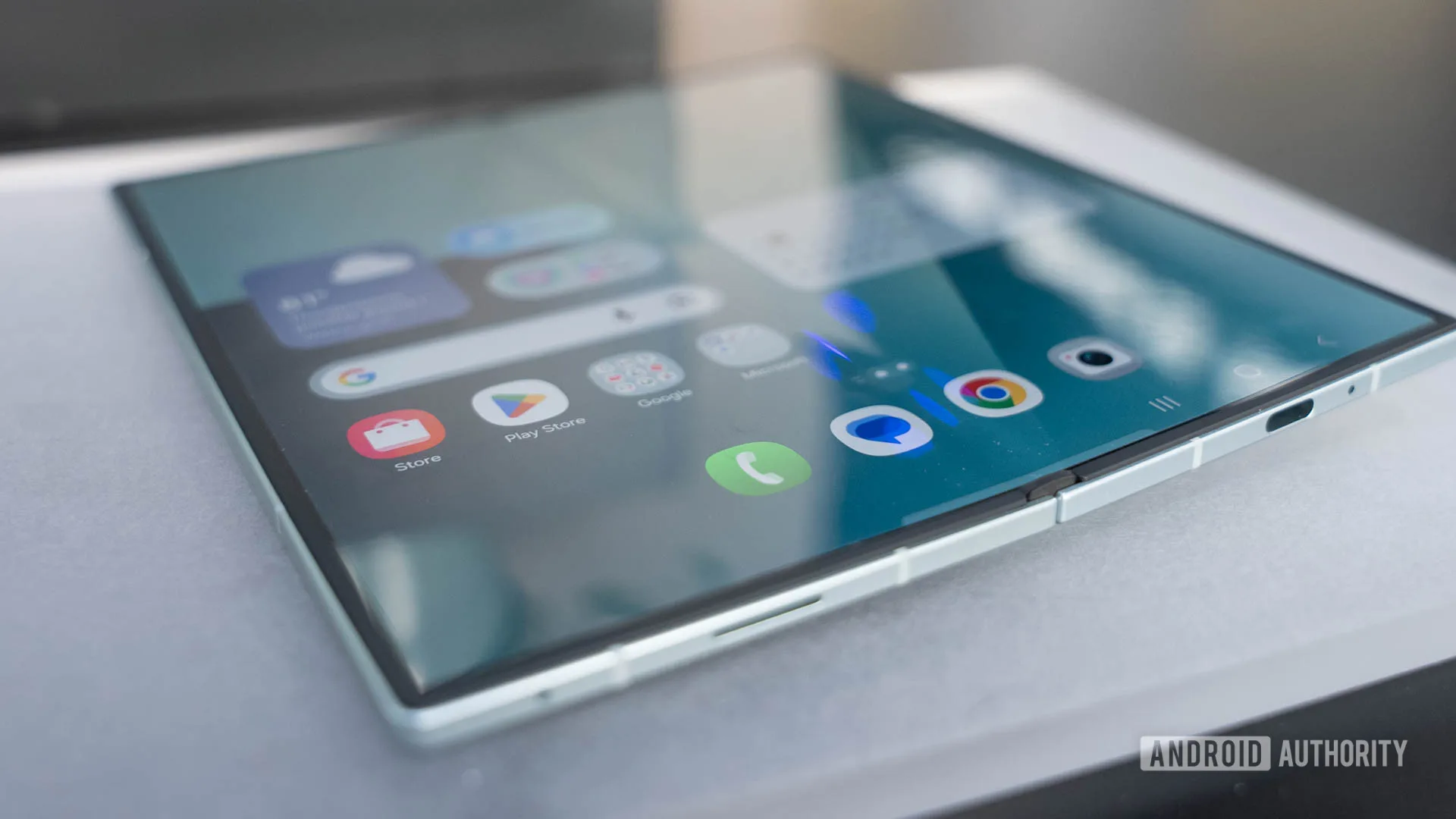
The image of a current Galaxy Z Fold model laid flat makes the commercial problem plain. Even after years of refinement, a crease is still easiest to spot on a dark or reflective screen and easiest to feel when your thumb crosses the center. It doesn’t make today’s Fold unusable—far from it—but it is a persistent reminder that you bought a device with a mechanical compromise.
There is a small irony in Samsung’s titanium push. Apple helped turn titanium into a mainstream phone-marketing material with the iPhone 15 Pro, largely framing it around weight, strength, and premium feel. Samsung is using titanium in a far less visible place. My read is that this is more meaningful. A titanium frame is nice; a material choice that addresses a foldable’s defining weakness is potentially much more valuable.
A flatter crease is not the same as no crease
Samsung and its rivals need to be precise here. The industry has used terms such as “crease-free” and “creaseless” rather loosely, and buyers should read them as shorthand for “substantially reduced.” A foldable OLED panel still needs a physical radius to close, and the hinge still has to direct the panel into that bend. Physics has not signed off on a truly flat folding sheet of glass.
Perception matters. A crease that catches overhead light, produces a visible valley in white backgrounds, or feels like a speed bump while reading is very different from one you only notice when actively hunting for it. Oppo, Honor, and Huawei have all made progress with broad water-drop hinge designs and redesigned display support layers. Samsung, which effectively created the modern global foldable category, has sometimes looked more conservative than those competitors on crease visibility.
Samsung Flex Titanium is a materials announcement with a larger point behind it: Samsung is acknowledging that the visual and tactile quality of the inner display remains central to the category’s credibility. Consumers have accepted folding phones with better hinges, slimmer bodies, and larger cover screens. But when they spend flagship money, they understandably expect the main display to feel close to a conventional premium phone.
Samsung describes the new construction as a way to meet design, quality, and endurance targets without forcing a compromise between thinness and stability.
That is an ambitious claim, and we’ll need hands-on time and longer-term testing to judge it. Samsung has not yet published durability-cycle figures, crease-depth measurements, or repair-cost details specific to Samsung Flex Titanium. Those will be more useful than marketing language. A less visible crease is good. A panel that resists dents and keeps its shape after two years is better.
The Galaxy Z Fold 8 is where this has to prove itself
The timing is no accident. The next Galaxy Z Fold is expected to arrive in a market that has become less forgiving. Foldables are no longer novelty gadgets shown off in airport lounges. They are expensive productivity phones competing with giant slab handsets, tablets, and increasingly polished foldables from Chinese brands. Samsung needs an answer that users can see immediately, not only one that looks impressive in a component cross-section.
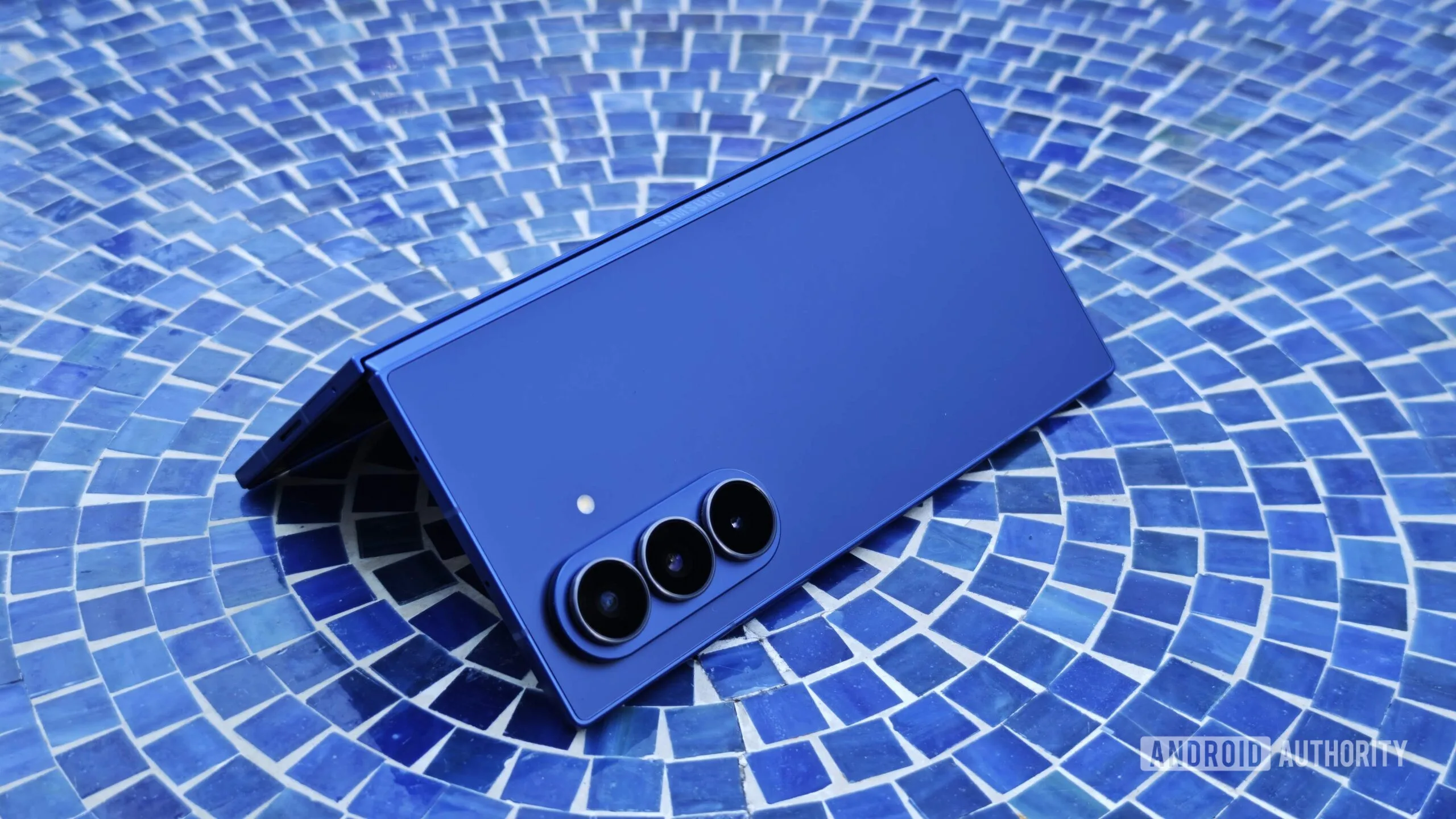
A Fold device propped in tent mode captures why Samsung keeps chasing this category. It can be a compact phone, a small tablet, a video stand, and a two-app work machine in one piece of hardware. But all of those use cases depend on people trusting the moving display at the center of it. If the panel seems delicate, the whole proposition starts to feel like buying a very expensive Swiss Army knife with a loose hinge.
Samsung’s display arm has been working on flexible OLED technology for years, and its public materials offer a broader look at that research through the company’s OLED technology pages. Flex Titanium looks like one of the more practical outcomes of that work: not a flashy new screen shape, but a structural change aimed at making an existing idea less compromised.
Frankly, that’s the right priority. The Fold 8 and Flip 8 do not need another gimmick nearly as much as they need their screens to feel normal when opened. If Samsung Flex Titanium delivers on that promise without adding bulk, hurting battery space, or creating a new repair headache, Samsung may have found the upgrade that makes its foldables easier to recommend. If it doesn’t, the crease will remain the tiny line that keeps the category from fully growing up.