

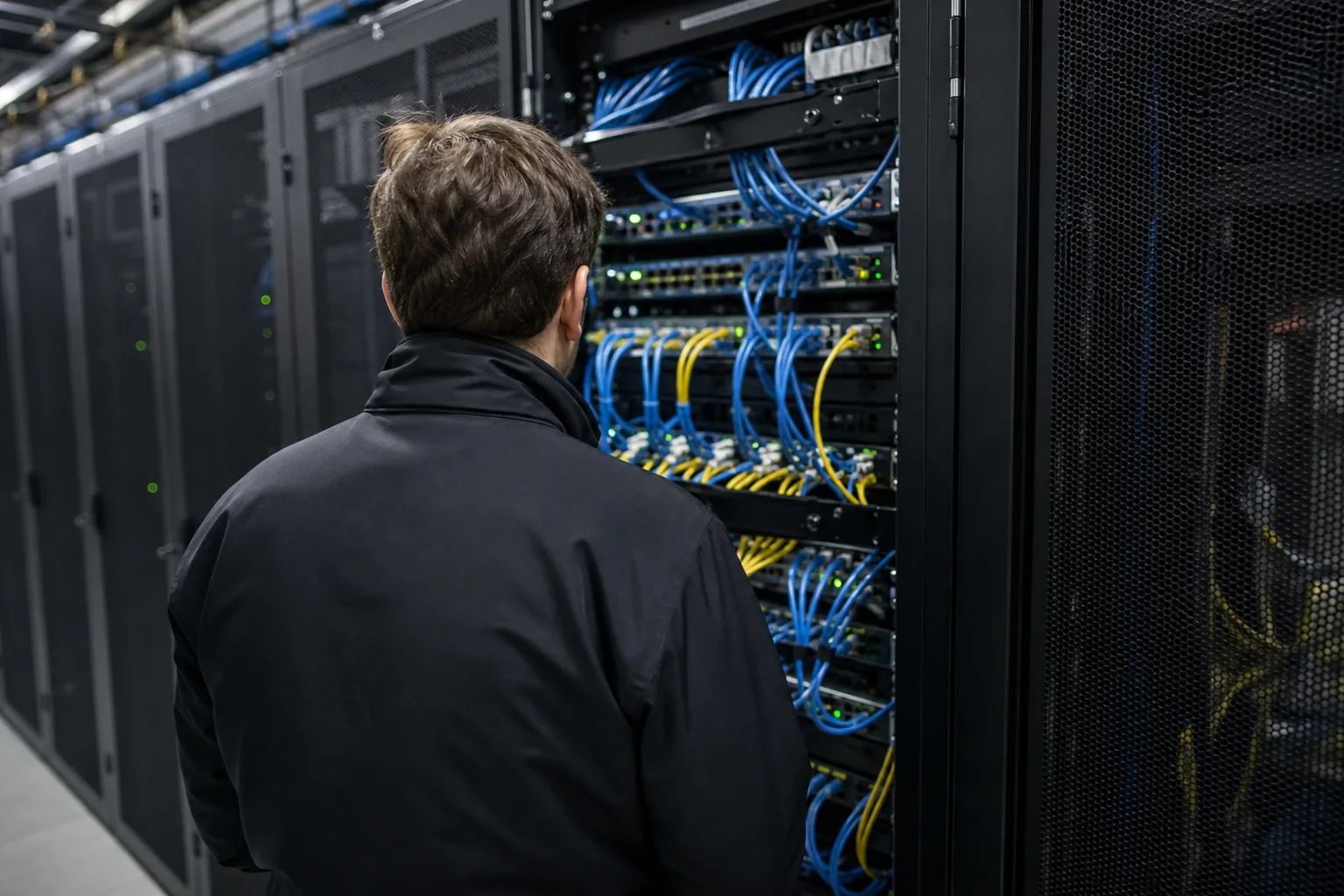
- Nokia AI data center demand gives the Finnish networking supplier a promising growth lane beyond its pressured mobile-networking business.
- The Nokia AI data center opportunity rests on hyperscalers and cloud builders continuing to expand capacity for training and inference workloads.
- Optical transport and high-speed Ethernet are becoming strategically important because AI clusters move far more bandwidth between servers.
- Nokia still has to prove it can turn favorable AI spending into durable market-share gains against entrenched networking rivals.
Table of Contents
Nokia AI data center demand is giving an old network name a new opening
For years, Nokia’s story has been tied to the slow, bruising economics of telecom equipment: carriers spend lavishly for a rollout, then pull back hard when the upgrade cycle ends. The Nokia AI data center opportunity offers something much more attractive: customers that are in a race to build capacity and cannot afford their networks to become the weak link.
That distinction matters. AI spending has often been discussed as a chip story, with Nvidia at the center and everyone else circling the bonfire. But an AI cluster is not a pile of GPUs with a power cable attached. It is a tightly connected system of compute, storage, optical links, switches, routers, cooling, and software. If data cannot move quickly between accelerators, those wildly expensive processors sit around like taxis stuck in traffic.
Nokia is positioning itself for that less glamorous, but very real, infrastructure layer. The company’s optical-networking and IP-networking operations stand to benefit as cloud providers, colocation operators, and large enterprises add AI capacity. The Wall Street Journal recently highlighted Nokia’s continued exposure to the surge in AI and data-center investment, and the broader logic is hard to dispute: every new mega-cluster needs an awful lot of networking.
For the Nokia AI data center strategy, that network build-out is the central commercial opportunity.
Frankly, this may be the clearest growth argument Nokia has had in some time.
Why Nokia AI data center infrastructure matters now
Modern AI systems generate punishing amounts of so-called east-west traffic: data moving laterally among servers inside a facility. Training a large language model requires many accelerators to share updates constantly. Inference, where a model answers user requests, brings a different traffic pattern but can become equally demanding at scale. A network that was adequate for ordinary cloud applications may not be adequate when thousands of GPUs need to operate in lockstep.
This is where high-speed Ethernet, routing, and optical transport become more than back-office plumbing. Network capacity determines how efficiently an operator can use compute hardware that may cost tens of thousands of dollars per accelerator. Even small delays add up at that scale.
Nokia has spent years building this portfolio through internal development and acquisitions. Its optical business sells gear designed to push enormous volumes of traffic across metro, regional, and long-haul networks, while its IP Networks unit offers routers and data-center switching products. The company has also pushed its event-driven network operating system, SR Linux, as an option for cloud-style operators that want more automation and flexibility than traditional proprietary network stacks allowed.
The technical argument for the Nokia AI data center push, then, is straightforward. AI workloads require more connections, faster connections, and better control over those connections. Nokia already makes products in those categories.
Its challenge is commercial. Having the right tools and becoming the default supplier are two very different things.
The competition is fierce, and incumbency still counts
Nvidia has expanded well beyond GPUs with its InfiniBand and Ethernet networking platforms. Arista Networks has become a major beneficiary of cloud and AI data-center build-outs. Cisco remains deeply embedded in corporate and service-provider networking. Ciena is a formidable optical competitor. Then there are specialist vendors, white-box hardware makers, and the in-house networking teams at the hyperscalers themselves.
That is a crowded room.
Nokia’s potential advantage is that it can sell across several layers of the network, especially where a customer needs to connect data centers to one another as well as connect machines inside them. Cloud providers increasingly build campuses spread across multiple buildings and regions, and AI’s appetite for compute can turn those interconnections into a strategic constraint. Nokia’s data-center networking portfolio is aimed squarely at that problem.
Still, buyers in this market are demanding. Hyperscalers typically have extensive engineering resources, exacting performance requirements, and enough purchasing power to squeeze suppliers on price. They also hate vendor lock-in. Nokia cannot rely on a famous telecom brand name; the Nokia AI data center effort needs clean product execution, credible software support, and reference customers willing to validate that its gear performs at the scale claimed.
My read is that the Nokia AI data center narrative has more credibility in optical transport and inter-data-center networking than in an assumption that Nokia will suddenly displace every established switch vendor inside hyperscale facilities. That would be a much harder claim to support.
A welcome hedge against the telecom cycle
Nokia’s mobile-networking business remains important, but the sector has been under pressure as operators digest earlier 5G investments. The hoped-for revenue bonanza from 5G has not arrived in the form equipment suppliers once imagined. Consumers got faster phones; carriers got a capital-intensive upgrade and a familiar struggle to charge more for service. It is an old industry joke with a painful amount of truth.
Data centers are not immune to cycles, of course. AI investment could cool, electricity constraints could delay construction, and investors may eventually demand that cloud companies show more direct returns from their giant capital budgets. We have seen this movie before with telecom build-outs, and nobody should assume every announced AI campus becomes a profitable, fully equipped facility on schedule.
But the spending backdrop is materially different today. Major cloud companies are competing not merely for more web traffic, but for AI capacity that can be sold to enterprise customers and used in their own products. That makes network investment a competitive necessity, not a speculative side project. The Nokia AI data center business can benefit even when its products represent a comparatively small slice of a total facility budget.
The real test is whether AI demand becomes repeatable revenue
Nokia’s investors should resist the temptation to treat every AI reference as proof of a permanent turnaround. Technology suppliers love attaching themselves to the biggest spending trend of the moment; remember when virtually every enterprise vendor suddenly had a metaverse strategy? The meaningful question is whether the company can establish recurring design wins, broaden its cloud customer base, and protect margins while competing for enormous accounts.
There are encouraging ingredients. The Nokia AI data center opportunity plays to assets the company already owns, rather than asking it to invent a consumer hit or gamble on an unproven platform. It also gives Nokia a path toward customers whose spending decisions are less tied to the sluggish upgrade schedules of mobile carriers.
If AI infrastructure spending holds up, Nokia has a legitimate chance to become a more relevant player in the network beneath the AI boom. But the prize will go to suppliers that make data move reliably at brutal scale, not the ones with the loudest AI slide in their investor deck. Nokia now has to show which camp it belongs in.
Frequently Asked Questions
What does Nokia AI data center business include?
Nokia sells the networking infrastructure that moves data within and between large computing facilities, including optical transport systems, routing equipment, and data-center switches. AI workloads create demand for more bandwidth and lower latency because enormous groups of servers must exchange data continuously.
Why do AI data centers need different networking equipment?
AI training clusters link thousands of accelerators that work on the same model at once. That produces intense east-west traffic between servers, rather than conventional traffic flowing mainly between users and applications. Network bottlenecks can leave expensive GPUs waiting, so operators are spending heavily on faster links.
Can Nokia AI data center growth offset weak telecom spending?
It can help, but it is unlikely to be a simple replacement for a global mobile-networking downturn. Telecom operators remain a major customer base, and their capital spending is cyclical. Nokia needs AI and cloud customers to become a sustained, material revenue source rather than a welcome but uneven supplement.

