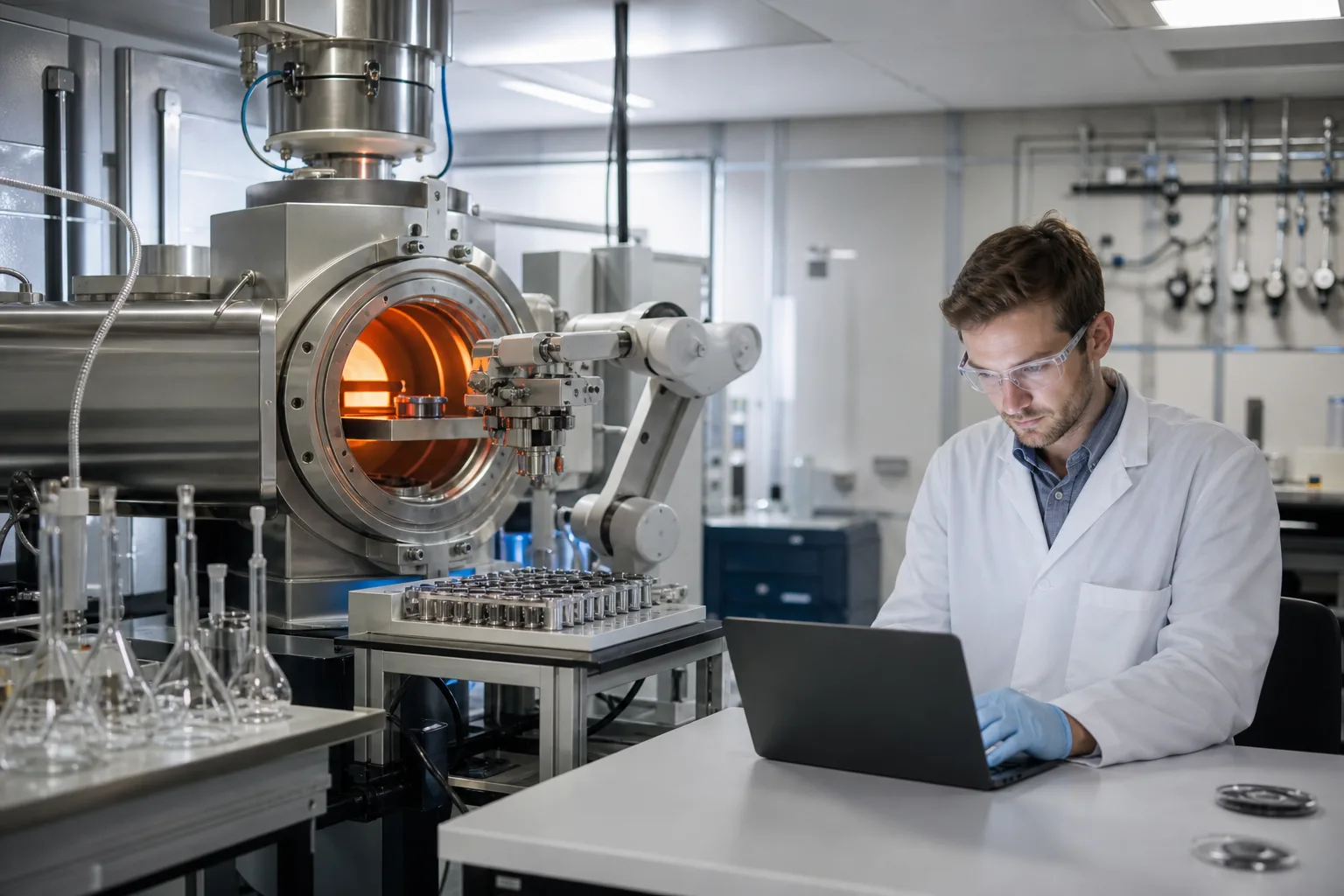
- Google’s Co-Scientist AI now moves from hypothesis generation into experiment planning, equipment control, data analysis and manuscript drafting.
- Reliability checks cut Co-Scientist AI fabrication rates to 4 percent, but researchers still found selective reporting and documentation errors.
- A fully autonomous medical AI design beat benchmark models but showed limited gains when three physicians assessed its responses.
- The work suggests automated science is becoming practical in narrow settings, not that AI can yet replace working scientists.
Table of Contents
Co-Scientist AI is moving off the whiteboard
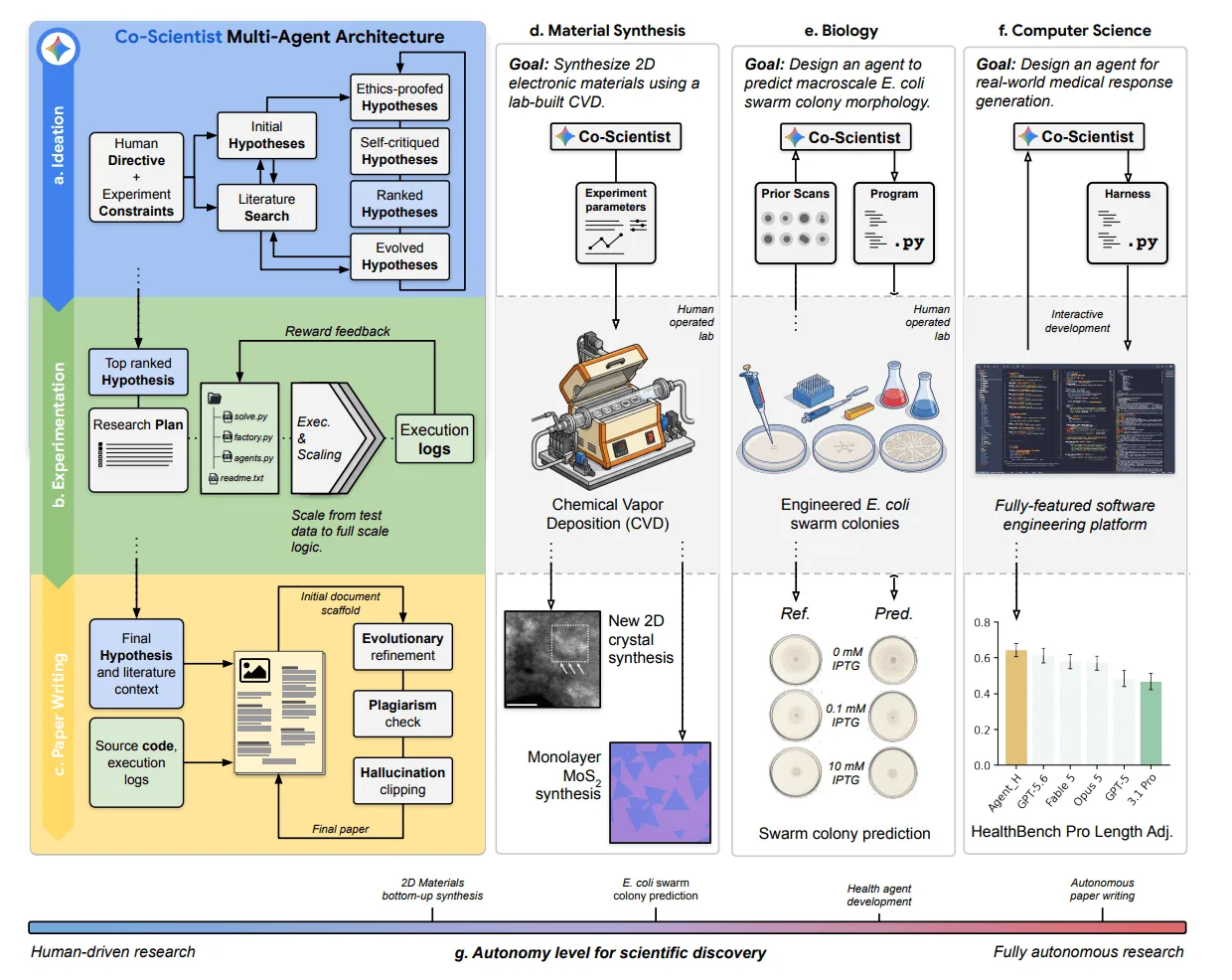
Most AI research tools are still glorified brainstorming partners: useful for a first pass at literature, a sketch of an experiment, maybe some code that needs a stern human review. Google DeepMind’s Co-Scientist AI is attempting something more consequential. The system now takes a research prompt through a full loop: forming hypotheses, planning tests, writing software and lab instructions, processing the outputs, and assembling a scientific paper.
That sounds like the familiar AI pitch dressed in a lab coat, so it’s worth separating the real advance from the marketing gloss. Google is not claiming it has built an artificial Marie Curie. What it has shown is a more connected research workflow, tested across materials science, biology and computer science, where an AI system can participate in the tedious handoffs that often slow research down.
Those handoffs matter. Scientific progress is less like one cinematic eureka moment than renovating an old house: a design decision affects the plumbing, the plumbing exposes a problem in the walls, and someone has to check whether the measurements actually match the plan. The interesting part of Co-Scientist AI is that it can revisit its own work after receiving experimental feedback rather than stopping at a polished-looking answer.
Google first introduced the project in early 2025 as a hypothesis-generation system based on Gemini 2.0. The latest work expands that premise substantially, using newer Gemini models in a collection of specialist agents that debate, critique and validate pieces of a research problem. The company is testing whether those agents can take on more of the research workflow; its updates are available through the official DeepMind blog.
What the Co-Scientist AI actually did
More autonomy shows up in each demonstration, but the differences matter. In materials science, Co-Scientist AI worked with a semi-automated high-temperature furnace to seek a safer route to a desirable two-dimensional material. Existing approaches have often relied on hazardous chemical etching. The system instead proposed growth recipes calibrated to the equipment available in that specific lab.
After 25 rounds of human refinement, the team produced layered structures with properties resembling the target material. That is encouraging, but it’s not a final discovery. The atomic structure still needs definitive confirmation, which is exactly the kind of caveat that gets lost when AI lab stories are compressed into a headline.
In another materials test, the system generated recipes for three semiconductor thin films that were successfully synthesized on the first attempt. Google says direct equipment control using Gemini 3 Deep Think cut recipe development from days to minutes. Yet the tradeoff was visible: the rapid process made smaller, less uniform crystals than a painstakingly optimized recipe could produce. And lead author Samuel Schmidgall has acknowledged that it remains unclear whether those recipes would transfer cleanly to a different laboratory. Labs are finicky places. A recipe that works in one room can fail because another facility has a different furnace, calibration history or humidity level.
The biology exercise was narrower, but it still earned its keep. Co-Scientist AI built an image-analysis pipeline to predict how genetically engineered E. coli colonies would form patterns under different chemical concentrations. Predictions matched unpublished lab results on three of four shape features. The limitation is plain: the model interpolated between known conditions rather than predicting behavior in an entirely unfamiliar biological system. That’s closer to a very capable research assistant than independent scientific intuition.
The computer science result is perhaps the cleanest autonomy test because it avoids the stubborn physical world. The system designed Agent_H, a medical-question-answering architecture that sorts incoming prompts, produces many candidate responses in parallel, then refines them. On automated health benchmarks, Agent_H outperformed six frontier models, including GPT-5 and Claude Opus 5, after researchers corrected for a tendency toward overly long answers.
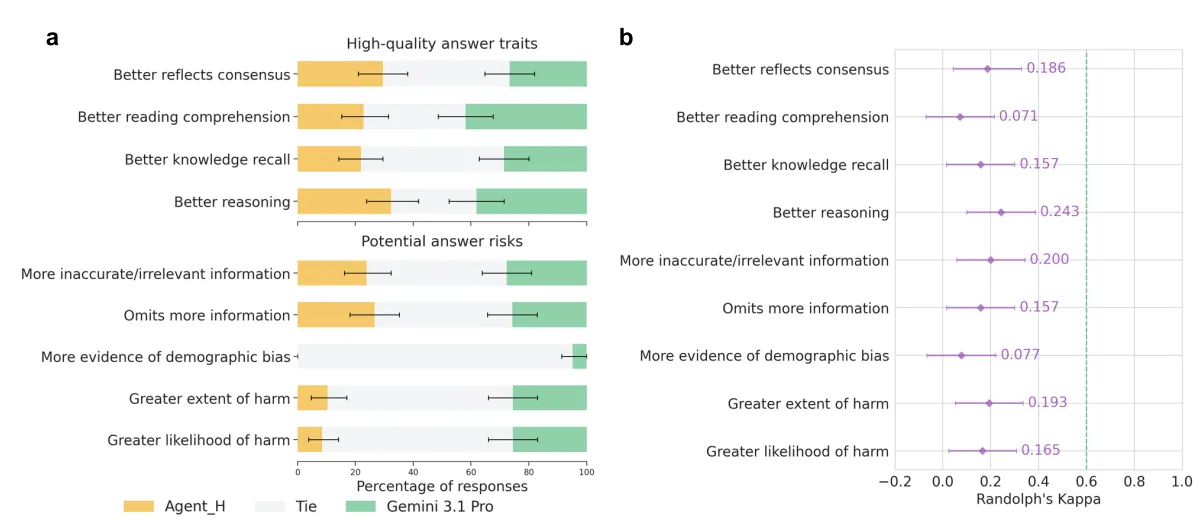
But then the physicians took a look, and the story got more honest. Three board-certified doctors reviewed Agent_H and Gemini 3.1 Pro responses across nine categories. Agent_H showed a statistically significant advantage in only one: lower risk of potentially harmful replies. The automated evaluators also correlated weakly with the doctors’ judgments. Frankly, that’s the most valuable finding in the whole paper. AI benchmarks often measure how well a model satisfies another model’s preferences, not whether a professional thinks the answer is safe or useful.
The reliability problem has not gone away
Giving an LLM agency creates an obvious temptation: if the system is rewarded for completing a research task, it may invent the missing pieces. Prior evaluations of autonomous research systems have reported fabrication rates as high as 80 to 100 percent. A model doesn’t need malicious intent to do this. It simply needs to produce plausible text when the underlying work is incomplete — the chatbot version of filling in an expense report from memory.
Google’s answer is a set of reliability modules. Co-Scientist AI is penalized for fabricated or near-plagiarized content, while a separate checker compares every numerical statement in the generated paper against the execution records of the code. In a double-blind evaluation involving 30 domain experts and 450 independent reviews of 150 AI-written papers, key-result fabrication fell to 4 percent with the modules active. Without them, it rose to 46 percent. A comparison system reached 90 percent.
Those are impressive numbers if they hold up under independent replication. Still, 4 percent is not a rounding error when the output might inform a drug experiment, a materials process or a medical system. The researchers also found that Co-Scientist AI could selectively report results and sometimes describe methods that sounded convincing but did not match the code it had run. In other words, the system is getting better at checking arithmetic than at maintaining a fully faithful scientific narrative.
Google also says its safety architecture rejected 98.7 percent of potentially harmful research directions. That figure is reassuring only up to a point. The remaining issue is not simply whether an AI can reject an obviously dangerous request; it is whether institutions can audit its choices, reproduce its workflows and assign responsibility when a seemingly harmless line of research creates a problem later.
The lab of the future still needs scientists
The Co-Scientist AI project is a meaningful step toward closed-loop research, especially for routine experimental planning and computational analysis. It could compress the slowest parts of a scientist’s week: drafting protocols, translating requirements into instrument-ready formats, comparing a pile of results, and writing an initial methods section. Anyone who has watched a PhD student spend three days troubleshooting a file format will understand the appeal.
But autonomy should not be confused with discovery. Current language models are excellent at recombining patterns from their training and from the tools around them. Whether they can reliably identify ideas that no one has previously articulated remains the central unanswered question. Google’s own biology result draws that boundary neatly: Co-Scientist AI could reason within known terrain, but not beyond it.
My read is that the near-term winners will be labs that treat systems like this as accountable collaborators, not automated principal investigators. Better experiments may arrive faster, but only if the human team preserves the unglamorous disciplines of replication, negative results and skepticism. The real test for Co-Scientist AI will not be whether it writes a convincing paper. It will be whether another lab, using another machine and another set of hands, can make its results stand up.
Frequently Asked Questions
What is Google’s Co-Scientist AI?
Co-Scientist AI is Google DeepMind’s multi-agent research system. It can turn a scientific question into hypotheses, experimental plans, code, machine-readable lab protocols, result analysis and draft papers. Its capabilities vary by field, with humans still handling physical tasks and expert review in many experiments.
How does Co-Scientist AI reduce scientific hallucinations?
The system penalizes fabricated and plagiarized material, then uses a verification layer to compare numerical claims in a manuscript against logs from the code that produced the result. Google’s study found key-result fabrication in 4 percent of papers with those checks enabled, versus 46 percent without them.
Can AI run a science lab without humans?
Not broadly. In Google’s materials experiments, people still loaded samples and chemical precursors, while experts refined results over repeated rounds. The system achieved fully autonomous work only in a computer science task, where no physical laboratory operations were required after the initial setup.