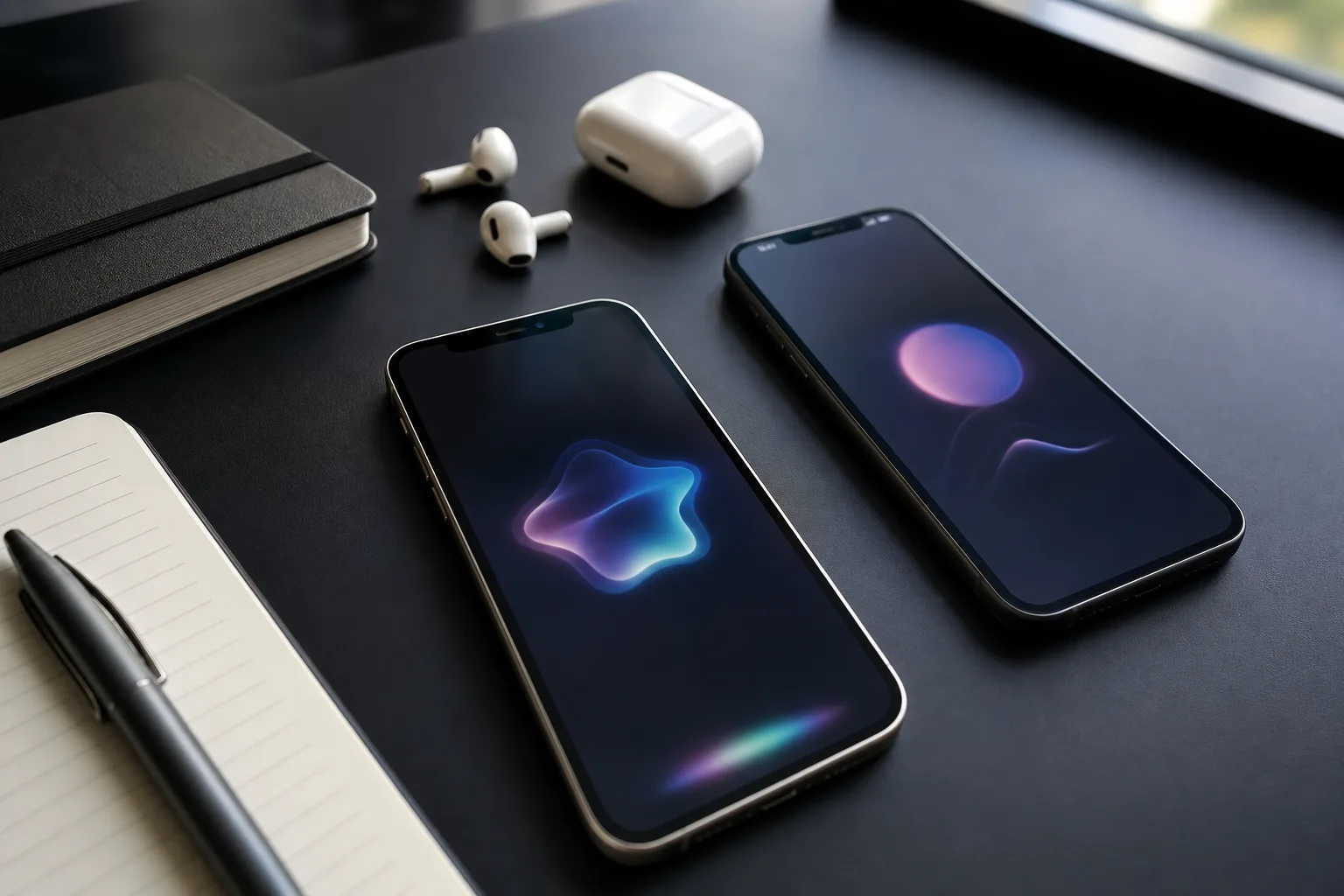
- Apple and Samsung AI plans must protect the smartphone’s role as the main gateway to personal computing and digital services.
- Apple and Samsung AI strategies differ sharply, but both companies need useful on-device features rather than another chatbot in a phone.
- AI agents could erode the app economy, leaving hardware makers to fight for relevance and recurring service revenue.
- Privacy, distribution and custom silicon give the two smartphone giants real advantages that smaller Android brands cannot easily copy.
Table of Contents
Apple and Samsung AI are fighting for the front door
The anxiety around Apple and Samsung AI is easy to understand. For nearly two decades, the smartphone has been the front door to modern digital life: the thing we use to message, shop, navigate, pay, watch, photograph and occasionally make an actual phone call. Generative AI raises an awkward possibility for the companies that own that door. What if people stop opening apps and simply ask an assistant to get things done?
The stakes for Apple and Samsung AI are high because the phone remains the most personal and widely used computing device most people own.
That is the real “AI apocalypse” facing Apple and Samsung, though the phrase is a little theatrical. Neither company is about to vanish in a puff of chatbot smoke. Apple remains extraordinarily good at turning hardware, software and services into a sticky ecosystem. Samsung is the world’s most prolific premium Android hardware maker and has deep manufacturing muscle, from displays to memory. But the rules around attention, search and software distribution are being rewritten, and their old advantages won’t automatically carry over.
Think of it like this: the app grid has been a shopping mall, with Apple and Google collecting rent at the entrance. An effective AI agent could become the personal shopper who bypasses half the stores. That may be convenient for users. It is less convenient for businesses built around getting you to tap their icon.
The advantage both companies already have
Apple and Samsung AI efforts begin from a position that most AI startups would kill for: hundreds of millions of devices already in people’s pockets, years of behavioral context, mature payment systems, developer ecosystems and globally recognized brands. A new AI service has to convince people to visit a website, install an app or change a habit. Apple and Samsung can place a feature directly in the operating system and put it one button press away.
Samsung moved first in the current phone cycle with Galaxy AI, highlighted by tools such as Circle to Search, live translation, transcription and generative photo editing. Some of these are genuinely handy. Circle to Search, in particular, succeeds because it is simple: see a thing, circle it, find out what it is. No prompt-engineering ceremony required. Samsung’s partnership with Google also gives it access to the company whose Android platform and AI research still shape much of the mobile market.
Apple, meanwhile, took its usual slower route. Apple Intelligence arrived with a promise to make Siri more aware of personal context, add writing and image tools, and perform many requests directly on device. Apple’s official Apple Intelligence overview lays out a hybrid approach: smaller tasks can run locally, while more demanding work can move to Private Cloud Compute. Apple has also offered optional access to ChatGPT for requests that benefit from OpenAI’s model.
Frankly, Apple’s privacy pitch may be more strategically important than its image-generation tricks. AI becomes far more valuable when it can see your calendar, messages, documents, location and habits. It also becomes far more unsettling. Apple’s effort to make privacy a product feature, rather than a footnote, is sensible. Whether users trust that distinction enough to care is another matter.
Apple and Samsung AI cannot survive on party tricks
The early AI phone market has a problem: much of it feels like a very expensive demo reel. Summarising a recording is useful. Removing a stranger from the background of a holiday photo can be amusing. Translating a call might be transformative for a small group of users. Yet none of those features, on their own, answers the central question: why should someone upgrade a perfectly good phone?
Apple and Samsung AI need to become quiet infrastructure, not a branded layer users remember to open once a week. The winning feature may not look especially futuristic. It could be an assistant that knows a delayed flight affects a dinner reservation, drafts a message, offers alternatives and asks before changing anything. Or a phone that finds the warranty PDF you need without forcing you through a scavenger hunt across email, cloud storage and browser tabs.
That is hard work. It requires trustworthy identity systems, dependable app integrations, permission controls and AI models that do not casually invent details. We have all seen a chatbot confidently make something up. Now imagine that behavior attached to your tax receipt, a medical appointment or a payment. The tolerance for error drops quickly when AI moves from writing whimsical birthday poems to acting on the world.
Samsung’s challenge is especially interesting because it lives inside Android but does not control Android in the way Apple controls iOS. Google can supply powerful features to Samsung, but it can also give similar capabilities to Pixel owners and competing Android brands. Samsung must distinguish its version through hardware integration, its Knox security platform, its retail reach and, crucially, execution. Nobody buys a flagship phone because it contains a logo for a cloud model.
Apple has a different constraint. Its integrated ecosystem is a moat, but it can also make the company slower to react when a platform change moves faster than its product cadence. Remember when Apple’s early Siri lead gradually became a punchline? The company cannot afford a repeat. A more capable Siri has to arrive as a product people can depend on, not merely a promise delivered in keynote language.
The app makers should be more worried
If Apple and Samsung AI succeeds, the immediate threat may fall less on either handset maker and more on the companies sitting between users and a completed task. A travel app wants you to browse. A retailer wants you to compare products on its own terms. A media company wants you inside its feed. An agent wants the answer, the best price or the reservation confirmation. Those incentives do not naturally align.
Apple and Samsung cannot treat developers as an afterthought here. Their platforms depend on developers, and developers will not happily fund an ecosystem that turns them into invisible suppliers. Apple already faces global scrutiny over App Store rules, while Google’s control of Android distribution and search remains under intense regulatory attention. Giving a built-in assistant privileged access to commerce and discovery could trigger a fresh round of complaints.
My read is that the phone makers have a narrow but valuable opening: become the trusted referee rather than the owner of every AI interaction. Let users choose models where possible. Make permissions obvious. Keep core personal data protected. Provide clear ways for services to participate and earn money. That is less glamorous than declaring a new AI era, but it is how platforms survive their own success.
The silicon question is bigger than it looks
Apple and Samsung AI also turns the chip into a consumer story. Apple’s A-series processors and Samsung’s mix of Qualcomm, Exynos and other silicon are no longer only about games and benchmark charts. Neural processing capacity, memory bandwidth and battery efficiency now determine which AI features can run privately on a device and which must be shipped to a data center.
Cloud AI sends the bill every time someone uses it. Companies can absorb that cost while a feature is new, but mass adoption changes the arithmetic fast. Local processing is cheaper, faster in patchy coverage and better for data that should never leave a device. It is also a reason the premium smartphone may retain value even as hardware upgrades have become harder to justify.
The real test is whether Apple and Samsung AI can turn that technical advantage into a reason people feel, rather than merely understand. For Apple and Samsung AI to matter, the companies do not need to beat every model maker at every benchmark. They need to make the phone feel more useful without making it feel less like yours. If they pull that off, the AI apocalypse will look less like extinction and more like another brutal platform transition. If they do not, someone else may end up owning the front door.
Frequently Asked Questions
What does Apple and Samsung AI mean for smartphone users?
It means phones may increasingly handle tasks across apps, translate conversations, edit media and surface personal information through AI features. The near-term difference will depend less on flashy demos than on whether those features save time reliably without exposing sensitive data.
Why are AI agents a risk to the app economy?
An AI agent can potentially complete a task such as booking travel, ordering food or comparing products without requiring a person to open several individual apps. If that behavior becomes common, app makers may lose direct customer relationships, data and chances to sell advertising.
Does Apple Intelligence run entirely on an iPhone?
No. Apple has described a mix of on-device processing and requests handled through its Private Cloud Compute system, with some optional ChatGPT integration. That hybrid model reflects the limits of phone hardware while attempting to maintain stronger privacy protections than conventional cloud AI services.