
- The Galaxy S27 Ultra camera could use inkjet-coated lens edges to reduce module height and suppress unwanted internal reflections.
- Samsung may expand the Galaxy S27 Ultra camera manufacturing process from a limited S26 Ultra test to three rear modules.
- Saving micrometers inside the lens stack could support bigger sensors, stronger stabilization, or a less intrusive camera bump.
- The reported change remains a manufacturing leak, so Samsung’s final camera hardware and lens lineup are far from settled.
Table of Contents
The Galaxy S27 Ultra camera may win space where it matters
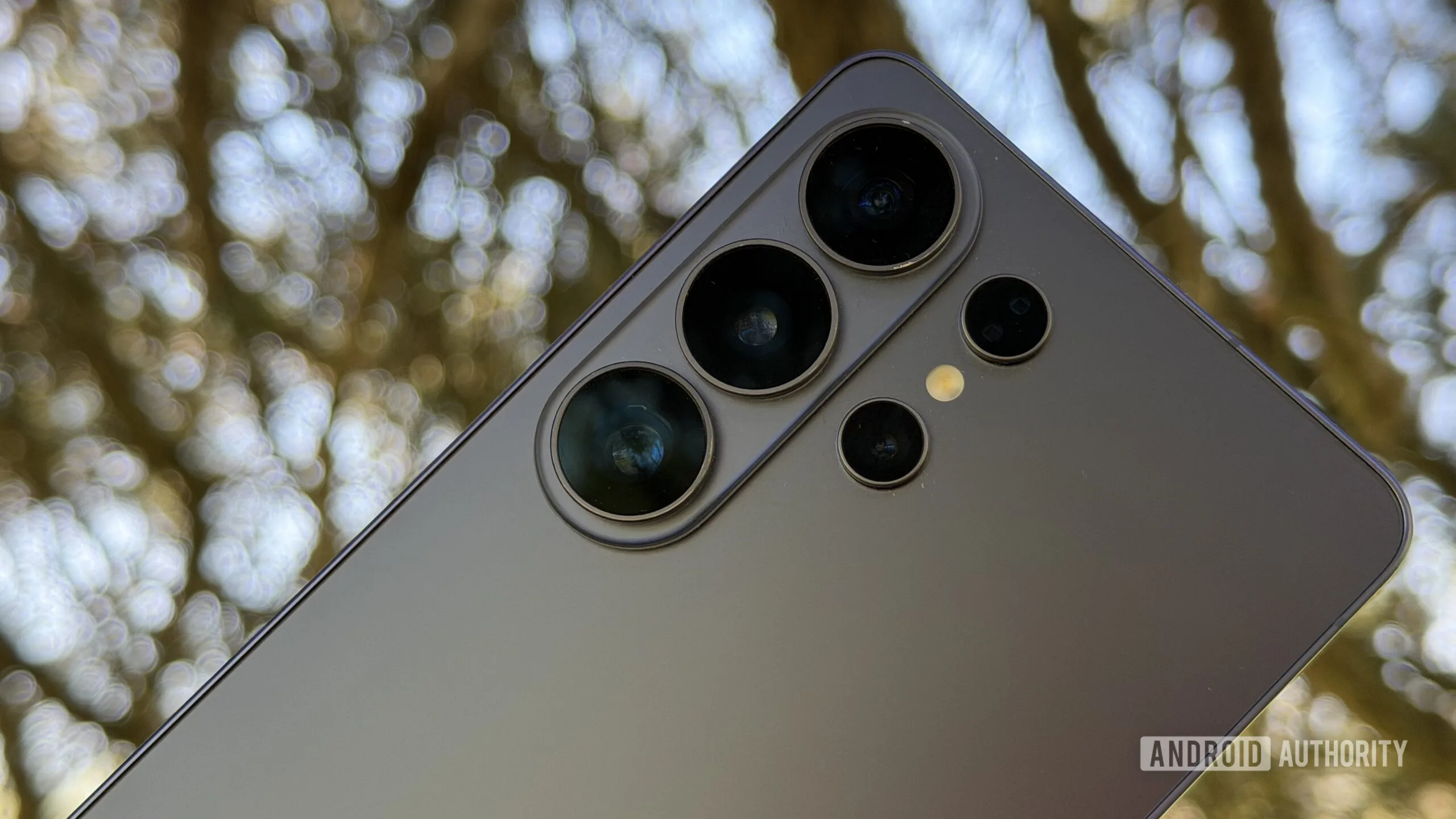
Phone makers have spent years treating the camera bump as an unfortunate tax on better photography. Want a larger sensor, longer zoom, or steadier video? Fine — but prepare for a slab of glass and metal that rocks on a table. The Galaxy S27 Ultra camera may take a less visible route around that problem: improving the tiny optical layers inside its modules rather than simply making the phone thicker.
A report from ZDNet Korea says Samsung plans to apply an inkjet-based lens process to three rear camera modules on its next Ultra phone. Samsung reportedly tested the approach on the Galaxy S26 Ultra, but a broader rollout would make this far more than a factory experiment. It could be the enabling technology behind the bigger imaging changes already being floated for the S27 generation.
That may sound like microscopic manufacturing trivia. Frankly, it is. But smartphone cameras are now so constrained by physics that microscopic trivia can decide whether a company fits a meaningful hardware upgrade into a phone at all.
Why lens-edge ink matters
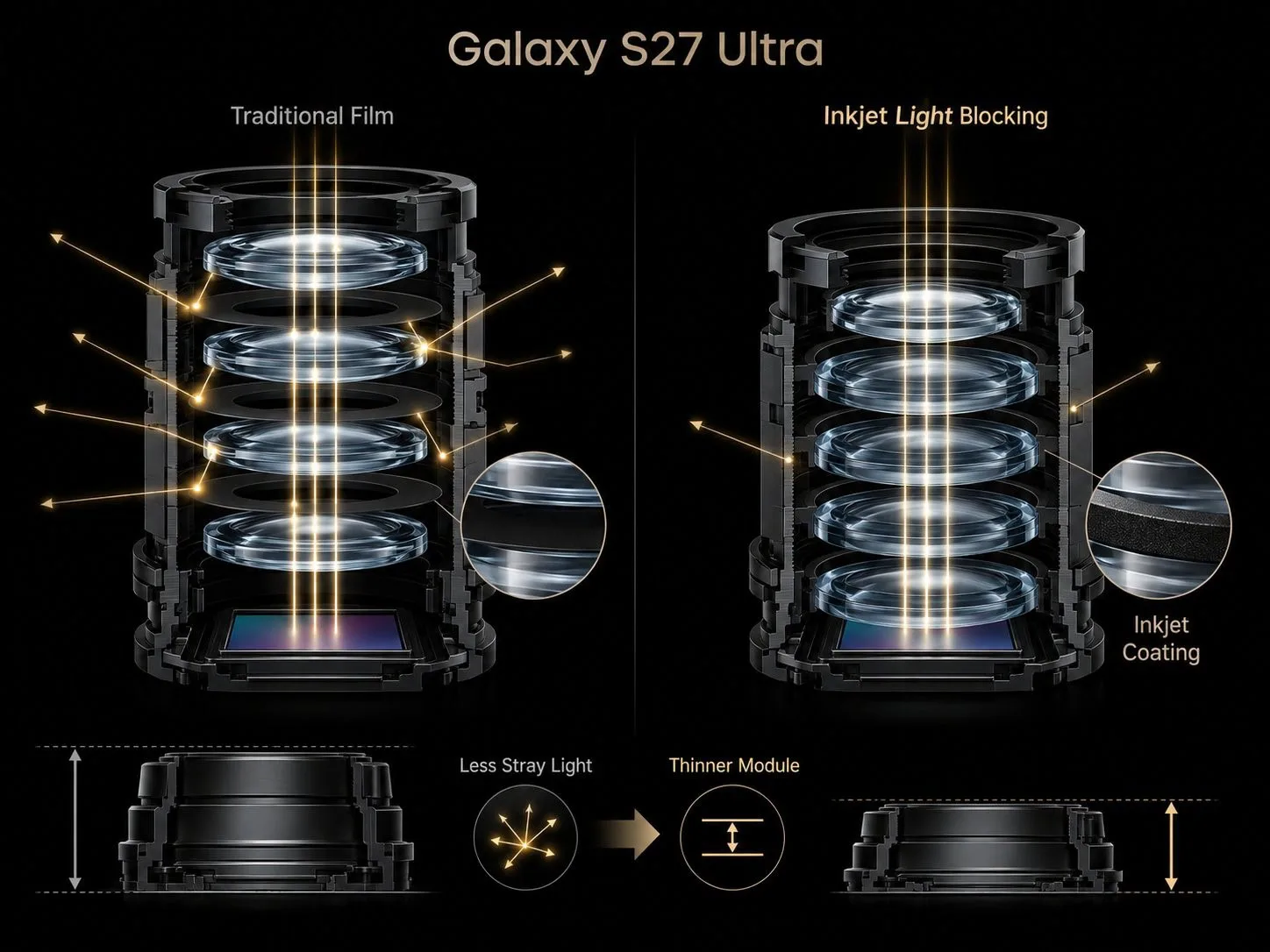
A modern phone camera is a miniature optical sandwich, typically containing six to eight lens elements. Between those elements, manufacturers use thin films and adhesive to block stray light. Without that control, light can ricochet within the module and create flare, haze, or ghostly artifacts — the sort of problem that turns a concert photo or sunset shot into an accidental impressionist painting.
The reported Samsung method sprays a matte-black, light-absorbing material directly onto the edge of selected lens elements. Think of it as painting the walls of a tiny room black rather than hanging curtains around every window. Less light goes wandering where it does not belong, and Samsung can reduce reliance on separate light-blocking films.
For the Galaxy S27 Ultra camera, the immediate payoffs would be modest but real: lower internal reflections and a slightly thinner optical stack. The report points to treatment on L3 Tele, L3 Wide, and L6 Wide layers, while other lens layers would reportedly retain conventional film. This is not a wholesale reinvention of mobile optics. It is a targeted production change, which is often how phone cameras actually improve.
Samsung’s ISOCELL HP2 sensor announcement is another example of its imaging hardware efforts. Lens-edge coating attacks a different part of the pipeline: getting cleaner light to the sensor before software has to rescue the image.
A smaller camera bump is only one possible outcome
The tempting interpretation is that Samsung will use the saved space to make the Galaxy S27 Ultra camera bump thinner. It might. Anyone who has used a recent Ultra handset without a case knows the current compromise: these are exceptional pocket computers, but their camera hardware can make them feel lopsided on a desk.
My read, though, is that Samsung is more likely to spend at least some of those recovered micrometers on capability. Camera teams rarely find extra internal volume and leave it empty. More room could accommodate improved optical image stabilization, a larger sensor package, or a more complicated lens assembly without making the device resemble a compact camera with a phone attached.
One persistent possibility is a 200-megapixel main sensor with variable aperture. Variable aperture has come and gone before, but the technical case remains sound. A wider aperture helps in dim scenes, while a narrower setting can preserve detail and reduce overexposure in bright light. The hard part is fitting mechanical complexity into a device consumers still expect to be thin.
There is also talk of LOFIC sensor technology, short for lateral overflow integration capacitor. In plain English, it is designed to capture a wider range between shadows and highlights before an image blows out. That could improve difficult scenes such as a face in front of a bright window. But LOFIC is not a magic switch, and its arrival on the Galaxy S27 Ultra camera remains speculative until Samsung confirms a sensor and its implementation.
The zoom question still hangs over Samsung
Samsung’s telephoto strategy is still unsettled. Rumors have suggested the company could alter, consolidate, or even drop the dedicated 3x camera. That would be controversial. Samsung’s current Ultra formula gives users distinct focal-length options, and removing one would invite obvious comparisons with rivals that use high-resolution sensors and crop-based zoom to cover the middle distances.
A slimmer optical stack could make that decision easier either way. If Samsung keeps multiple zoom cameras, the manufacturing change gives engineers more room to preserve image quality. If it moves toward fewer modules, the company could devote more physical space to the remaining telephoto system. Neither choice is automatically better; a 3x lens is useful because it captures portraits and everyday subjects at a natural-looking distance, not because another spec line looks impressive.
The Galaxy S27 Ultra camera also has a competitive problem to solve. Apple, Google, Xiaomi, Vivo, and Oppo are all pursuing their own mix of large sensors, periscope lenses, computational processing, and specialized coatings. Hardware gains are becoming harder to advertise because consumers mostly judge the result, not the lens diagram. They notice whether a night photo has ugly flare. They notice whether a phone sits flat enough on a café table.
Don’t mistake a production rumor for a finished phone
There is plenty of runway before Samsung’s next Ultra model becomes official, and supply-chain reports are not launch-day specifications. The Galaxy S27 Ultra camera could use this inkjet process while retaining a familiar camera bump. Samsung could also change the lens lineup, sensor choice, or even its priorities once components enter mass production.
Still, the report is believable precisely because it is unglamorous. The next major camera advance may not be a giant sensor announcement or a flashy AI mode. It may be a few eliminated films, a tighter lens stack, and less stray light bouncing around inside a module. If that gives Samsung room to improve photos without making the Galaxy S27 Ultra camera housing even more cumbersome, that is the kind of engineering progress users will feel every day — even if they never see it.