- The Govee Sky Ceiling Light costs $400 and brings Matter connectivity to a high-output, color-tunable smart ceiling fixture.
- Govee says the Govee Sky Ceiling Light reaches 7,000 lumens and offers a 478nm blue spectrum intended for daylight-starved rooms.
- The company also announced a $170 COB strip and outdoor permanent lights starting at $500.
- AI Lighting Bot 2.0 is becoming Govee’s pitch for generating scenes from moods, activities, and plain-language requests.
Table of Contents
Govee Sky Ceiling Light aims above the usual smart bulb
Smart lighting has mostly been a game of lamps, strips, and bulbs tucked behind a television. The Govee Sky Ceiling Light takes a different route: put the smart hardware directly in the ceiling, make it bright enough to handle a room on its own, and charge $400 for the privilege. That’s a serious number for decorative lighting, but it also suggests Govee sees an opening between cheap color bulbs and the far pricier world of built-in architectural fixtures.
Announced alongside two other lighting products, the ceiling unit combines Matter support, color effects, adjustable white light, and Govee’s latest AI-driven scene generator. Availability starts September 4 through Govee. On paper, the Govee Sky Ceiling Light looks like the company’s most ambitious attempt yet to move from gadgety ambient glow into the light you might actually switch on every morning.
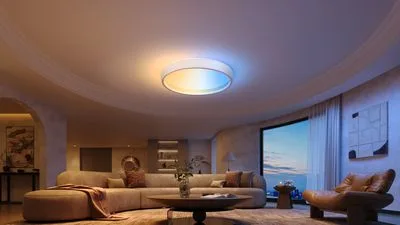
A strip behind a desk can make a gaming setup look better in photos; a ceiling fixture determines whether the room feels usable. Govee says this one can produce up to 7,000 lumens, a figure that puts it in a very different class from the company’s smaller accent products. For a large living room, studio, or basement that currently relies on several lamps, that output could matter far more than another rainbow chase effect.
What the Govee Sky Ceiling Light actually offers
Govee lists a white-color-temperature range from 1,000K to 10,000K. In normal-person terms, that stretches from extremely warm, candle-like amber through an unusually cool blue-white tone. Most people will live in the middle of that range, but having broad adjustment is useful if a room serves double duty as a workspace by day and a movie room at night.
The more unusual specification is a 478nm sky-blue spectrum. Govee says that wavelength can support the body’s ‘natural vitality and rhythm’ when daylight is limited. I’d treat that wording cautiously. Lighting affects how people perceive alertness and time of day, but wellness claims around spectral lighting are often much more confident than the evidence warrants for any individual product. A bright, cool morning setting may feel helpful in a windowless office; it is not a substitute for sunlight, sleep, or a clinician’s advice.
Still, this is a smarter direction than simply selling millions of colors. The Govee Sky Ceiling Light is trying to make color temperature and brightness part of an everyday routine, rather than a feature activated once to impress friends at a party. Whether users actually build those habits is another matter. Plenty of smart-home features end up as expensive ways to set one favorite scene and forget the app exists.
Matter is supposed to solve part of that problem. Matter is the industry standard intended to let devices work across platforms such as Apple Home, Google Home, Amazon Alexa, and Samsung SmartThings without every buyer being locked into a single vendor’s ecosystem. The standard remains messier in practice than its backers would like, especially around advanced features, but basic cross-platform control is a legitimate selling point for a permanent fixture. Readers can find the compatibility framework on the Connectivity Standards Alliance’s Matter page.
For someone using an iPhone, Matter support should make the Govee Sky Ceiling Light easier to fold into an Apple Home setup for on-off control, dimming, automations, and voice commands. The important caveat: rich animated scenes and Govee’s AI tools will likely remain best handled in Govee’s own app. That split is common in Matter products, and buyers should understand it before assuming every flashy feature appears inside their preferred smart-home dashboard.
AI scenes are useful right up until they become a gimmick
Govee is also putting AI Lighting Bot 2.0 at the center of the pitch. The company describes the software as mood-responsive, capable of adjusting lighting based on a request or a user’s stated mood. Ask for a focused working environment, presumably, and it can suggest something bright and restrained; ask for a party scene and it can go louder.
Frankly, AI is not the reason to buy the Govee Sky Ceiling Light. Prompt-based lighting sits in the same category as AI-generated playlists: handy when you don’t know what you want, less useful once you have personal preferences. The better test is whether Govee makes good defaults and lets people save, edit, and reliably trigger the results. No one wants to negotiate with a chatbot because the kitchen lights turned purple at breakfast.
AI does have a reasonable role in a lighting app with an overwhelming number of effects. Govee has long catered to enthusiasts who enjoy granular controls, segmented colors, and elaborate scenes. A plain-language shortcut could make that depth approachable for someone who simply wants a calm evening scene or a less harsh work light. The company’s challenge is to keep the tools optional rather than turning the app into another place where AI interrupts a straightforward task.
Two more products show where Govee is headed
The same launch includes the $170 COB Strip Light 2 Pro, which uses text prompts to create custom scenes. Govee says it packs 1,344 LEDs and 16 integrated circuits per meter, plus a three-layer groove design intended to smooth the output in single- and multicolor modes. Those specs are aimed at a familiar problem with low-cost strips: visible hot spots that make a wall look dotted rather than evenly washed with light.
Govee is also launching the Permanent Outdoor Lights 2 Pro, starting at $500 and arriving September 7. Each light head has two independently controlled integrated circuits, allowing the upper and lower zones to show separate colors or effects simultaneously. That could make for more flexible holiday displays, but it also speaks to a broader Govee strategy: sell products people install once and keep for years, not disposable accessories that get moved with every apartment lease.
The Govee Sky Ceiling Light is the clearest expression of that strategy. At $400, it has to compete less with a pack of smart bulbs and more with a conventional fixture plus separate bulbs, installation time, and the prospect of future platform support. That’s a higher bar, especially when ceiling wiring can turn a fun weekend project into a call to an electrician.
My read is that Govee has a credible product here if its light quality matches the headline specifications and Matter setup is painless. The company is betting that ambient lighting has matured beyond the LED-strip phase. The question now is whether consumers are ready to pay premium-fixture money for a ceiling light whose best trick may be making a room feel ordinary, comfortable, and properly lit.