

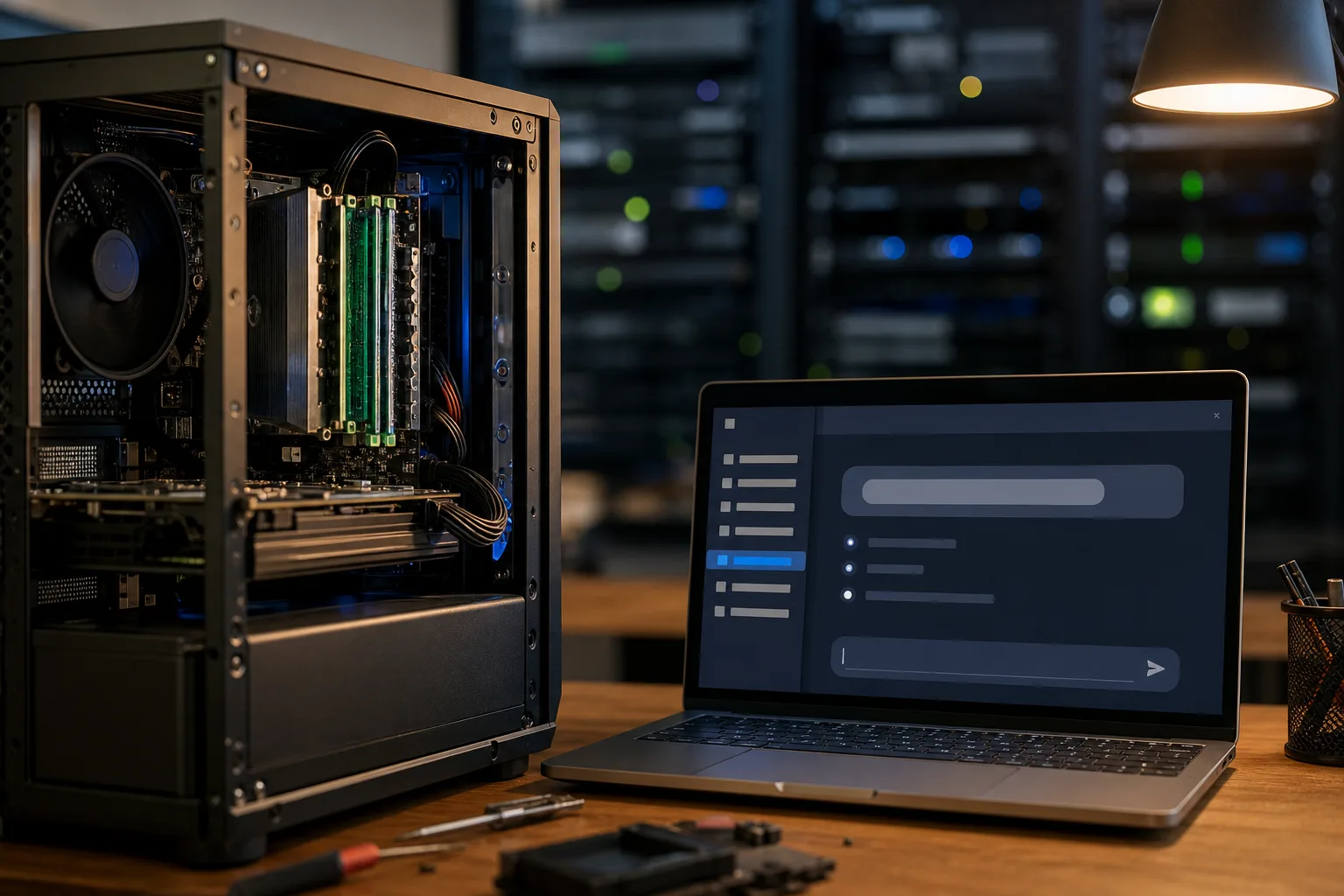
- Sam Altman argues local AI inference leaves too much scarce DRAM idle on personal computers instead of centralized cloud infrastructure.
- The local AI inference debate is really about who controls computing capacity, user data, and the price of everyday digital work.
- AI data-center construction is intensifying demand for high-bandwidth memory, servers, power, and conventional consumer DRAM.
- Local models offer privacy, offline reliability, and ownership benefits that a utilization spreadsheet cannot fully measure.
Table of Contents
Local AI inference is colliding with the cloud’s appetite for memory
Sam Altman has a blunt view of local AI inference: putting lots of DRAM in millions of PCs so it sits idle most of the day is, in his words, “quite terrible.” Speaking on Stripe co-founder John Collison’s Cheeky Pint podcast, the OpenAI chief made the case for pooling scarce memory inside data centers, where it can be kept busy serving demand around the clock.
There’s a narrowly valid engineering argument there. A giant cloud fleet can schedule work across machines far more tightly than households can. Most of us do not run an AI model at 3:17 a.m. But Altman’s framing skips the awkward bit: personal computers are not inefficient mini-data centers. They are things people own. A laptop’s unused memory is no more a social failure than an empty seat in a family car.
And when the person making the case for centralization runs OpenAI — a company spending aggressively to build an immense global compute business — it is hard not to see self-interest in the proposed solution. My read is that this is less a revelation about optimal resource allocation than a very clean statement of the cloud industry’s preferred future.

Altman told Collison that many people expect open-source models and capable PCs to reduce the need for data centers. “Somehow, they assume that the problem is solved now because we are going to have open-source models, we’re going to be able to run them on our computers, and so we’re not going to need all the stuff in the data center,” he said. His response was that the global supply of DRAM should be used where utilization is highest.
That sounds sensible until you ask the obvious question: highest utilization for whom?
Why local AI inference matters beyond benchmark scores
The case for local AI inference is not that every task should happen on a gaming PC under someone’s desk. Frontier-scale training, huge context windows, video generation, and massive enterprise workloads plainly belong in server farms for now. Nobody is editing a feature-length AI film on a thin-and-light laptop during a train ride. At least, not yet.
But plenty of useful AI work is modest: summarizing a private meeting transcript, searching files, cleaning up a photo, translating a document, or helping write code while the internet is down. Apple, Microsoft, Google, Qualcomm, AMD, and Nvidia are all betting that more of those jobs will run on devices. That is not nostalgia for the old PC era. It is a response to latency, privacy, recurring cloud bills, and the simple fact that an internet connection is not a birthright everywhere.
With local AI inference, the user can choose what stays on the machine. A law firm, hospital, journalist, developer, or parent does not have to send every draft, voice note, or family image to a remote service merely because the cloud operator says its memory pool is being used efficiently. Centralized systems can have strong security, of course. But security and autonomy are different promises, and both matter.
Resilience is the other advantage. Cloud AI is convenient right up until an outage, a rate limit, a policy change, or a company shutdown gets in the way. Remember when Google killed Stadia? The service model makes amazing things possible, but it can also turn a product you relied on into a support-page memorial. A local model may be weaker than the best hosted model, yet it remains available when the vendor’s priorities shift.
OpenAI’s DRAM argument arrives during a real supply squeeze
Altman is not inventing the underlying shortage. AI infrastructure is putting extraordinary pressure on the memory business, particularly high-bandwidth memory used alongside advanced accelerators. SK hynix, Samsung, and Micron have been racing to expand supply as Nvidia’s AI systems and rival platforms consume HBM at a startling rate. The traditional DRAM market has its own cycles, but the data-center gold rush is changing what manufacturers prioritize.

That matters even if you never touch ChatGPT. Memory capacity and pricing affect laptops, desktops, phones, consoles, workstations, and the DIY PC market. More demand for premium server memory does not translate one-for-one into higher prices for a consumer DDR5 kit, since these are different products and supply chains. Still, fabs, packaging capacity, engineering attention, and capital spending are finite. When the richest customers want every available wafer pointed at AI, ordinary buyers tend to feel the aftershocks.
OpenAI’s own ambitions intensify the tension. The company has pursued huge infrastructure partnerships and has reportedly discussed extraordinarily large build-outs to secure compute for future models. Whatever final figures emerge, the direction is unmistakable: the leading AI labs want more chips, more memory, more data centers, and vastly more electricity. The infrastructure announcement illustrates the scale of the industry’s plans, even if announcements are not the same thing as completed facilities.
So when Altman says local AI inference is a poor allocation of memory, consumers may hear something else: please do not compete with the infrastructure we need to build our business. Frankly, they are not wrong to hear it that way.
Utilization is a business metric, not a universal value
The strongest version of Altman’s argument is economic. Shared infrastructure lowers duplication, allows specialist operators to optimize hardware, and can make advanced capability available to people who could never afford a powerful workstation. If an AI assistant needs hundreds of billions of parameters, cloud access is the practical answer. A world where only wealthy people can buy serious compute would be worse.
But that does not imply that all computing should migrate to a handful of operators. A refrigerator is not wasteful because it sits idle between meals; it is useful because it is there when you need it. Personal RAM works the same way. It supports software you own, games you play, projects you build, and increasingly, local AI inference that does not meter your every request.
Cloud providers have repeatedly argued that centralization is more efficient. Sometimes they are right. Yet the technology industry has a long history of presenting corporate dependency as consumer convenience. Subscription software, locked-down repair ecosystems, streaming libraries that vanish overnight — the pattern is familiar. The bill rarely gets smaller once the user has no alternative.
The answer is a hybrid. Let massive hosted models handle jobs that demand massive clusters. Let local AI inference handle personal, private, latency-sensitive work on hardware people control. That requires more memory in consumer devices, not less, plus efficient open models that do not need a warehouse to answer an email.
Altman may be correct that aggregate DRAM utilization looks better from inside a data center. But people do not buy computers to improve OpenAI’s utilization chart. They buy them so they can decide what happens when they press Enter. Whether the industry preserves that choice may be the more important AI fight.