

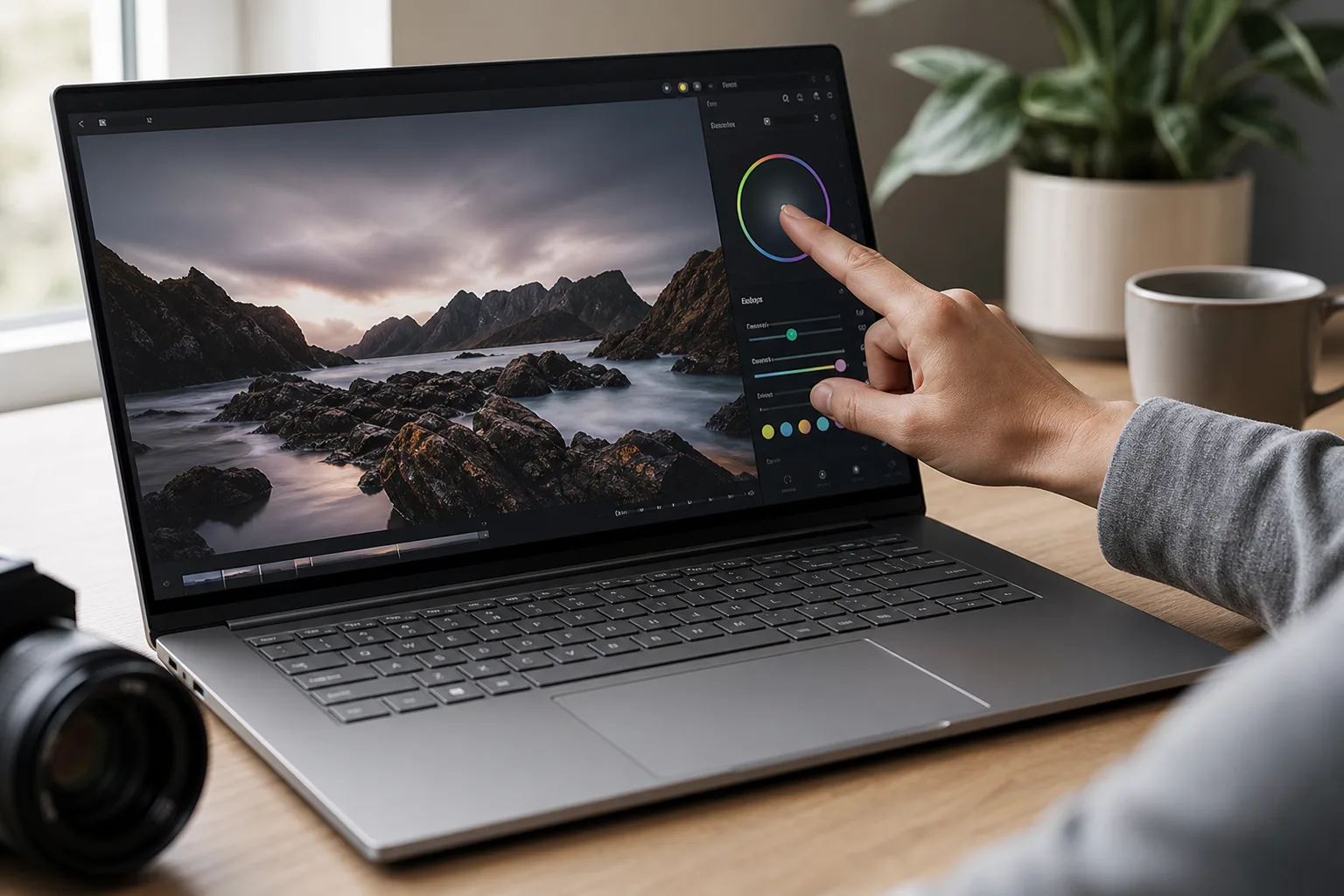
- The touchscreen MacBook Pro has begun arriving in Australia and New Zealand, putting Apple’s first touch-enabled Mac in front of ordinary buyers.
- Apple’s touchscreen MacBook Pro starts at $2,899 and combines OLED technology with a thinner design, Dynamic Island, and a restored glowing logo.
- The $699 OLED iPad mini adds an Acoustic Display and IP67 resistance, giving Apple’s smallest tablet an unusually tough build.
- Premium MacBook Pro configurations may be hard to find at first, with online delivery estimates stretching into late November and December.
Table of Contents
The touchscreen MacBook Pro finally leaves the showroom
For years, Apple treated a touchscreen MacBook Pro as a category error. Touch belonged on an iPad, the company argued, while the Mac was built around a cursor, keyboard, and trackpad. That line has now expired. Customers in Australia and New Zealand are starting to receive Apple’s new PROLED MacBook Pro models, making this the first moment ordinary buyers—not carefully managed demo stations—can test whether touch actually belongs in macOS.
This is more consequential than the usual annual silicon bump. Apple has periodically made the Mac feel fresher with its in-house chips, but the interaction model stayed stubbornly familiar. The new high-end machines change that equation with touch input, an OLED panel, a slimmer body, and a Dynamic Island replacing the notch. Apple has even restored the illuminated Apple logo, a detail that will make longtime Mac users feel about 2012 years younger.
The rollout begins on Friday, November 6, in Australia and New Zealand before moving through Asia, the Middle East, Europe, and North America. As ever, social feeds will get the first useful evidence: photos in harsh sunlight, complaints about fingerprints, battery observations, and perhaps the first person trying to poke an on-screen button while the laptop sits across the room. Those mundane tests are where product claims either become believable or collapse.
Apple’s premium 14-inch model starts at $2,899, while the 16-inch version starts at $3,399. Those are serious prices, even by MacBook Pro standards. Buyers weighing a touchscreen MacBook Pro against the $1,999 entry-level 14-inch model are paying for a machine with the more ambitious display and touch hardware, while that lower-priced version gets Apple’s M6 chip.
Why the touchscreen MacBook Pro is a bigger bet than it looks
Touch laptops are not new. Microsoft has been pushing the idea since the original Surface era, and Windows manufacturers from Dell to Lenovo have spent more than a decade selling convertible notebooks. But Apple has generally watched from the sidelines, insisting that its tablet and laptop lines should remain distinct. Frankly, the company wasn’t entirely wrong: a touch screen on a conventional laptop can feel a bit like putting a doorbell on a refrigerator. You can do it, but it doesn’t automatically solve a problem.
The case for a touchscreen MacBook Pro is more compelling because Apple has spent years borrowing interaction concepts between platforms. macOS already has iPhone-style controls in places, while Apple silicon lets developers bring many iPad apps to the Mac. Dynamic Island is perhaps the clearest symbol of that crossover. On an iPhone, it turns a camera cutout into a live activity area. On a Mac, its usefulness will depend on whether Apple and third-party developers give it genuinely useful status information rather than another decorative black pill.
The OLED transition may be the more consequential part of the package. OLED brings the pixel-level contrast and deep blacks that have made Apple’s OLED iPhones and iPad Pro displays so appealing. Apple’s existing mini-LED MacBook Pro screens are excellent, particularly for HDR work, but they are thicker assemblies and can show blooming around bright objects on dark backgrounds. If the PROLED implementation delivers OLED’s visual payoff without punishing battery life or creating durability concerns, creative professionals will notice immediately.
Apple is selling the new machines with M5 Pro or M5 Max chips, while the lower-priced MacBook Pro gets M6. The naming is awkward enough to make a spreadsheet feel tempting, but the commercial logic is clear: the high-end model is being sold as a display, design, and professional-workflow upgrade rather than merely a faster processor. That could be smart. Many people buying a $3,399 laptop already have plenty of CPU performance; they want a screen they can trust for video, photography, and color-sensitive work.
There are still reasons to be skeptical
A touchscreen MacBook Pro invites practical questions Apple will need to answer with software, not marketing. Will macOS buttons and menus become easier to hit without making the interface cartoonishly oversized? Can touch work alongside the trackpad rather than constantly competing with it? And will Apple provide useful gestures that do not turn every editing session into an arm workout?
Microsoft learned this the hard way. Windows touch hardware often impressed in stores, then ran into an operating system built from generations of desktop conventions. Apple has the advantage of tighter control over both hardware and software, but macOS was not designed around fingers either. The company’s own Mac lineup still emphasizes familiar desktop workflows, and there is no indication that the touchscreen models are becoming tablet-laptop hybrids with 360-degree hinges or detachable keyboards.
Availability is the immediate headache. Early touchscreen MacBook Pro orders for the PROLED models are reportedly slipping to late November or early December, which suggests early supply could be tight. That may reflect demand, manufacturing complexity, or simply Apple’s preference to keep the first production run controlled. We’ll know more once retail stock settles. The OLED iPad mini, standard 14-inch MacBook Pro, and iMac appear likely to be easier to find.
The OLED iPad mini may be the quieter winner
Apple’s smallest tablet also gets a surprisingly substantial update. The new OLED iPad mini starts at $699, uses an A20 Pro chip, and becomes Apple’s most affordable OLED iPad. It is nearly a millimeter thinner than its predecessor, but the more interesting engineering choice is its Acoustic Display, which removes conventional speaker openings from the enclosure.
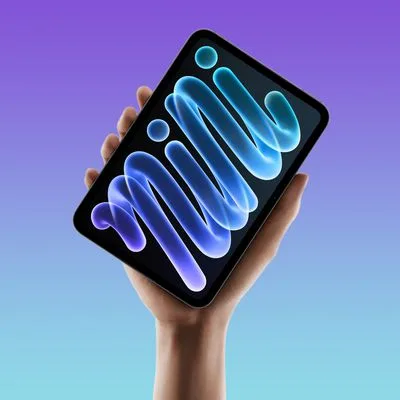
Without those openings, Apple can seal the iPad mini well enough for an IP67 water and dust resistance rating. That is a meaningful practical upgrade for a device that gets tossed into bags, used in kitchens, carried by kids, and occasionally placed far too close to a pool. An IP67 rating does not mean it should become your bathtub reading slate, but it does give the mini a resilience Apple’s iPads have largely lacked.
The OLED iPad mini also sharpens Apple’s awkwardly effective device segmentation. A buyer who wants touch-first computing, a compact size, and a more casual posture still has a very strong reason to choose the iPad. The touchscreen MacBook Pro, meanwhile, is for people who need macOS applications, ports, sustained performance, and a conventional laptop workspace. Apple is finally allowing those worlds to overlap without fully merging them.
Apple has opened a door it spent years keeping shut
The new M6 iMac, starting at $1,499, and entry MacBook Pro will probably be straightforward upgrades for anyone coming from older Intel machines or early Apple silicon. The premium models are different. With the touchscreen MacBook Pro, Apple is acknowledging that a longstanding product boundary had become less defensible as displays, software, and user habits converged.
My read is that touch will not suddenly make every Mac owner reach for the screen all day. Most people will still use the trackpad for long stretches, just as iPad owners still reach for keyboards when work gets serious. But for quick controls, image manipulation, presentation work, and those moments when your hand is already near the display, touch can be a useful extra path. Apple’s real challenge is making that path feel intentional rather than like a feature it reluctantly copied from Windows after a decade of saying it didn’t matter.
If the first customer reports confirm strong OLED performance and sensible touch behavior, the touchscreen MacBook Pro could become the template for Apple’s professional laptops rather quickly. If macOS feels clumsy under a fingertip, though, Apple may discover why it resisted the idea for so long.