

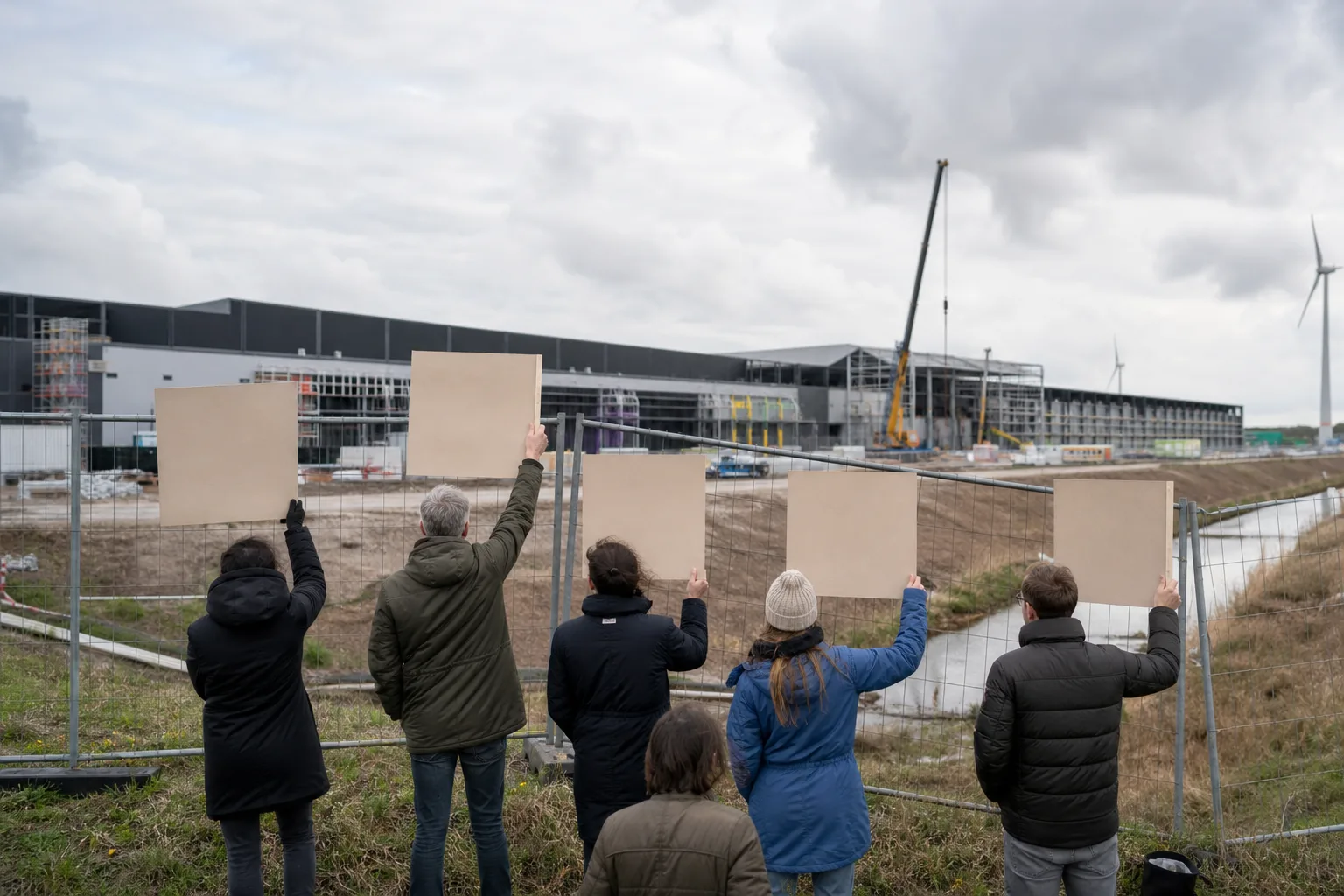
Protests over a Microsoft data center have turned what might once have been a niche planning dispute into a very visible argument about AI, electricity and who gets to decide how a city grows. The action was part of a wider weekend of demonstrations across Europe against the rapid expansion of data centers.
The immediate image is dramatic: protesters at the perimeter of a major cloud company’s project. But the more consequential story sits behind the fence. Data centers have become the physical factories of the internet economy, and the AI boom has made their appetite for power feel newly urgent. For years, companies could pitch cloud infrastructure as distant, invisible plumbing. That pitch is getting harder to sustain when the plumbing occupies valuable land, connects to already-stressed grids and asks residents to trust corporate climate promises.
- Demonstrators took part in coordinated European protests over infrastructure expansion.
- The Microsoft data center protest reflects a wider clash over electricity, water, land use and the rapid buildout required for AI services.
- Europe’s reporting rules may improve transparency, but communities still lack clear answers about who absorbs local infrastructure costs.
- Microsoft and other hyperscalers face a harder political question: whether clean-energy pledges can keep pace with their construction plans.
Table of Contents
Why the Microsoft data center protest matters
Calling it a Microsoft data center protest risks making this sound like a single-company dispute. It isn’t. Microsoft is a useful target because it is one of the largest cloud providers on Earth, alongside Amazon Web Services and Google, and because its Azure business is central to the industry’s race to provide AI computing capacity. But the demonstrators’ broader objection is to a development model that is spreading quickly across European cities and towns.
Cloud campuses are often sold on familiar economic-development language: investment, construction jobs, digital resilience and tax revenue. Some of those benefits are real. A region without serious computing infrastructure can become dependent on facilities elsewhere. Yet a hyperscale site generally does not employ people at anything like the scale of the factories it resembles from the outside. What it can consume, however, is substantial power, network capacity, cooling equipment and land.
That imbalance helps explain why a Microsoft data center project can trigger a sharper public reaction than an ordinary commercial build. Residents are being asked to weigh a locally concentrated burden against services whose revenue and primary beneficiaries may be distributed globally. If you use Teams, Xbox, Copilot or a company application hosted on Azure, you are part of the demand equation. You are also unlikely to get a vote on where the servers go.
My read is that the Amsterdam action is less about rejecting technology outright than rejecting the assumption that technology infrastructure should receive automatic approval. After a decade in which platforms seemed almost weightless, their warehouses of computation have become impossible to ignore.
AI has changed the data-center math
The old internet needed plenty of servers, of course, but generative AI has made capacity planning considerably more fraught. Training large models requires dense clusters of advanced chips. Serving those models to millions of users then adds a second, continuing workload. A search query, a video stream and an AI-generated response are not equivalent electrical events, even if they all arrive in a browser tab.
Global electricity consumption from data centers could rise sharply as AI and other compute-intensive services expand. The agency’s Energy and AI report makes clear that demand is not some distant concern for the 2040s; grid planners are dealing with it now.
Not every Microsoft data center is automatically a climate disaster. The details matter enormously: the regional grid mix, whether new renewable generation is actually added, the timing of electricity use, hardware efficiency, cooling design and whether waste heat can serve nearby buildings. But companies often present renewable-energy procurement as a broad answer to a very local question. Buying clean-energy certificates or signing a distant power-purchase agreement may improve a corporate accounting ledger. It does not necessarily create spare capacity at the local substation.
Frankly, this is where industry messaging often loses people. A company says it will be carbon negative by 2030, or water positive, and those are meaningful goals on paper. A neighbor sees a large, guarded facility going up near their community and asks whether their grid connection, water supply or housing plan will be affected. Both conversations can be valid. Only one tends to happen at a town meeting.
The Netherlands already knows this argument
Amsterdam is not entering this fight cold. The Netherlands has spent years wrestling with the footprint of hyperscale infrastructure. National scrutiny intensified after controversy around proposed hyperscale development in Zeewolde. Dutch authorities later tightened the conditions around large-scale sites, particularly outside designated areas.
Those decisions signaled that the sector could no longer assume an easy welcome. The Netherlands is an attractive location because of its connectivity, skilled workforce and proximity to major European markets. It is also densely populated, with real limits on land, grid capacity and public patience. A Microsoft data center project must contend with those same constraints. You cannot keep treating a country with finite space like an infinitely expandable server rack.
The reported Amsterdam Microsoft data center protest lands in that established political context. It also arrives as European governments try to reconcile two ambitions that frequently collide: building domestic digital capacity and meeting increasingly demanding climate targets. Leaders want Europe to be less dependent on foreign technology infrastructure. They also want to protect grids for homes, public transport, industry and electrification. Those goals don’t neatly fit together when everyone wants more compute at once.
Transparency is improving, but not fast enough
The European Union has begun asking for more visibility. Under the recast Energy Efficiency Directive, larger data centers are expected to report information on energy performance, water use, waste heat and renewable-energy use through a European database. That is a sensible move, and long overdue. If facilities draw utility-scale resources, the public should be able to compare their performance rather than rely on glossy sustainability pages.
Still, reporting is not consent. Data can tell a community how efficiently a Microsoft data center operates after it has been built; it cannot settle whether the site was the best use of constrained power in the first place. Nor does a Europe-wide scorecard solve the basic issue of timing. A grid upgrade may take years. A cloud provider’s demand can arrive far sooner.
There is a practical route through this, although it requires more than public-relations commitments. Developers should publish site-specific power and water projections before approvals, explain how their projects interact with grid queues, commit to additional clean generation rather than merely matching annual consumption, and offer enforceable plans for waste-heat reuse where feasible. Regulators, for their part, should stop handling data centers as generic warehouses. Their resource profile is different, and planning rules should reflect that.
Microsoft’s harder political test
Here is the problem every hyperscaler now faces: the more successful its AI products become, the harder its environmental targets are to meet.
The Amsterdam incident puts that contradiction in a concrete place. A Microsoft data center is no longer just a line item in a capital-expenditure plan; it is a political object, visible enough to attract organized opposition. The next Microsoft data center proposal may face similar scrutiny across Europe, especially where grid connections are scarce and local governments feel that the benefits flow elsewhere.
Tech companies can dismiss protesters as hostile to progress if they want. That would be a mistake. The useful question is not whether Europe needs data centers. It plainly does. The question is whether the companies building them can prove that their next wave of AI infrastructure deserves the power, land and public trust it is asking for.