

Table of Contents
A familiar iPad Air formula, with more room to choose
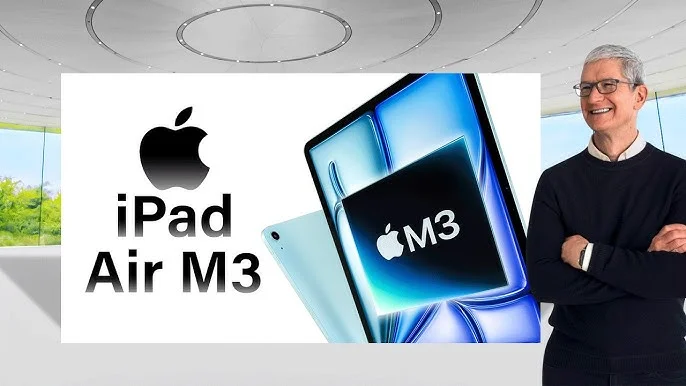
Apple has unveiled a new iPad Air powered by the Apple M3 chip, bringing faster performance to a tablet line that has long occupied the middle ground between the entry-level iPad and the iPad Pro. The new iPad Air comes in 11-inch and 13-inch models, with prices starting at $599 for the smaller version and $799 for the larger one.
That pairing of a mainstream price point with a larger display option is the real story here. The iPad Air has traditionally been the model for people who want more capability than Apple’s basic tablet offers but do not want to pay premium prices for a Pro. Adding a 13-inch option makes that choice more practical for buyers who spend long stretches reading, working in apps, editing documents, or using the iPad alongside a keyboard.
Apple’s update also arrives less than a year after the last iPad Air, a sign that the company is keeping the tablet lineup in regular motion rather than treating the Air as an occasional refresh. That does not necessarily make the previous model obsolete. It does, however, make the new M3 version a more meaningful consideration for anyone coming from an older iPad, particularly an M1-powered iPad Air.
The M3 matters most for older iPad Air owners
Apple says the new device is twice as fast as the older M1-powered iPad Air. That is a substantial claim, and it gives the M3 update more weight than a simple annual chip swap. For routine tasks such as web browsing, streaming, email and note-taking, many users may not feel a dramatic difference every minute of the day. Tablets have been fast enough for those basics for some time.
The value of extra performance tends to show up when an iPad is asked to do more than the basics: working across several apps, handling graphically demanding work, or keeping pace over several years of ownership. Apple says the M3 processor delivers faster speed and better graphics performance, which makes the iPad Air better suited to buyers who expect their tablet to serve as more than a casual screen for media consumption.
The new iPad Air also supports Apple Intelligence, Apple’s latest AI features. That support matters because platform features increasingly shape a device’s useful life. A faster chip is not merely about loading an app more quickly; it can determine which new capabilities a device is positioned to receive and run. For buyers replacing an older iPad, the M3 Air is therefore an upgrade in both immediate performance and compatibility with Apple’s current direction.
Still, Apple has made a clear product-line decision. The iPad Air uses M3 rather than the latest M4 chip. Some users will reasonably ask why the company did not bring its newest silicon to a model that is now available with a 13-inch display and a keyboard accessory designed for more serious use. The answer is likely less about what the M3 can do than about how Apple separates the Air from the Pro. The company needs the iPad Air to feel capable while leaving room above it for buyers who want the most advanced option.
That division will frustrate shoppers who judge every new Apple device against the very latest chip. But it should not obscure the practical point: M3 is still positioned here as a significant improvement over the M1-powered iPad Air. For most people considering the Air on performance grounds, the question is not whether M3 is newer than M4. It is whether the device will handle the work they actually do, at a price they are prepared to pay.
The 13-inch model changes who the iPad Air is for
Apple is offering the iPad Air in 11-inch and 13-inch variants. The smaller model remains the obvious fit for portability, reading, casual use and people who want an iPad that can move easily between a bag, a desk and a sofa. The 13-inch model pushes the Air toward a different role. A bigger canvas can make documents, split-screen work and creative apps feel less constrained, even when the software experience remains recognizably iPad.
The larger version starts at $799, placing a $200 gap between it and the $599 11-inch model. That difference is not trivial, especially because the larger screen is only the beginning for buyers who want to build a more laptop-like setup. Apple is also selling a new Magic Keyboard accessory, with a larger trackpad and function keys. It costs $269 for the 11-inch model and $319 for the 13-inch version.
Those prices sharpen the buying decision. The Magic Keyboard can make sense for people who write frequently or want cursor control and dedicated keys, but it is not an automatic purchase. An 11-inch iPad Air starting at $599 becomes a considerably more expensive proposition once a $269 keyboard is included. The 13-inch model, starting at $799, reaches another level again with its $319 keyboard. Buyers should think about the complete setup they expect to use, not only the entry price on Apple’s store page.
That does not make the accessory a poor fit. It simply reinforces the iPad Air’s unusual position. It can be a straightforward tablet for everyday tasks, or it can become a more work-oriented device with the right add-ons. Apple is giving customers the choice, but the cost of turning the Air into a keyboard-driven machine remains part of the calculation.
A stronger Air, but not an attempt to erase the Pro
The new iPad Air comes in four color options, another reminder that Apple still sees the model as a broadly appealing consumer device rather than a narrowly professional tool. The Air has been one of Apple’s best-selling models, and that appeal rests on balance: enough power for demanding users, a lower starting price than premium alternatives, and a design that does not require buyers to justify a specialist purchase.
Apple continues to dominate the tablet market, but dominance does not remove the need for a clear reason to upgrade. Owners of a recent iPad Air may find that the M3, Apple Intelligence support, bigger display choice and new keyboard are appealing without being essential. The case is stronger for people with an older iPad, especially those who have been waiting for a larger screen without moving into the Pro range.
There is also a sensible argument for choosing the M3 iPad Air precisely because it is not trying to be everything. Apple’s decision to hold the latest M4 chip for a higher tier may feel like deliberate restraint, because it is. Yet the Air’s job is to offer a good balance of performance and price, and the M3 model appears built around that premise.
For everyday users, students, families and buyers stepping up from an older device, the M3 iPad Air looks like a solid upgrade. For shoppers who want the largest available display option in the Air line, the 13-inch version broadens the appeal considerably. The important caveat is simple: decide early whether the Magic Keyboard is part of the purchase. Its larger trackpad and function keys add useful flexibility, but its $269 and $319 prices can change the value equation quickly.
Apple has made the iPad Air faster, given it more display real estate, added support for its latest AI features and preserved a starting price of $599. That is a persuasive update for the right buyer. It is also a carefully managed one, leaving the M4 and the company’s most premium positioning elsewhere. For many people, that distinction will matter less than the fact that the iPad Air now offers more room, more speed and a clearer path to becoming the tablet they use every day.

