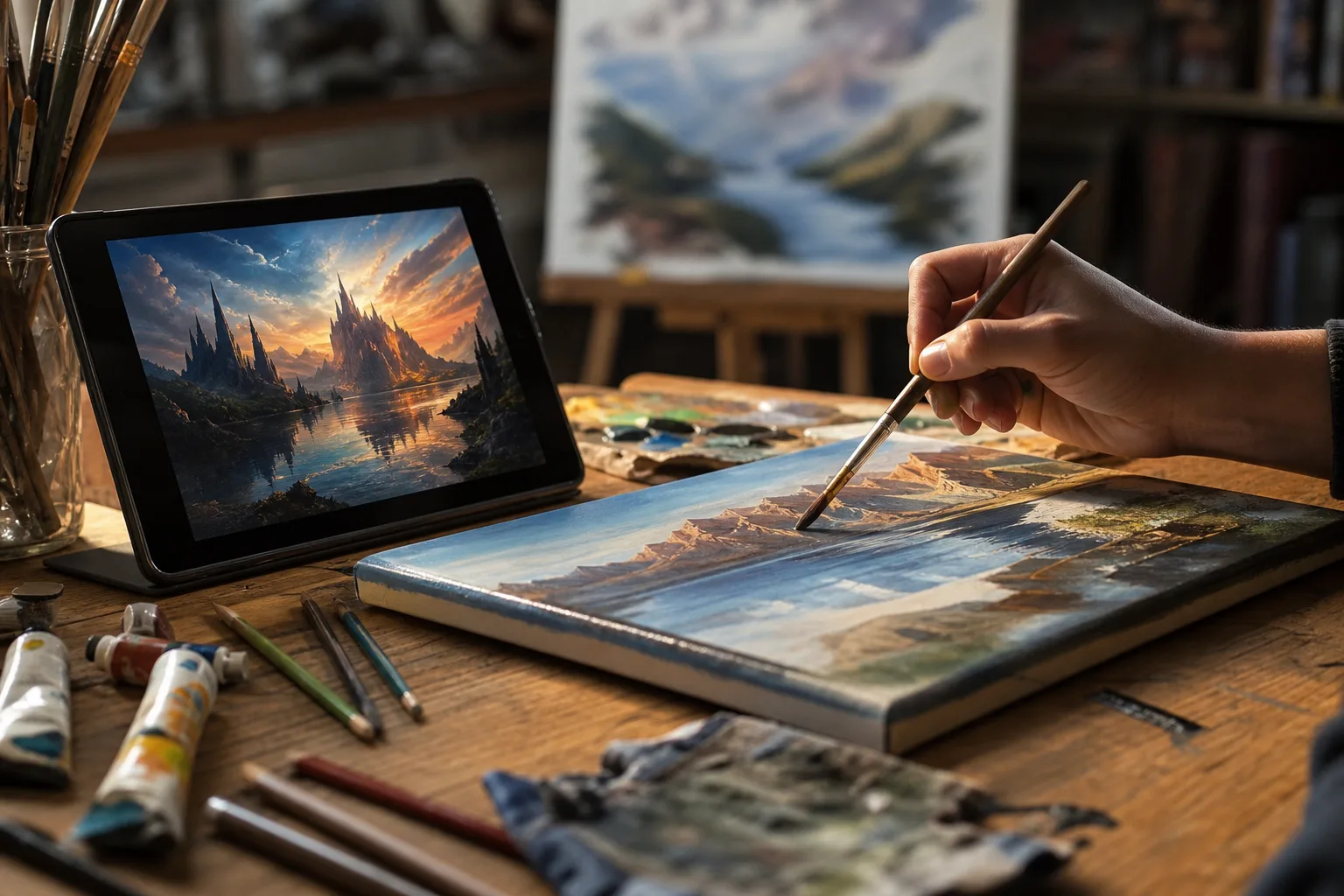
- Art and AI are clashing in ways that force us to ask what art is fundamentally for in the first place.
- The art and AI debate isn’t just philosophical — it has real economic consequences for millions of working creatives.
- Generative AI tools from companies like Adobe and OpenAI are already reshaping how creative work gets commissioned and valued.
- How we define artistic value in the next few years will shape copyright law, creative careers, and cultural output for decades.
Table of Contents
Art and AI: A Question That’s Been Waiting for a Crisis
The tension between art and AI has finally forced a question that philosophers and artists have dodged for centuries: what is art actually for? Not in the abstract, gallery-wall sense. In the practical, economic, existential sense. Because the answer — whichever way it lands — will determine whether human creativity survives as a profession, a culture, and a way of making meaning in the world.
This isn’t hyperbole. Generative AI tools are now capable of producing images, music, prose, and video at a quality and speed that would have seemed implausible five years ago. OpenAI’s DALL-E, Midjourney, Adobe Firefly, Suno for music, Runway for video — the list keeps growing and the outputs keep improving. The business case for replacing a freelance illustrator or a stock photo shoot with a few typed prompts is, financially speaking, difficult to argue against. And that’s the problem.
What Do We Actually Mean When We Say Art Matters?
There are broadly two camps in the art and AI conversation, and they talk past each other constantly. The first camp says art is about the output — the painting, the song, the story. If it moves you, it works. By that logic, a Midjourney image that makes someone cry is as valid as a Rembrandt. The second camp says art is about the process — the struggle, the intention, the human experience compressed into a form that other humans can recognise and share. By that logic, a machine can’t make art any more than a photocopier can write a novel.
Neither position is obviously wrong. But the stakes of choosing one over the other are enormous. If we accept that output is all that matters, then the economic case for paying human artists collapses almost immediately. Why commission a $5,000 illustration when a $20-a-month subscription does the job in 30 seconds? If we insist that process and human intention are what define art, we need to build that belief into law, into commissioning practices, into how we teach children about creativity — and we’re nowhere near doing that yet.
The Copyright Wars Are Already Here
The legal system is scrambling to catch up. In the United States, the Copyright Office has repeatedly ruled that AI-generated images without substantial human authorship cannot be copyrighted — a position that sounds principled until you realise how blurry the line between “AI-generated” and human-authored work has already become.