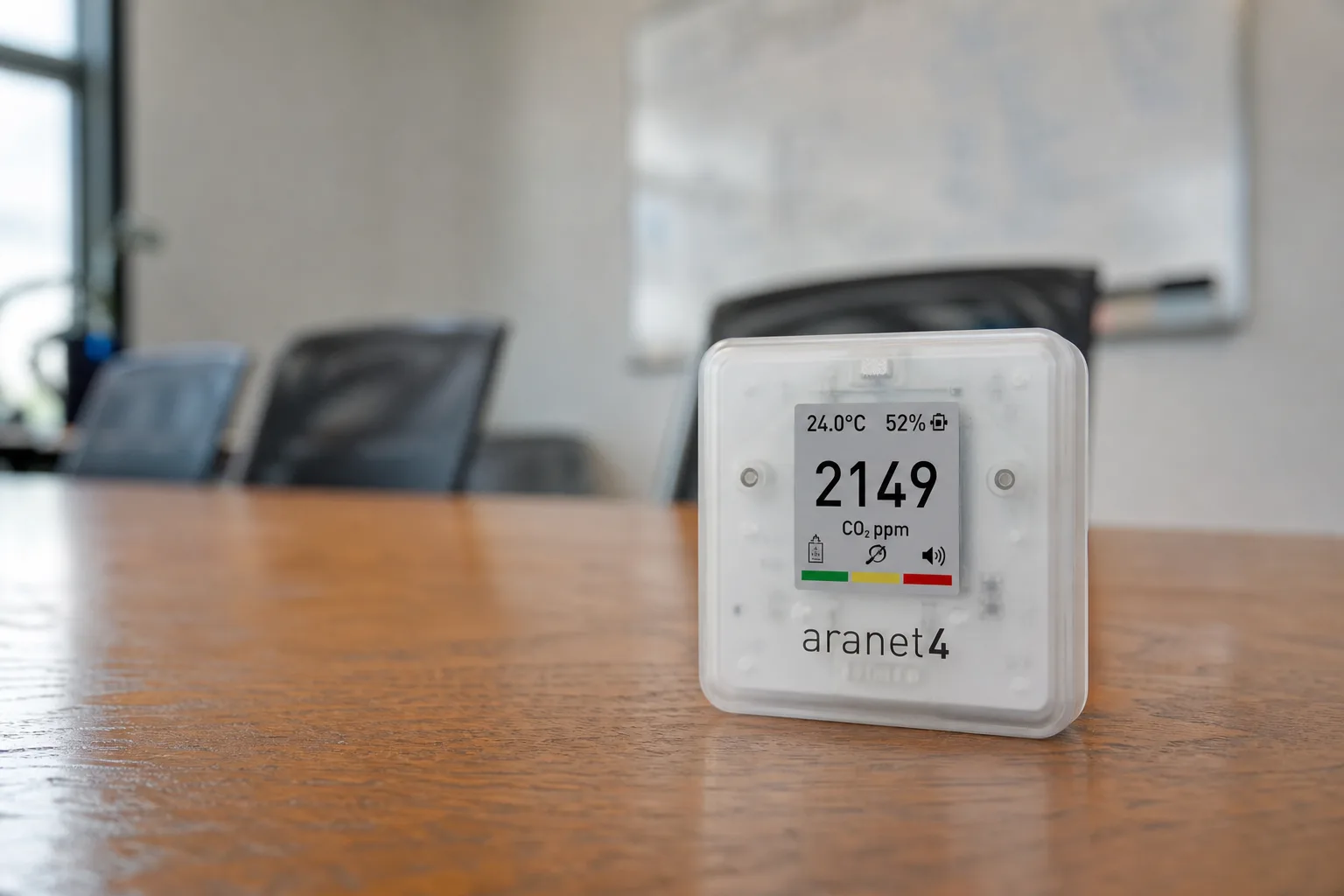
There’s a variable that’s almost certainly affecting every important meeting your organisation runs. It’s invisible, odourless, and nobody in the room notices it getting worse in real time. CO2 in meeting rooms — specifically, the steady climb of carbon dioxide concentration as people breathe in an enclosed space — is quietly degrading decision quality at exactly the moments you can least afford it. The research is clear and has been for years. The practice of actually measuring it remains, for most companies, essentially nonexistent.
- CO2 in meeting rooms can exceed 2,000 ppm within an hour, a level researchers link to measurably impaired decision-making.
- A Lawrence Berkeley National Laboratory study found CO2 in meeting rooms at 2,500 ppm pushed cognitive performance into what researchers called ‘dysfunctional’ ranges.
- Harvard research identified strategy, planning, and using information under pressure as the cognitive tasks most degraded by elevated CO2.
- A basic CO2 monitor costs less than an hour of most professionals’ time, yet almost no organisation routinely tracks indoor air quality.
Table of Contents
What the Numbers Actually Look Like
A software development consultant who has spent decades studying why capable teams underperform now carries a portable CO2 monitor everywhere they work. The premise is simple: outdoor air sits at roughly 400 parts per million (ppm). That’s your baseline. What happens indoors is a different story. CO2 in meeting rooms tells a very different tale from the air outside.
In a closed meeting room with a handful of people, readings have been observed climbing past 2,000 ppm. A photo of a real reading — 2,143 ppm — has been published, taken in exactly the kind of ordinary meeting room where companies routinely make their most consequential calls.
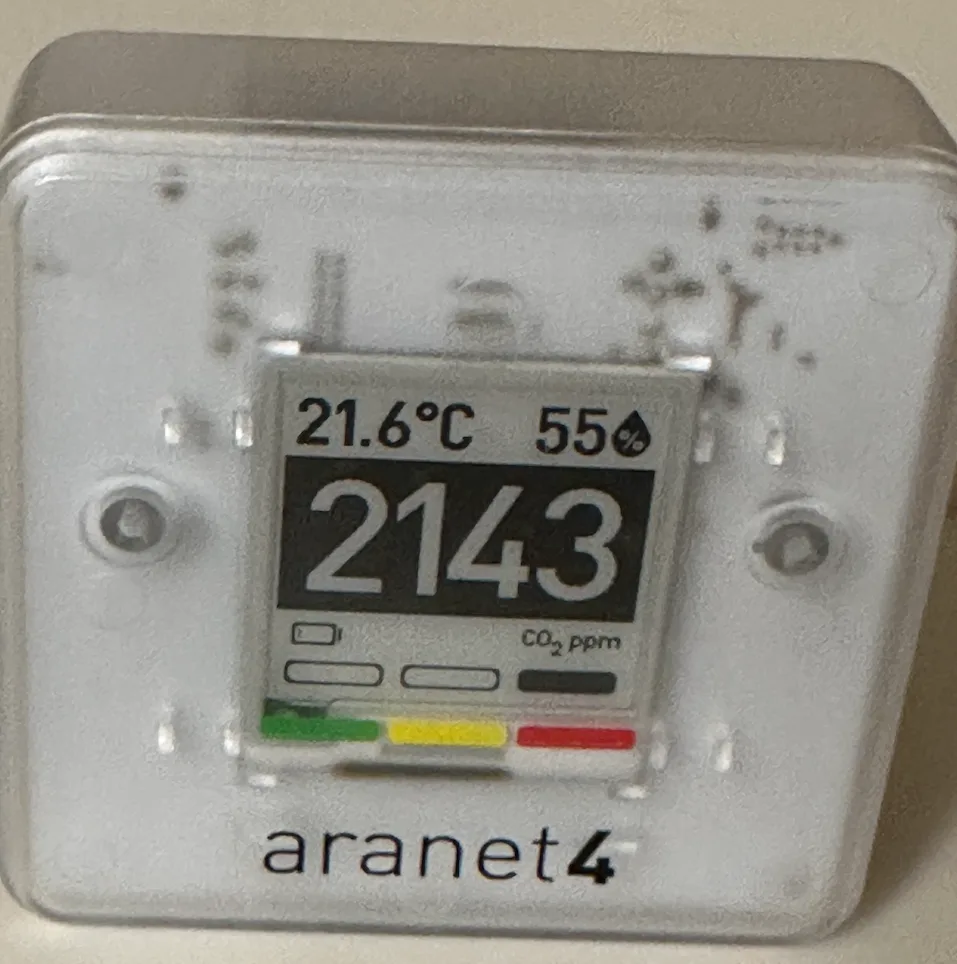
That number isn’t exceptional. It’s boringly, depressingly typical. A handful of people in a room with no fresh air exchange will push CO2 past 1,000 ppm within the first hour. A full-day strategy offsite in a windowless boardroom? You’re in the 2,000-plus range for most of the afternoon, quite possibly the entire time you’re debating the decisions that matter most. CO2 in meeting rooms scales directly with occupancy and time — the longer people stay, the worse it gets.
The Research Behind the Problem
The case against high CO2 in meeting rooms isn’t speculative. It has hard experimental backing from credible institutions. Researchers at Lawrence Berkeley National Laboratory conducted controlled experiments in which participants were placed in a chamber where only the CO2 concentration varied. At 1,000 ppm — again, a level a closed room reaches in under an hour — performance dropped significantly on six of nine decision-making measures compared with a clean-air baseline of 600 ppm. At 2,500 ppm, seven of the nine measures fell substantially. Some scores dropped into a range the researchers explicitly labelled dysfunctional.
A separate study from Harvard found cognitive scores declining as CO2 rose, with the steepest losses concentrated in exactly the domains you typically call a meeting to exercise: strategic thinking, planning, and processing information under pressure. That’s not a peripheral finding. That’s the core of what knowledge work actually is.
Put those two data sets together and you have a straightforward, uncomfortable picture. The longer the meeting, the more people in the room, and the less ventilation — the worse the thinking. The typical all-hands quarterly planning session hits all three conditions simultaneously. In that context, CO2 in meeting rooms isn’t a background detail; it’s a direct input into whether the session produces good decisions or poor ones.
Why Nobody Notices — and Why That Makes It Worse
The insidious part isn’t the impairment itself. It’s the invisibility of it. Nobody sitting in a 2,000 ppm room feels cognitively impaired. What they feel is vaguely tired. A little foggy. Slightly checked out. And they attribute it to something else entirely — the meeting running long, a bad night’s sleep, the colleague who can’t stop repeating their point. The actual cause, the air itself, never enters the conversation because there’s nothing to prompt it. You can’t smell CO2 building up. You can’t see it. You have no intuitive mechanism for detecting it.
This is what makes CO2 in meeting rooms different from almost every other performance variable an organisation tracks. You can see when a project is behind schedule. You can measure when test coverage drops. You get an alert when a server goes down. But the cognitive environment your most important meetings happen in? Completely uninstrumented, for essentially every company on earth.

The parallel here is hard to argue with: organisations already instrument their build pipelines, their cycle times, their defect rates. They measure the systems their people work inside because they understand that the environment shapes the output. The air in the room is part of that environment. It’s just the one input almost nobody is measuring.
CO2 in Meeting Rooms Isn’t Just a Boardroom Problem
The shift to remote and hybrid work hasn’t made this better. In some ways, it’s made it worse. A knowledge worker in a small home office with the door shut is running the same physics experiment as a boardroom, just at smaller scale. The room fills with CO2 at roughly the same rate. The afternoon cognitive dip that so many remote workers experience and chalk up to motivation, diet, or the general grind of back-to-back video calls may be, at least partly, a ventilation problem. CO2 in meeting rooms — whether those rooms are in a corporate headquarters or a spare bedroom — follows the same rules.
One telling episode reportedly involved a client who tried to use air quality as justification for a return-to-office push, arguing the company’s building ventilation was clearly superior to whatever employees had at home. A monitor was brought along to test the claim. The result was mixed at best. Some parts of the building genuinely did perform well — outdoor-level CO2, good air exchange. But the meeting rooms were still problematic. And predictably, the more people packed into an area, the worse the readings got. The building wasn’t a solution. It was just moving the problem into a more expensive postcode.
The Fix Is Embarrassingly Simple
For all the research behind it, the practical response to elevated CO2 in meeting rooms is almost insultingly straightforward. Open a window. Open a door. Create any path for fresh air to move through the space. That’s it. That’s the intervention. It costs nothing and takes five seconds.
The slightly more involved step — and still a trivially cheap one — is actually measuring what’s happening. A capable portable CO2 monitor, something like the widely-used Aranet4, costs well under £200. That’s less than an hour of billable time for most of the people you’re putting in those rooms. For that price, you get real-time feedback on whether the air in any given space is actually fit for the kind of thinking you’re asking people to do in it.
The broader implication here goes beyond buying a gadget. Organisations spend enormous amounts of money optimising how their people work — productivity tools, meeting frameworks, agile coaching, leadership training — while ignoring a physical constraint that research shows can push performance into measurably dysfunctional territory. Before concluding that a team is disengaged, or that they lack strategic thinking ability, or that the meeting culture needs an overhaul, it would be worth checking whether they can literally think clearly in the rooms where they’re expected to do it. CO2 in meeting rooms is a measurable, fixable variable; it deserves the same attention as any other factor that demonstrably affects output.
As building sensor technology becomes cheaper and more integrated — and as hybrid work continues to scatter people across environments that no facilities team has ever inspected — indoor air quality monitoring is gradually moving from quirky consultant habit to something that looks more like basic workplace hygiene. The question isn’t really whether CO2 affects cognition. That’s settled science. The question is how much longer organisations will keep running their highest-stakes conversations in the one environment they’ve never thought to measure.
Frequently Asked Questions
How quickly does CO2 in meeting rooms reach problematic levels?
A closed room with just a few people breathing in it can exceed 1,000 ppm — the level at which research shows cognitive performance starts to drop — within the first hour. Larger groups or smaller rooms accelerate that climb significantly.
What do researchers say about CO2 levels and decision-making performance?
Lawrence Berkeley National Laboratory researchers found that at 1,000 ppm, performance dropped on six of nine decision-making measures versus a 600 ppm baseline. At 2,500 ppm, seven of nine measures fell, with some scores entering what the researchers described as dysfunctional ranges.
Does the CO2 problem only affect traditional offices, not remote workers?
No. Remote workers in small home offices with doors closed face the same physics. A sealed home office accumulates CO2 the same way a boardroom does, which may partly explain the productivity dip many remote workers experience in the afternoon.
How can you fix high CO2 levels in a meeting room without expensive HVAC upgrades?
Opening a door or window is the simplest and cheapest fix — it costs nothing. A portable CO2 monitor gives you real-time feedback so you know when ventilation is actually needed.