

Table of Contents
A Different Approach to Foldable Design
The Huawei Pura X Max enters the market as the first commercially available wide foldable device, placing Huawei ahead of Apple and Samsung, both of which are still preparing similar products. That distinction matters because foldable phones have largely settled into familiar categories: devices that open like a book, and smaller models built around a vertical fold. Huawei is making the case that there is room between those established ideas for a different kind of premium phone.
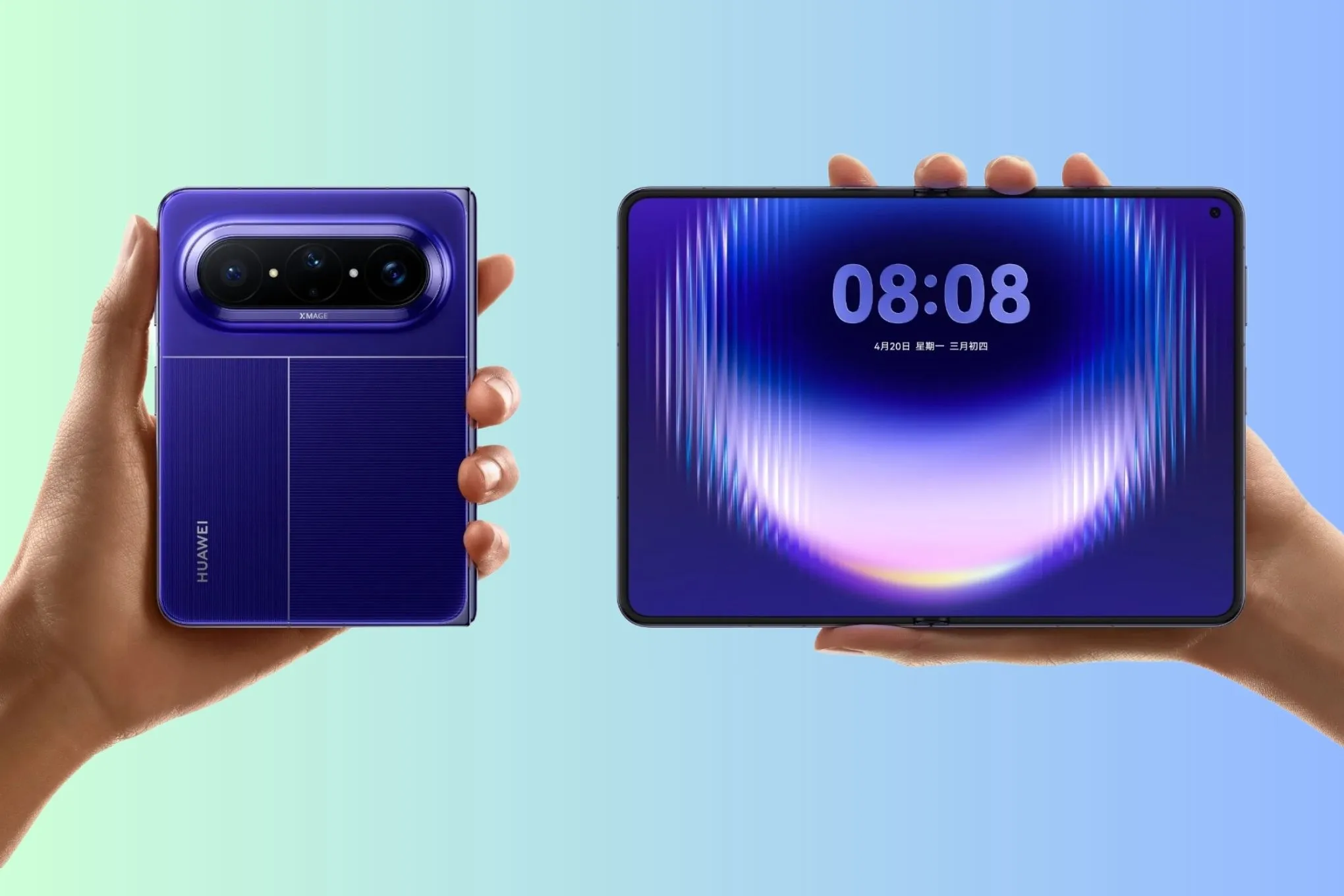
The Pura X Max shifts away from the book style fold used in most current foldable phones. Instead, it opens into a wider horizontal layout. At first glance, that may sound like a modest change in orientation. In practice, the proportions of a screen determine much of what a foldable is useful for. A taller inner display can make a phone feel like a phone with extra space; a wider one has a stronger claim to being a pocketable device intended for viewing, reading, working across apps, and handling media without constantly turning the handset sideways.
The device includes a 5.4 inch outer display and expands into a 7.7 inch inner screen with high brightness levels. Those two displays point to the central compromise Huawei is trying to manage. The outer screen still needs to support quick, ordinary interactions when the device is closed. The larger inner panel has to justify the added size, cost, and mechanical complexity of a folding design. A 7.7 inch screen gives the Pura X Max a noticeably different canvas from a conventional phone, but the real test is whether that space feels useful in routine moments rather than only impressive in product images.
That is where the horizontal format could be more meaningful than another annual specification increase. Wider displays can better suit video, documents, web pages, and side-by-side app layouts, while also giving software more room to show information without squeezing it into a narrow column. Yet screen width can create its own compromises. Apps are not automatically better merely because they have more pixels around them; the layout has to make sensible use of the added room. Huawei’s design is therefore a bet on daily habits, not just on display size.
From a hardware perspective, the phone uses Huawei’s Kirin 9030 Pro chipset, showing continued reliance on internal chip development. This matters because Huawei still operates under supply constraints in global semiconductor access. In that setting, the chipset is not a background detail. It is part of the company’s effort to maintain control over a premium product strategy while operating with limits that many competitors do not face in the same way.
The Pura X Max also includes a 5,300mAh battery with both wired and wireless fast charging, along with a triple camera system built around a 50 megapixel primary sensor. These are the kinds of features buyers expect in the premium category, especially when a foldable is being positioned as more than an experimental second device. Battery capacity matters particularly in a phone designed around a large, bright inner display. Camera hardware matters because buyers at this level are unlikely to accept an obvious trade-off simply for the novelty of a hinge.
Its pricing makes the intended audience plain. The device starts above $1,600 and exceeds $2,000 for higher storage variants. That places the Pura X Max firmly in the high end segment, where a new form factor must do more than attract curiosity. It has to persuade buyers that the design changes how they use a phone enough to warrant paying well beyond the cost of a conventional flagship. Foldables have always faced that burden, and a wide foldable raises it further because it asks consumers to trust an approach they have not yet had much opportunity to evaluate.
Market Timing and Competitive Gap
The Huawei Pura X Max enters the market months before competing devices from Apple and Samsung are expected. Current industry expectations place those rival launches in the later part of 2026. Huawei’s advantage is not simply that it can claim to be first. It has a period in which it can see how people respond to the wide foldable format outside of demonstrations and launch coverage.
That window gives Huawei the chance to test consumer response and refine its approach based on real usage data. The most useful feedback will not be whether people find the phone interesting. New foldables almost always attract attention. The harder questions concern whether users spend meaningful time on the 7.7 inch inner screen, whether the 5.4 inch outer display remains practical, and whether a horizontal layout improves the tasks people already perform every day.
Being early is valuable, but it does not automatically decide the category. Apple and Samsung still have time to refine their response before entering the same space, and established brands can benefit from watching a new format meet real-world expectations. Huawei, however, has forced the conversation forward. Companies can no longer treat wide foldables as a distant design exercise if a commercial device is already asking customers to consider one.
This early move also changes how competition in foldables is measured. For years, much of the attention around the segment has centred on incremental hardware upgrades: thinner bodies, improved hinges, brighter panels, larger batteries, and camera improvements. Those changes matter, but they rarely alter the basic purpose of the device. Form factor innovation is different. It asks whether the phone should be shaped differently in the first place.
Huawei’s decision to commercialize this design first suggests that speed to market can still influence perception, even in a segment dominated by a few major brands. The Pura X Max gives Huawei a chance to define the terms of the debate: not just whether foldables should get better, but what kind of foldable buyers should want next.
Near Term Outlook for Foldable Innovation
The release of the Huawei Pura X Max may push competitors to accelerate their own development timelines. If users respond positively to the wider layout, it could become a standard option alongside vertical foldables. That would be a healthier outcome for the category than treating one folding shape as the answer for every buyer. A person who wants a compact device has different needs from someone who wants a larger workspace for media and multitasking.
There is also a risk that the format becomes a solution looking for a problem. Folding phones already ask users to accept extra cost and a more complicated physical design in exchange for flexibility. A wider inner screen only strengthens that proposition if it makes common tasks noticeably easier or more enjoyable. If it does not, the Pura X Max may be seen as another variation in an already niche category rather than a direction others need to follow.
Pricing remains a limiting factor. With the device starting above $1,600 and moving beyond $2,000 for higher storage variants, the Pura X Max is not positioned for mass-market experimentation. It is aimed at buyers willing to pay for premium hardware and a distinct format. That can still be strategically useful: high-end products often reveal whether an idea has enough appeal to move into a broader range later. But the price ensures that early demand alone will not settle the question.
From an editorial standpoint, the key issue is straightforward: does this design solve a real user need, or does it simply add another variation to an already niche category? The answer will depend on how effectively the wider display improves daily use across apps, media, and multitasking. Huawei has secured a strategic lead in experimentation. The more consequential achievement will be proving that the wide foldable is not merely different, but genuinely better for the people prepared to buy one.
Stay Updated: Gadgets

