

Table of Contents
Table of Contents
- Background: What Was IRL?
- The Fake User Scandal
- IRL Shutting Down: The Final Decision
- Lessons From the Collapse
Background: What Was IRL?
IRL shutting down marked the abrupt end of a social app built around an appealing, familiar premise: help young people find things to do and make it easier for them to do those things together. Event discovery has always been a difficult social-media category. It asks a platform to solve several problems at once: show people relevant activity, persuade them to invite friends, and create enough local momentum that opening the app feels useful rather than empty.
IRL tried to meet that challenge by positioning itself around real-life connection. Its original concept centered on event discovery, then had to contend with the unusual conditions of the COVID-19 pandemic, when in-person gatherings became far less dependable. The company adapted by incorporating online event discovery alongside that original idea. On paper, that was a sensible response to a changing market. A service designed to organize people around plans needs to follow where those plans are actually happening.
The company’s founder, Abraham Shafi, reported a user base of 20 million. IRL also secured more than $200 million in venture capital. Those claims mattered because social platforms are routinely judged on scale before they are judged on mature business performance. A large user number can suggest a powerful network effect: more users should mean more invitations, more events, more content and more reason for the next user to join.
That logic depends on the number being real. A social app cannot meaningfully benefit from a network effect if most of the network is not made up of people. In event discovery especially, the distinction is unforgiving. A bot can inflate a total, but it cannot attend an event, answer an invitation, bring friends or form a local community.
That is why the report from The Information was so damaging. It revealed a troubling issue: the majority of IRL’s user base — nearly 95 percent — appeared to be fake. The central question was no longer whether IRL could turn a fast-growing audience into a lasting business. It was whether the audience presented to investors, employees and the public existed in the first place.
For additional background on the story, a video from FireShip examines IRL’s trajectory and the fallout around its reported users.
The Fake User Scandal Behind IRL Shutting Down
Internal skepticism among IRL employees about the company’s user-base claims eventually led to a board investigation. That sequence matters. Startups often live with noisy data, aggressive growth targets and disputed definitions of what counts as a user. Those are serious operational issues, but they are not automatically evidence of deception. The problem becomes far more severe when employees themselves question whether the headline metric can be trusted.
After Shafi’s suspension in April, IRL’s board of directors investigated. Its findings were alarming: the board discovered that 95 percent of the supposed 20 million users were either automated or bots. The conclusion cast serious doubt on the credibility of IRL’s numbers and stripped the company’s earlier growth narrative of its most important support.
User totals are not merely a marketing device in venture-backed technology companies. They can affect valuation, fundraising, hiring plans and the confidence of partners. They also shape internal decisions. A company that believes it has a large, active audience may spend differently on product development, marketing and expansion than one that understands it is still trying to win over a relatively small base of real people.
The alleged scale of the problem at IRL made it particularly hard to treat as a routine data-cleaning exercise. If nearly all of a reported audience is automated or bot activity, the number is not just overstated at the edges. It changes the basic picture of the business. The difference between a service with 20 million real users and one whose purported audience is overwhelmingly fake is the difference between a viable social network and a misleading dashboard.
The Securities and Exchange Commission (SEC) has initiated an investigation to determine if IRL misled investors and violated securities law. That investigation places the issue beyond the usual startup argument over growth quality. Investors can tolerate a missed forecast or a product that fails to catch on. They cannot make informed decisions if the underlying evidence of adoption is unreliable.
The episode also fits an uncomfortable pattern in the tech industry: user numbers can be easy to repeat and difficult for outsiders to verify. Earlier this year, JP Morgan sued the founder of Frank, a startup it acquired for $175 million, for falsely reporting user figures. The comparison does not erase the specific allegations surrounding IRL, but it does show why investors have reason to interrogate headline metrics rather than accept them as proof of market traction.
IRL Shutting Down After a $1 Billion Valuation
IRL’s financial rise made its collapse all the more striking. In June 2021, the company secured a substantial investment of $170 million from SoftBank, leading to a valuation exceeding $1 billion. That valuation placed IRL among a class of startups expected to grow into major technology businesses. A billion-dollar valuation is not a guarantee of durability, but it carries an implicit expectation that the company has something difficult to replicate: a large audience, a defensible product or a credible path toward both.
Within a year, however, IRL laid off 25 percent of its workforce. Layoffs can reflect many pressures, including a change in spending priorities or a need to extend a company’s runway. In IRL’s case, they also read differently in hindsight. They were a sign that the optimistic valuation and the practical demands of operating the company were no longer moving in the same direction.
Shafi attempted to reassure remaining staff by saying the company had sufficient cash reserves to sustain operations until 2024. The statement highlighted the unusual nature of what followed. This was not presented simply as a company that had run out of money after an expensive attempt at growth. The crisis went to the credibility of the user base itself, which is harder to repair than a weak quarter or a failed feature launch.
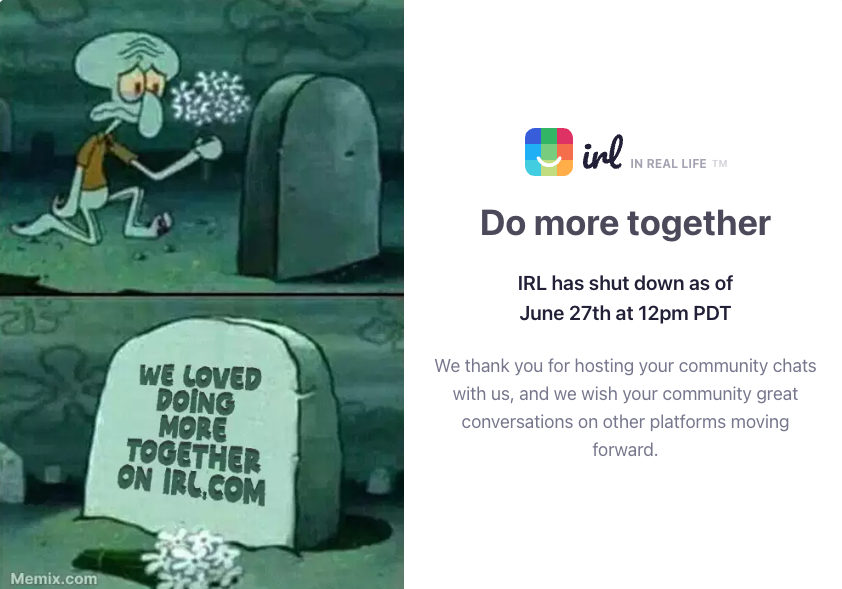
Ultimately, IRL shutting down became inevitable. Visitors to IRL.com are greeted with a message announcing that the app’s closure was effective June 27. For users, the closure ends a product that had promised to make social coordination and event discovery easier. For employees and investors, it closes a much more complicated chapter: one in which a highly valued company’s public image collided with questions about whether its core metric represented genuine demand.
The loss is not only financial. Social products depend on trust in a very direct way. People use them because they expect other people to be there. When that premise breaks down, there is little left for the product to offer, regardless of the money raised or the valuation previously assigned to it.
Lessons From the IRL Shutting Down Collapse
The story of IRL shutting down is a cautionary tale for investors and founders alike, but the lesson is not merely “check the numbers.” Metrics need to be understood in context. A large reported audience may look impressive, yet it says little on its own about whether users are active, whether they return, whether they find value, or whether the service is forming a real community.
For founders, the pressure to present growth can be intense. Social platforms are often encouraged to demonstrate scale quickly because scale attracts attention and capital. But the incentive to make the top-line figure look bigger can create a disastrous gap between what a company says it is building and what users actually experience. That gap eventually reaches the board, the workforce and the market.
For investors, IRL is a reminder that due diligence cannot stop at headline totals. The most useful questions are often basic ones: Who are the users? What are they doing? Are they interacting with one another? Would the service still have value if acquisition spending stopped? Those questions are especially important for an event-focused app, where real participation is the product.
Authentic user engagement is far more valuable than inflated metrics. When the social app valued at $1 billion, IRL, built its reported growth on bots rather than real users, the entire foundation proved unsustainable. Genuine community-building must remain at the heart of any social platform’s strategy. Without it, even a well-funded app can become a very expensive illusion.

