


The most persistent myth in tech right now is that developers should be afraid of really good AI. That one day a model will write flawless, architecturally sound, edge-case-aware code and make senior engineers obsolete. That’s the debate dominating conference talks and developer forums. It’s also almost entirely the wrong conversation. Bad AI replacing developers — not because it’s brilliant, but because it’s cheap enough and good enough to delay a hiring decision — is the actual dynamic playing out inside companies right now.
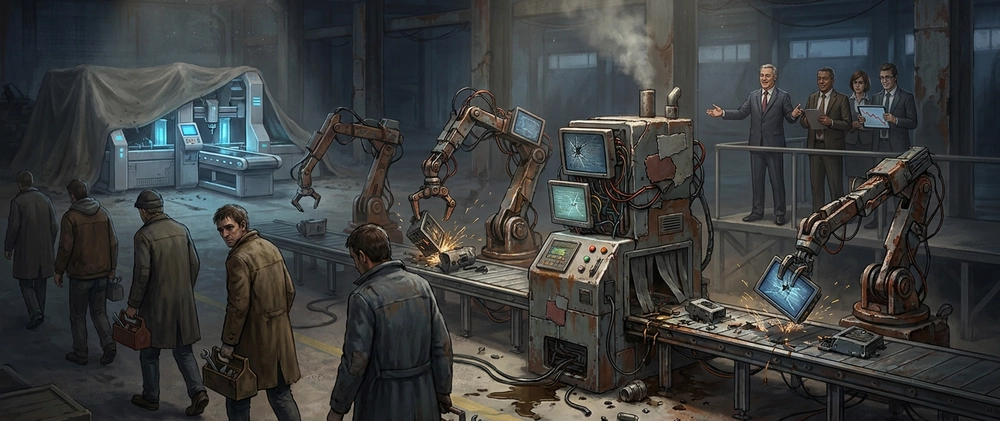
- Bad AI replacing developers is already happening — not because the tools are good, but because they’re cheap enough to justify headcount cuts.
- The real risk of bad AI replacing developers isn’t incompetent code today — it’s hidden technical debt that surfaces months after the layoffs.
- Skills like systems thinking, debugging intuition, and organizational trust can’t be replicated by a $20-a-month subscription.
- The genuine threat to engineering careers isn’t brilliant AI — it’s a spreadsheet wielded by a VP chasing a 40% cost reduction.
Table of Contents
The Boardroom Question Nobody’s Asking Out Loud
Here’s how engineering directors and developers tend to frame the AI threat: can this tool match the output of a senior engineer? Can it understand system architecture? Does it reason through edge cases? These are genuinely interesting technical questions. They are also completely irrelevant to the person approving headcount.
The question in the boardroom isn’t “Is this AI as good as our best engineer?” It’s simpler and far more dangerous: “Is this AI good enough that we don’t need to backfill when someone leaves?” Those two questions have almost nothing in common. One is a quality benchmark. The other is a cost justification. And only the second one determines whether your role exists in eighteen months. Bad AI replacing developers doesn’t require the tools to be impressive — it only requires them to be cheap enough to make a compelling slide in a budget meeting.
A VP doesn’t get promoted for maintaining excellent code health across the platform. They get promoted for cutting engineering spend by 40%. That’s not cynicism — that’s just how quarterly earnings cycles work. When incentive structures reward cost reduction over capability investment, a mediocre AI tool that ships a feature that mostly works isn’t a failure. It’s a success. Ship it, log the bugs, let the remaining team deal with the fallout.
What “Vibe Debt” Actually Means — and Why It’s Dangerous
A phrase gaining traction in developer communities is vibe debt — a specific category of technical debt generated by AI-produced code. It’s code that looks right on review. It passes the linter. It might even work fine through the first quarter after deployment. But something feels off. There’s a structural wrongness that’s hard to articulate until it isn’t — until a production incident at 2 AM makes everything uncomfortably clear.
The insidious part about vibe debt is that it doesn’t appear on a quarterly report. What does appear? The salary line item that got eliminated when the team was cut. The timeline, when it plays out, looks something like this: AI-generated code ships in the spring. A subtle bug surfaces in the autumn. The engineer who would have spotted it during review was laid off six months earlier. A contractor gets brought in at twice the day rate to diagnose and fix it. The total cost of the “savings” quietly exceeds the original salary budget — and nobody officially acknowledges it happened. This is the hidden accounting of bad AI replacing developers: the losses are real, they’re just booked in a different quarter.
This isn’t a new story. It’s the outsourcing playbook, rerun with a new protagonist. Every few years a new technology or labor arbitrage strategy emerges that makes skilled engineers look expensive by comparison. Offshore development teams in the 2000s, no-code platforms in the 2010s, and now AI code generation. The cycle is consistent: replace skilled people with a cheaper option, declare victory for two quarters, quietly hire specialists to clean up the mess, never publish a post-mortem on total cost of ownership. AI just makes the first step more convincing than any previous iteration.
Bad AI Replacing Developers: The Pattern Already Emerging
It’s worth being concrete about what this looks like in practice. Companies aren’t announcing “we’re replacing our engineering team with AI.” What they’re doing is subtler: freezing backfills when engineers leave, reducing graduate intake, shrinking teams below sustainable capacity, and pointing to AI tooling as justification. The engineers who remain get handed more surface area to cover. AI handles the initial code generation. Reviews get faster and shallower because there aren’t enough people for thorough ones. Vibe debt accumulates silently. Bad AI replacing developers this way leaves no single decision to point to — just a gradual erosion of engineering capacity that only becomes visible when something breaks.
According to a RAND Corporation study on AI in software development, AI coding tools can increase output speed for routine tasks — but the productivity gains are uneven, and the risk of subtle defects increases when human review bandwidth shrinks alongside headcount. Faster generation paired with thinner review is not a net win. It’s a delayed loss.
The organizations most exposed to this dynamic are the ones where leadership views engineering as a cost centre rather than a capability. That distinction matters enormously. A company that sees engineering as essential infrastructure will use AI to make their engineers more productive. A company that sees engineering as an expense to be managed will use AI as a reason to have fewer engineers. Same tools, very different outcomes. Bad AI replacing developers is almost always a symptom of that second framing, not a cause of it.
The Skills That a $20 Subscription Can’t Replace
If bad AI replacing developers is driven by cost pressure rather than quality, then the defense for engineers isn’t “be slightly better at writing functions than GPT-4o.” That’s a race nobody should want to run. The more durable position is built on skills that don’t reduce to code generation.
Systems thinking — understanding how components interact across an entire platform, not just producing working code in isolation — is something current models handle poorly. They’re excellent at local solutions. They’re weak at reasoning about how a local solution reverberates through a distributed system two layers up.
Debugging intuition is harder still to replicate. There’s a pattern-matching capability that experienced engineers develop — a sense of wrongness from a stack trace, an instinct about where a race condition is hiding — that emerges from years of production firefighting. An AI tool can parse a stack trace. It can’t feel the wrongness in one at 2 AM when the context is three years of platform history.
Organizational trust is perhaps the most underrated. Being the person in a room whose judgment a team actually believes when you say “this architecture will break under load” is not a capability you can provision from an API. It’s earned over time through being right, being honest about uncertainty, and being present when things go wrong.
None of these appear on a feature velocity dashboard. All of them become critical when a codebase full of vibe debt starts producing production incidents and leadership needs someone who can actually diagnose what happened — and stop it happening again. The scenario of bad AI replacing developers gets most dangerous precisely at the moment those skills are no longer in the room.
Who’s Actually at Risk Here
Counterintuitively, the developers in the most immediate danger aren’t necessarily the least technically skilled. They’re the ones working in organizations where the cultural frame around engineering is transactional. Where features are outputs to be generated rather than systems to be understood. Where the CTO is three layers removed from production and the CFO has more influence over team sizing than the VP of Engineering.
In those environments, bad AI replacing developers is an almost inevitable outcome — not because anyone made a conscious strategic decision to degrade engineering capability, but because quarterly incentives reward the person who cut costs and punish nobody for the technical debt that doesn’t surface until next year’s budget cycle.
The developers with more durable positions are the ones embedded in organizations that have experienced the outsourcing cycle enough times to know how it ends. Companies that have already paid the contractor cleanup tax. Companies where a production incident caused by accumulated shortcuts is recent enough to be institutional memory. Those organizations tend to be more skeptical when someone proposes that AI tools can simply absorb headcount reduction without consequence. They’ve seen bad AI replacing developers tried under different names before — and they remember how the post-mortem read.
The Spreadsheet Is the Threat, Not the Model
Framing this as an AI problem misses the point. The underlying mechanism — prioritizing short-term cost reduction over long-term engineering health — predates large language models by decades. AI is just the current vehicle. It happens to be a particularly convincing one because the output is visible and immediate, while the costs are invisible and delayed.
What’s different this time is the speed. Offshore outsourcing took months to implement. No-code tools required process changes. AI coding assistants can be rolled out to an existing team in an afternoon, and the case for not backfilling a departing engineer becomes easy to make the same week. The compression of that timeline means organizations can make consequential structural decisions about engineering capacity before they have any real evidence about the long-term cost of those decisions. Bad AI replacing developers happens faster than the feedback loop that would reveal the mistake.
The engineers who navigate this period well won’t be the ones who out-generate an AI on routine tasks. They’ll be the ones who can walk into a codebase full of AI-generated slop, diagnose what’s actually broken, articulate clearly why it’s broken, and earn enough trust from the people around them that when they say it needs to be fixed properly — not patched — someone listens. That’s not a skill set that emerged because of AI. It’s the skill set that’s always separated good engineers from replaceable ones. Bad AI replacing developers just made the distinction more urgent.

