
- AI coding costs forced Microsoft to cancel most Claude Code licenses and migrate thousands of engineers to GitHub Copilot by June 30.
- Uber burned through its entire 2026 AI budget in months, with its CTO admitting the company is back to the drawing board on AI coding costs.
- Token-based pricing means vendors profit more the longer your session runs — your productivity and their revenue are directly linked.
- Roughly 28 million of the world’s 30 million developers can’t sustainably absorb current AI tool pricing at any scale.
Table of Contents
When AI Coding Costs Break Even the Biggest Buyers
Two stories dropped in the same news cycle last week, and together they say something the AI industry really doesn’t want you to hear. AI coding costs have become so unmanageable that Microsoft — the company that owns Azure, co-developed GitHub Copilot, and holds a significant stake in Anthropic’s biggest rival OpenAI — has cancelled most of its internal Claude Code licenses. Every major product team, including Windows, Surface, Teams, and Outlook, is being moved onto GitHub Copilot CLI before June 30. The reason, according to consistent reporting, is brutally simple: usage exploded, the bills became indefensible, and it was cheaper to migrate thousands of engineers than to keep feeding the meter.
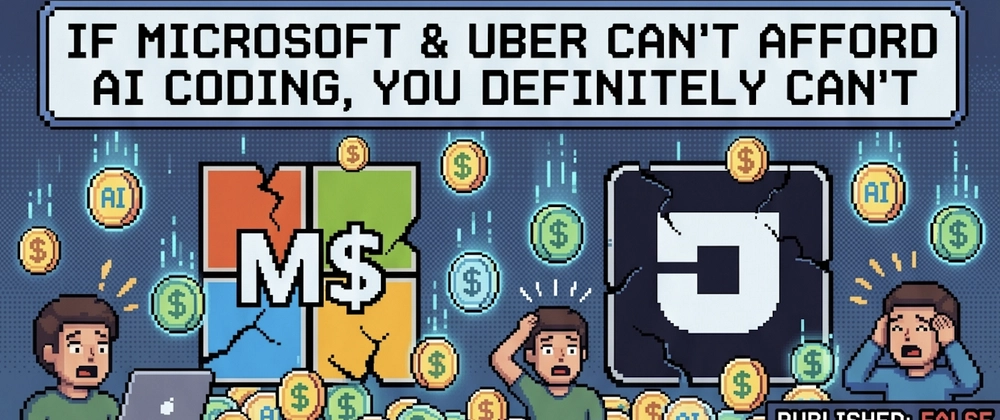
Almost simultaneously, Uber CTO Praveen Neppalli Naga went public with an uncomfortable admission. Uber, a company that spent $3.4 billion on R&D last year and is still increasing that number, burned through its entire planned 2026 AI budget within months. Engineers were ranked on internal leaderboards for AI tool adoption. Claude Code became the dominant tool of choice across the org. Then the invoices arrived. Naga said Uber is now “back to the drawing board.” The AI coding costs at Uber were significant enough to reset the company’s entire approach to AI tooling mid-year.
Let that settle for a moment. Two of the most well-capitalised, AI-enthusiastic companies on the planet — companies with dedicated ML infrastructure teams, negotiated enterprise contracts, and direct relationships with the model providers — both hit a financial ceiling on AI coding costs before we’re even halfway through 2025. If the economics don’t work for them, what exactly is the plan for everyone else?
The Parking Meter Business Model Nobody Wants to Talk About
The tools themselves aren’t the problem. Claude Code is genuinely impressive. So is Cursor. So is OpenAI’s Codex. The engineering behind these products represents years of serious research and real capability. But the business model underneath all of it has a structural flaw that’s starting to show at scale.
Every major AI coding tool today runs on token-based pricing. You pay for what the model reads and generates — input tokens, output tokens, reasoning tokens, tool-call tokens. And here’s the part worth sitting with: the more productive the tool is, the more tokens it burns, and the more money the vendor makes. Productivity and cost are positively correlated by design. Every time the agent re-reads your codebase to remind itself of the file structure, every redundant reasoning loop, every “let me check that file again” — that’s billable. The meter doesn’t stop running just because the agent is spinning its wheels. This is precisely why AI coding costs can spiral so quickly even on tasks that feel routine.
The industry’s answer to this has been to make context windows bigger. We went from 32K tokens to 200K, then to 1 million, now pushing toward 2 million with models like Anthropic’s Claude. The pitch is that a bigger window means the model can hold more of your codebase in view at once. What that framing leaves out is that you’re paying to stuff your entire repository into a fresh prompt on every single turn. That’s not memory — it’s amnesia with a billing account attached.
Why AI Coding Costs Keep Climbing: The Token Arms Race
The whole industry has settled into what you might call a token-maximising arms race. Longer reasoning chains. More tool calls per task. Bigger context windows. Every one of these improvements is also, not coincidentally, a reason to charge you more. The architecture of these tools isn’t designed around efficiency — it’s designed around capability demonstrations that happen to require burning a lot of tokens. Rising AI coding costs are a direct and predictable output of this architecture.
Real memory doesn’t work this way. Your brain doesn’t reload your entire life history every time you try to remember where you left your keys. It selectively surfaces what’s relevant, compresses things that don’t need full resolution, and lets irrelevant details fade. A coding agent with genuine persistent memory — one that actually retained your codebase architecture, your team’s conventions, the decisions made last month, the bug fixed in auth.ts three weeks ago — wouldn’t need to re-read 400,000 tokens of context on every new task. It would already know. The token bill would collapse. Arguably, quality would improve too, because the agent wouldn’t be drowning in freshly-loaded context it has to process from scratch.
So why hasn’t anyone built this? Because memory cuts token revenue. For any vendor whose margin depends on token consumption, persistent memory is a direct conflict of interest. Building the feature that uses fewer tokens means making less money per session. The incentive structure actively works against the efficiency improvement that would make AI coding costs sustainable at scale.
The $200/Month Plan and the Subsidy That Won’t Last
If you’re an individual developer on a $20 or $200 monthly plan and things feel manageable right now, that’s real — but it’s worth understanding why. You’re almost certainly being subsidised. The actual compute cost of a heavy agentic coding session significantly exceeds what most personal plans charge. Someone upstream is eating that difference while the major players race to build market share and user dependency before they need to show real margins.
Anthropic is reportedly raising at a $900 billion valuation. OpenAI just closed another massive round. At numbers like those, the investor math doesn’t close on “we lose money on every power user indefinitely.” The subsidised pricing era has an expiry date, and when it ends, the AI coding costs that broke Microsoft’s internal budget will become everyone’s problem — not just the enterprise teams.
A Global Developer Market That Doesn’t Fit the Pricing Model
There are approximately 30 million software developers worldwide. By most reasonable estimates, maybe 2 million of them work at organisations that can sustainably absorb token-metered agentic coding at current prices — companies with venture backing, large engineering headcounts, or the kind of revenue that makes a $1,500-per-seat monthly tool feel like a rounding error.
The other 28 million are a different story entirely. A developer in São Paulo earning R$15,000 a month isn’t budgeting $200 for a Claude subscription. A two-person startup in Jakarta isn’t running a Cursor team plan. An independent developer in Lagos isn’t dropping enterprise-tier money on agentic coding infrastructure. The math doesn’t work, and another OpenAI funding round at a higher valuation doesn’t change that arithmetic. For the vast majority of the global developer population, AI coding costs are simply out of reach at current pricing levels.
This matters because the narrative around AI and global developer access has been relentless. Every major AI keynote for the past two years has included some version of “AI levels the playing field for developers everywhere.” The language of democratisation has been central to how these products are sold, funded, and covered. But current AI coding costs tell a different story. A junior developer in Toronto on a subsidised Pro plan has more effective AI leverage per dollar than a senior engineer in a lower-cost market who can’t justify the subscription. That’s not democratisation — it’s a new access gap wearing a futurist paint job.
What the Microsoft and Uber Situations Actually Signal
The real lesson from Microsoft and Uber isn’t that AI coding tools don’t work. They clearly do — that’s precisely why usage exploded at both companies. Engineers weren’t burning through budgets because the tools were useless. They were burning through budgets because the tools were useful enough to use constantly, and constant use at token-metered pricing is financially brutal at scale.
What these two cases signal is that the current architecture — maximum context, maximum tokens, maximum cost per session — isn’t a sustainable foundation for how the industry will actually develop. The companies that figure out genuine efficiency first, whether through persistent memory, smarter context management, or pricing models that aren’t directly tied to session length, will be the ones that can actually reach the full developer market rather than the 7% of it that can currently afford to play. Solving AI coding costs isn’t a secondary concern — it’s the central challenge standing between these tools and mainstream adoption.
Microsoft’s pivot back to its own Copilot tooling is telling in a different way too. When your own engineers are jumping ship from a third-party AI tool because it’s too expensive — and you happen to own a competing product — you do the math quickly. Expect more large enterprises to run similar calculations in the next six to twelve months. The era of uncritical AI tool adoption on open budgets is clearly over, and the pricing models that worked during the land-grab phase are going to face serious pressure as finance teams start reading the invoices.