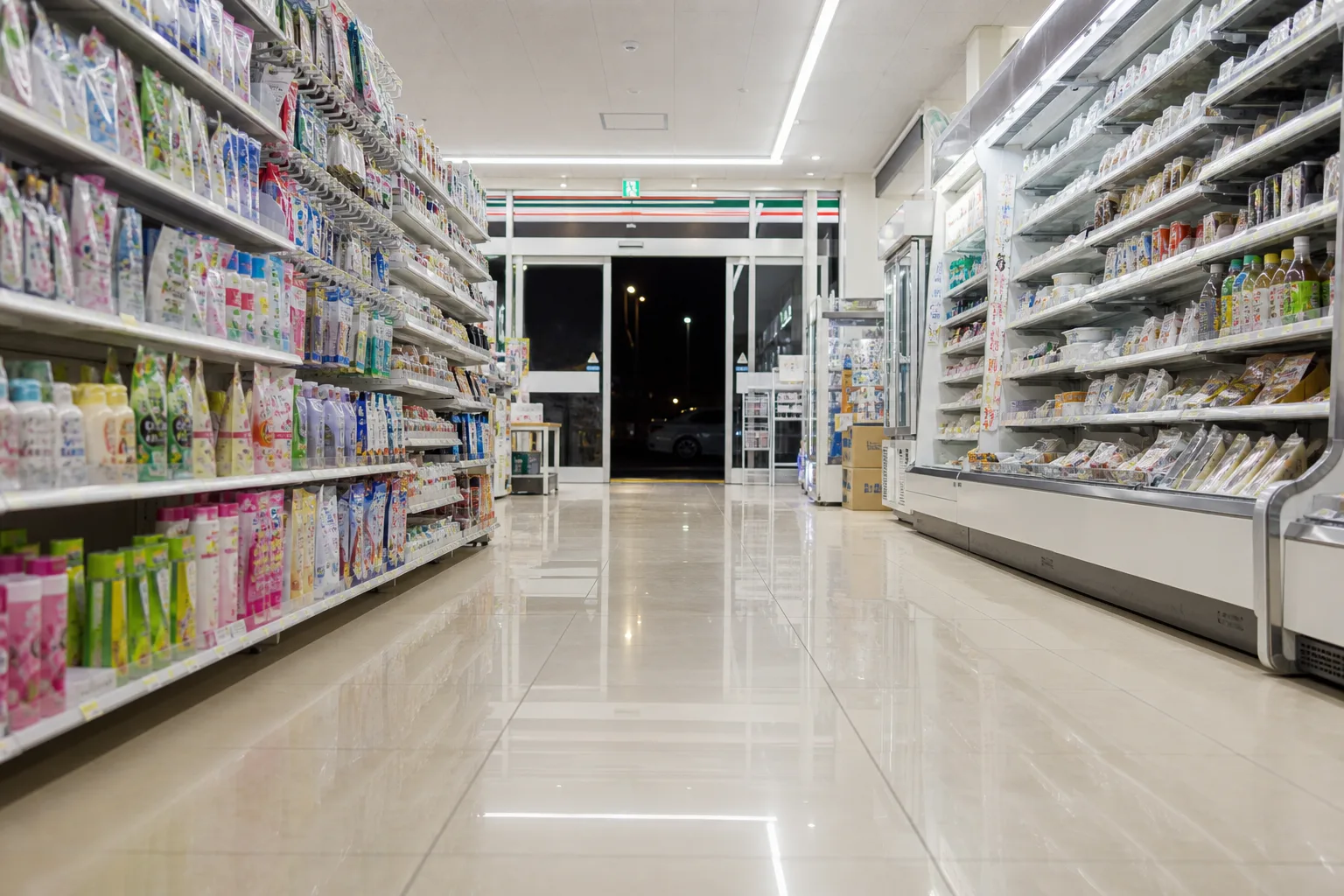
- Toshifumi Suzuki founded Seven-Eleven Japan in 1973, growing it to over 10,000 stores within three decades.
- Toshifumi Suzuki defied internal opposition to introduce franchising to Japan’s retail industry in 1974.
- He later led the rescue of the original U.S. 7-Eleven parent company, Southland, in 1991.
- His integrated data systems made Seven-Eleven Japan a surprising early model for supply-chain technology.
Table of Contents
Toshifumi Suzuki and the Reinvention of Japanese Retail
Toshifumi Suzuki, the man who took a struggling American convenience store licence and turned it into one of the most operationally sophisticated retail empires in history, has died. His name may not carry the same immediate recognition in the West as Steve Jobs or Jeff Bezos, but among people who study retail, supply chains, or the history of consumer technology, Suzuki belongs in the same conversation. Born on December 1, 1932, in Nagano prefecture — then a largely rural area about 125 miles northwest of Tokyo — he would go on to reshape how hundreds of millions of people shop.
He didn’t start in retail. After graduating from Chuo University in Tokyo with an economics and commerce degree in 1956 — where, by his own account, he spent time as a student protestor and a stint leading a labour union — Suzuki worked in publishing sales. It took a chance meeting in 1963 with Masatoshi Ito, a legendary Japanese retailer then building what would become the Ito-Yokado superstore chain, to redirect the trajectory of his career entirely. And, as it turned out, the trajectory of Japanese commerce.
A Franchise Idea Nobody Wanted
By the early 1970s, Ito-Yokado was running into a familiar problem. Japan’s retail laws — some dating back to the 1930s, reinforced again in the 1950s — were designed to protect traditional neighbourhood markets, the ubiquitous mom-and-pop shops that dotted every city block. Those laws had already squeezed the superstore model, and Ito-Yokado needed a new growth path. Toshifumi Suzuki, who had become a company director in 1971, was sent to the United States to negotiate a licensing deal for a Denny’s restaurant chain. What he came back with was something far more consequential.
During those U.S. trips, Toshifumi Suzuki encountered the 7-Eleven convenience store chain, then operated by the Southland Corporation out of Dallas, Texas. Suzuki saw something his colleagues didn’t. Japanese consumers, he argued, were actually ideal candidates for a well-run convenience store format. They shopped frequently, often multiple times a day, valued freshness above almost everything else, and lived in compact homes with little storage space. The small local shop wasn’t dying because people didn’t want it — it was dying because it was badly run.
His Ito-Yokado colleagues were not convinced. Backed by economic consultants, they argued that small-format retail was structurally incapable of achieving the economies of scale needed to be profitable. Toshifumi Suzuki pushed back anyway. His argument was elegant: franchise the format, let existing shop owners buy in, trade their locations and customer loyalty for modern management systems and supply-chain support. You don’t fight the entrenched small retailers — you recruit them.
He convinced Masatoshi Ito. Then he flew back to Dallas and convinced Southland, whose own executives had absorbed the same scepticism about small-format retail in Japan. In November 1973, Southland agreed to license its name and systems to the new Japanese subsidiary for a 0.6 percent gross-profit royalty, with a commitment to open 1,200 stores within eight years. Seven-Eleven Japan was formally established with Toshifumi Suzuki as president and Ito as chairman — and crucially, staffed with people from outside the retail industry to avoid the calcified thinking that had held it back.
What Made Seven-Eleven Japan Different
The franchise launched in 1974, and Toshifumi Suzuki didn’t just import the American model — he rebuilt it from the inside out. Where U.S. convenience stores leaned on long shelf lives and bulk inventory, his version emphasised freshness, tight product selection, and rapid restocking. That required an information infrastructure that simply didn’t exist yet in Japanese retail.
What followed was one of the most quietly influential technology deployments in retail history. Seven-Eleven Japan built integrated data systems that connected point-of-sale terminals, inventory management, customer behaviour tracking, and supplier logistics into a single, real-time picture. In an era before the phrase “data-driven” had entered the business lexicon, Suzuki was running a company on exactly that principle. Store managers could see what was selling by the hour and adjust orders accordingly. Suppliers received demand signals almost instantly. Waste dropped, margins improved, and customers found what they were looking for.
By 2003, Seven-Eleven Japan operated more than 10,000 stores, with the wider Ito-Yokado Group recording over $28 billion in worldwide sales. That data infrastructure didn’t just improve the bottom line — it pushed manufacturers and distributors to meet standards they had never been held to before, effectively forcing a modernisation of Japan’s notoriously layered consumer-goods distribution system.
The Rescue of an American Icon
Perhaps the most striking chapter in Suzuki’s career is the one where the student surpasses the teacher. By 1990, Southland — the original 7-Eleven parent, the company that had licensed its brand to him in 1973 — was in serious financial trouble, weighed down by debt and struggling operationally. Toshifumi Suzuki and Ito-Yokado stepped in, acquiring a controlling stake and effectively rescuing the U.S. business in 1991.
The reversal is almost too neat to be real: the Japanese subsidiary, built on a foreign licence, came back to bail out the licensor. It speaks to how thoroughly Toshifumi Suzuki had not just adopted the convenience store model but genuinely advanced it. The company eventually reorganised under Seven & i Holdings, the parent that today oversees one of the largest convenience store networks on the planet, with 7-Eleven locations spanning North America, Japan, and well beyond.
Beyond Stores: E-Commerce and Economic Reform
Suzuki’s ambitions extended past physical retail. He was an early and vocal advocate for business-to-consumer e-commerce in Japan, pushing Seven-Eleven’s network of stores as a platform for online order collection and payment — a model that anticipated by years what Amazon and others would later call click-and-collect. In a country where credit card penetration was low and trust in online payment was limited, using a trusted physical store as the fulfilment node was genuinely clever infrastructure thinking.
He was also a forceful public voice for economic liberalisation, arguing consistently that Japan’s layered distribution systems and protectionist retail regulations were costing consumers and holding back domestic growth. In January 2004, Nikkei Industrial News ranked Toshifumi Suzuki the fifth most respected business leader in Japan — recognition from a country where such consensus-based rankings carry real weight.
A Leader Who Didn’t Wait for Consensus
What made Toshifumi Suzuki unusual, particularly within the context of Japanese corporate culture, was his refusal to be governed by it. Japan’s business tradition prizes collective decision-making, deference to seniority, and incremental change. Suzuki operated differently. He was willing to be the lone voice in the room, to push an idea his colleagues thought was ridiculous, and to back his conviction with action before the data had caught up to his instincts.
That disposition — contrarian but not reckless, data-hungry but willing to act on incomplete information — is what allowed him to see what others missed in 1973: that Japan’s small-format retail wasn’t a dying sector, it was an underserved one waiting for better management. He was right, spectacularly so, and the proof is still visible in the brightly lit 7-Eleven on virtually every street corner in Tokyo today.
Retail and supply-chain observers will keep returning to the work of Toshifumi Suzuki as AI-driven inventory management, frictionless checkout, and hyper-local logistics become the new battlegrounds in convenience retail. The questions he was asking in the 1970s — how do you get the right product to the right shelf at the right moment? — are still the questions that matter. He just happened to answer them several decades early.