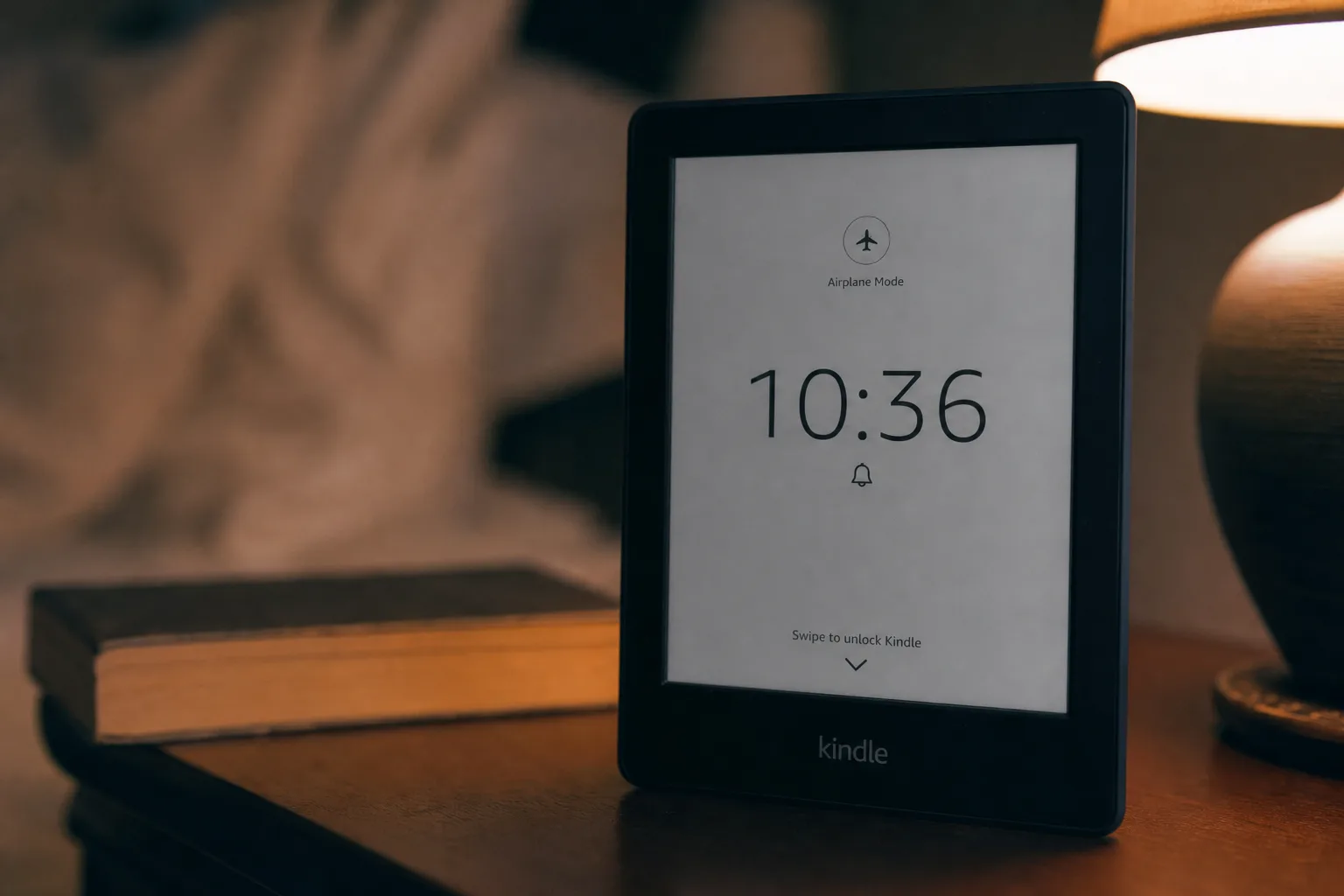
- Rust on Kindle is now possible thanks to cross-compilation via cargo-zigbuild targeting ARMv7 and musl libc.
- Getting Rust on Kindle required building a custom Slint backend to drive the e-ink screen and touch input.
- The developer published a working kindle-backend crate on crates.io, making the project reusable for others.
- Linux’s “everything is a file” philosophy made framebuffer output and touch input surprisingly straightforward.
Table of Contents
Table of Contents
- When a Nightstand Clock Turns Into a Full Jailbreak Project
- From a Bedside Clock to a Rust Target
- Why the Backend Is the Interesting Part
- A Small Crate With a Larger Lesson
When a Nightstand Clock Turns Into a Full Jailbreak Project
Rust on Kindle was not exactly the goal when developer Sverre sat down with a 7th-generation Kindle Paperwhite and a screwdriver — metaphorically speaking. The original plan was modest: jailbreak the device, borrow some existing code, and use the Kindle as a bedside clock. That is the sort of project that sounds almost quaint in an era of phone screens, smart displays and always-on assistants. A Kindle has a readable screen, low visual noise and a physical presence that suits a nightstand better than another glowing rectangle.
Simple enough, at least until the software stack becomes visible.
The distinction matters. Running a small application on a general-purpose computer is usually a matter of installing dependencies and choosing a toolkit. Running one on a dedicated e-reader means confronting the boundary between a pleasant programming language and the hardware it is meant to control. The Kindle’s e-ink display does not behave like an ordinary desktop monitor, and touch input is not something an application gets for free just because the device has a touchscreen.
That is where this stopped being a clock project and became a piece of low-level systems work. Sverre’s route to Rust on Kindle involved cross-compilation through cargo-zigbuild, targeting ARMv7 and musl libc. Those details are not decorative. They describe the practical work of producing software on one machine for a different processor and runtime environment, then making it fit an appliance whose original purpose was reading books rather than welcoming third-party Rust applications.
Programmers often describe this kind of escalation as inevitable. You crack open one door and find a corridor of more interesting problems behind it: first getting code onto the device, then making a binary run, then drawing pixels, then handling touch, then turning those pieces into something another person can use. Sverre frames the experience through a citation to developer Pete Cordell, which is fitting. The real satisfaction in projects like this is rarely the first visible result. It is the moment the formerly inaccessible parts of a device become understandable.
From a Bedside Clock to a Rust Target
Rust is an especially interesting choice for this sort of experiment because its appeal is not limited to speed. Systems programming on constrained or unusual hardware tends to expose assumptions that are easy to ignore elsewhere: what libraries are available, what operating system interfaces exist, how input arrives, and how graphics are presented. Rust gives developers a language designed for close-to-the-metal work while retaining tools and package conventions familiar to modern application development.
But a language alone does not turn a Kindle into a friendly target. Cross-compilation is the bridge, and cargo-zigbuild is central to this project because it makes it possible to build for ARMv7 with musl libc rather than assuming the developer’s own machine matches the Kindle. That is the unglamorous part of portability. A program may be logically correct and still be unusable if its output cannot run in the environment where it is needed.
The use of musl libc also points to a broader reality of embedded and appliance-like Linux systems: developers cannot always rely on the exact runtime arrangements available on a conventional desktop distribution. Portability is often won or lost in these seams. Toolchains, binary targets and libraries are not side issues when the destination is a jailbroken e-reader. They are the project.
The result is more significant than “Rust runs on a Kindle.” Plenty of hobby projects prove that an old device can be made to execute new code. The more useful achievement is creating a repeatable route for doing it. A one-off binary is a personal success. A build path that others can understand and adapt is infrastructure.
Why the Backend Is the Interesting Part
The custom Slint backend is the clearest sign that this was not just an exercise in compiling. Slint provides an application interface, but an interface only becomes real when it can reach the device’s display and receive input from its touch hardware. Sverre had to build the layer that connected those worlds: a backend able to drive the e-ink screen and work with touch input.
That work has a useful conceptual simplicity. On Linux, screens and inputs can often be approached through ordinary file-oriented interfaces. The familiar “everything is a file” philosophy is not merely a slogan here; it helps explain why framebuffer output and touch input could be surprisingly straightforward. If a framebuffer can be addressed as an interface for output, and touch events can be read through the operating system’s input mechanisms, the task becomes less about proprietary magic and more about correctly connecting known Linux primitives.
“Straightforward” should not be confused with effortless. E-ink is a very different medium from the displays for which many user-interface assumptions are made. A bedside clock can tolerate a deliberately calm interface, but the backend still has to translate an application’s needs into output the device can show. The same is true of touch: receiving events is only the beginning; an application framework has to make useful sense of them.
This is why the backend deserves more attention than the jailbreak itself. Jailbreaking gets a developer through the door. The backend determines whether there is anything practical on the other side. It is the difference between demonstrating that a device is open enough to run code and making it viable for a class of applications.
A Small Crate With a Larger Lesson
Sverre published a working kindle-backend crate on crates.io, which changes the character of the project. The crate makes the work reusable for others rather than leaving it as a private implementation detail behind a bedside clock. That is the point at which a personal hack begins to matter to a broader developer community.
Reusable work is especially valuable in niche hardware projects because the initial friction is so high. Every person who wants to experiment with a Kindle would otherwise need to rediscover the same path through cross-compilation, display output and touch support. Publishing the backend does not remove all the complexity, nor should readers assume it turns a Kindle into a general-purpose tablet. It does, however, give future experimentation a starting point grounded in a working implementation.
There is a healthy lesson here for open development. The most useful artifacts are not always polished consumer products. Sometimes they are the awkward but functional pieces that make a previously impractical idea approachable: a target configuration, a hardware abstraction, a backend with enough of the hard work already solved. Those projects widen the field of what someone else can try.
For Kindle owners, the immediate appeal is obvious. An e-reader repurposed as a bedside clock has character, and it uses hardware that was already designed to remain readable for long stretches. For Rust developers, the appeal is more technical. This is a concrete example of a modern systems language leaving the usual desktop-and-server path and meeting a constrained device on its own terms.
For everyone else, it is a reminder that old hardware is often less limited than its official software suggests. The 7th-generation Kindle Paperwhite did not become a different device. Its screen, touch input and Linux foundations were already there. Sverre’s work simply traces a route from those capabilities to a usable Rust application stack — and, by publishing kindle-backend, leaves that route open for others.