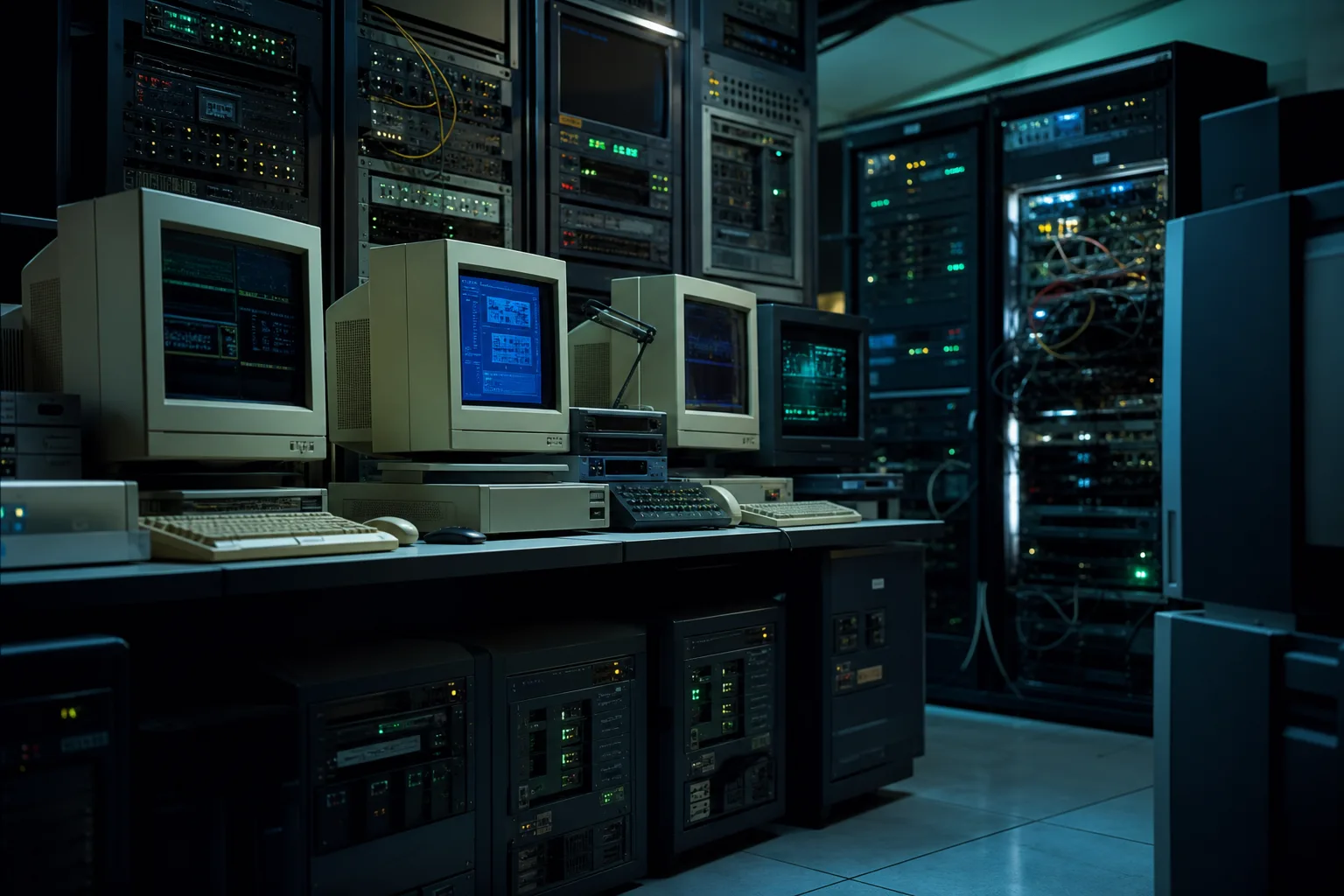
- Jurassic Park computers used real Apple and Silicon Graphics hardware, giving the 1993 control room an unusually credible technical foundation.
- The Jurassic Park computers included an SGI Crimson, Indigo workstations, Macintosh systems, removable storage and a rare Motorola Envoy PDA.
- The production borrowed roughly $1.7 million in period hardware and software, a sign that the production treated its computing props as serious set design.
- The film’s live monitor graphics were operated from an adjacent room, an early practical solution for convincing on-screen interfaces.
Table of Contents
Jurassic Park computers were props with receipts
The most convincing thing about Jurassic Park computers may be that they weren’t invented for the movie. Spielberg’s 1993 blockbuster put actual Apple and Silicon Graphics gear in its control room, then surrounded it with enough cables, storage modules and glowing displays to make John Hammond’s operation feel expensive, complicated and a little brittle. Which, frankly, is exactly what it should feel like.
Three decades later, the machines date the film in obvious ways. There are chunky CRTs, passive-matrix laptop displays and hardware that occupied a small apartment while holding less storage than a cheap promotional USB stick. Yet the set has aged far better than the fictional computer interfaces in most science-fiction films of the era. The production started with real equipment and worked outward from there, and you can feel that decision in every shot.
According to accounts collected in The Making of Jurassic Park, Silicon Graphics loaned about $875,000 of equipment, Apple provided another $350,000, and roughly $500,000 in additional systems and software filled out the production. That is around $1.7 million in early-1990s technology before anyone adjusted for inflation. Hammond said he spared no expense; the art department apparently took him literally.
Special effects coordinator Cory Faucher explained the philosophy bluntly: “Everything in the set was real. We couldn’t fake any of it, because audiences are so sophisticated now in their knowledge of computers.” It’s a marvelous time capsule. In 1993, “sophisticated” meant viewers might identify a Macintosh. Today, viewers pause a 4K stream to identify individual drive arrays.
The Apple PowerBook that starts the story
The first of the Jurassic Park computers appears before anyone reaches Isla Nublar. Alan Grant and Ellie Sattler have an Apple PowerBook 100 in their field trailer, a machine that was already a practical, recognisable portable computer rather than some vague futuristic slab.
Its specifications now read like a dare: a 16MHz Motorola 68000 processor, between 2MB and 8MB of memory, and a 9-inch monochrome 640-by-400 display. It ran System 7.0.1. The archived technical specifications show just how constrained early PowerBook computing was by modern standards, although that misses the point a little. In 1993, carrying a usable computer to a dig site was still a meaningful luxury.
The PowerBook 100 also tells us something about the film’s visual logic. Among the Jurassic Park computers, it belongs with Grant and Sattler because they are scientists in the field, while the control-room staff get specialized graphics workstations. Hammond gets enormous screens and an infrastructure bill that would make a modern theme-park CFO reach for the antacids. The hardware quietly establishes hierarchy before the dialogue does.
The Jurassic Park computers that ran the control room
Ray Arnold’s station is neat, organized and built around an SGI R4000 Indigo workstation, a Macintosh, CCTV monitoring and removable media. Dennis Nedry’s desk, by contrast, looks like a garage workbench after a bad week: multiple computers, several displays, a handheld device, stacks of storage and no visible commitment to cable management. The Jurassic Park computers at these stations double as character design through peripheral placement.
At the heart of Nedry’s setup sits an SGI IRIS Crimson, too large to fit on the desk and parked on the floor beside it. The Crimson was serious machinery in 1992, configurable with a 100MHz R4000 or 150MHz R4400 MIPS processor and a selection of graphics subsystems designed for real-time 3D work. A top configuration could carry up to 256MB of RAM, an almost comical figure for the period and a reminder that visual computing was expensive long before Nvidia became the industry’s favorite ticker symbol.
The Crimson’s screen often displays a 3D chessboard, an on-brand bit of Silicon Graphics eye candy. But the film does something smarter than merely pointing cameras at expensive boxes. The animated hurricane, maps and system views look like the sort of visual output a well-funded SGI installation could plausibly generate. The Jurassic Park computers don’t perform magic. They perform an exaggerated version of specialized, contemporary computing.
That distinction matters. Plenty of films from the period treated a computer monitor as a neon slot machine that could unlock doors, trace calls and render a satellite flyover in the same 10-second animation. Jurassic Park still takes liberties, obviously, but its interfaces have the texture of software made by people who care about maps, sensors and data. The Jurassic Park computers feel less like hacker-movie props and more like an enterprise dashboard built by a team that has never once heard the phrase “user research.”
There’s a practical explanation for those screens. Michael Backes led a four-person graphics team that spent roughly six months producing the animations. During shooting, the team operated from a makeshift room beside the set and fed imagery to particular monitors in response to radio cues. So when an actor seems to call up a map or weather display, someone off-camera is making that moment happen live. That is not real-time park software, but it is real-time filmmaking.
Storage, handhelds and the strange genius of overbuilding
The most wonderfully excessive part of the Jurassic Park computers setup may be the PLI Mini Arrays on both desks. Nedry has a stack of five; Arnold has two. These external storage systems were a visual shorthand for serious data, and in the early 1990s they absolutely were. A 1GB unit reportedly cost $3,598, making seven gigabytes of removable storage a small corporate procurement event rather than an impulse buy at the checkout counter.
Seven gigabytes is nothing now. It is less than a single minute of high-bitrate 4K video, and many phones cache more than that without asking. But when high-end PCs often shipped with drives measured in tens or low hundreds of megabytes, it represented an enormous digital archive. DNA records, animal telemetry, security footage, weather simulations: for the story’s purposes, the storage stack sells the idea that Jurassic Park has data coming out of its ears.
Look closely, though, and the prop work contains a charming imperfection. The arrays’ indicator lights appear inactive, and their orientation changes between shots. That’s continuity for you. Even a park capable of resurrecting dinosaurs couldn’t prevent someone from rotating a storage tower between setups.
Nedry also has a Motorola Envoy PDA near his workstation. The device was a remarkably ambitious early mobile concept: a folding body, antenna, radio modem rated at 4,800 bits per second, fax and data capabilities, and infrared transfer. It had 1MB of RAM and 4MB of ROM. More intriguingly, the unit in the film appears to have been an original mockup from frogdesign rather than a widely sold consumer product. Spielberg reportedly saw it through frogdesign founder Hartmut Esslinger, who showed it to him during a chance airplane encounter.
That detail explains why the Jurassic Park computers are worth revisiting. They are not merely a list of old machines hiding in a beloved film. They document a moment when computer makers wanted their hardware to signify the future, and Hollywood was willing to rent the future at extraordinary cost.
Why this set still works
My read is that Jurassic Park understands a truth many newer productions forget: convincing technology should look a little inconvenient. It needs maintenance. It needs specialists. It needs backups, equipment racks, proprietary software and one underpaid administrator who knows too much. Nedry’s sabotage lands because the park’s systems look interconnected enough to fail spectacularly.
Today’s equivalent set might be a wall of cloud dashboards, tablets and machine-learning alerts. It would be cheaper to build, easier to update and much harder to make memorable. The Jurassic Park computers have physical mass, which gives the failure of the park physical consequences. When the lights go out, you can see the infrastructure that stopped working.
That’s why the control room remains more persuasive than many modern depictions of “advanced” technology. It didn’t predict our gadgets. It captured the enduring anxiety underneath them: someone always has the admin password, the backup may not be where you expect, and the most expensive system in the room is only as reliable as the person running it.
Frequently Asked Questions
What computers were used in Jurassic Park?
The film used a mix of real Apple Macintosh hardware and Silicon Graphics systems. Visible equipment includes an Apple PowerBook 100, an SGI R4000 Indigo, and Dennis Nedry’s floor-standing SGI IRIS Crimson, alongside removable PLI storage arrays and other hardware.
Were the Jurassic Park computers really working?
Many of the screens were actively driven during filming, but not by the actors’ keyboards. A computer graphics crew in a room beside the set received radio cues and sent prepared animations to the control-room monitors, creating the impression of a responsive park system.
Why did Jurassic Park use Silicon Graphics workstations?
Silicon Graphics systems were used on the production to provide graphics for the set’s screens. The SGI machines could run real-time 3D animation, while a graphics team fed prepared animations to monitors during filming.