- 100,000-GPU systems signal that AI leadership increasingly depends on operating an entire computing stack, not merely buying leading chips.
- The rise of 100,000-GPU systems puts networking, electricity, cooling, software reliability and customer workloads on equal footing with accelerators.
- WAIC 2026 reporting reflects China’s push to turn massive AI infrastructure into practical industrial and consumer services.
- A huge GPU count is meaningful only when developers can keep machines busy and produce models people will pay to use.
Table of Contents
100,000-GPU systems are changing the argument
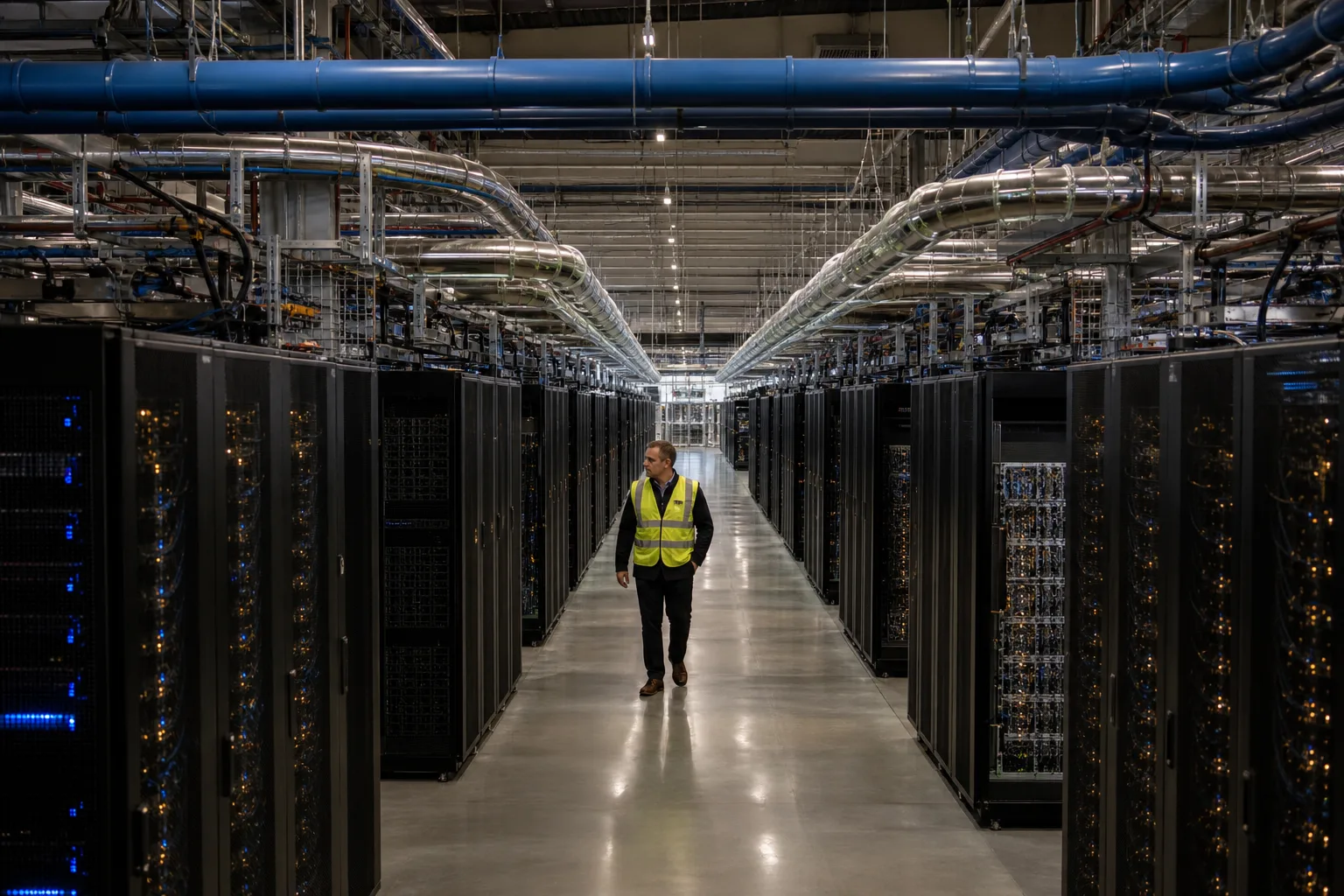
100,000-GPU systems are the kind of numbers that make even seasoned infrastructure people pause. A single accelerator is a component. A rack is equipment. But a cluster reaching into six figures is closer to a power station, a factory and a software platform piled on top of each other. Reporting from WAIC 2026 suggests that this is where the AI race is heading: away from the familiar scoreboard of who has the fastest chip, and toward who can operate the whole unwieldy machine.
The distinction matters because, for the past few years, Nvidia’s GPUs have become the shorthand for AI capability, much as Intel once stood in for the entire PC industry. It was never quite that simple, of course. Yet the shortage of high-end accelerators made the chip itself the obvious bottleneck, and therefore the obvious story.
Now the bottleneck is spreading. If the claims around 100,000-GPU systems hold up in real-world deployments, owning accelerators will be only the admission ticket. Operators must connect them with extremely fast networking, prevent failures from cascading across thousands of machines, feed them enough electricity, remove extraordinary amounts of heat, schedule training jobs, and give developers a reason to use the resulting capacity. That is a much harder business than placing a very large hardware order.
WAIC, the World Artificial Intelligence Conference in Shanghai, has become an increasingly useful stage for this shift because China’s AI ambitions are now tied as much to infrastructure and industrial deployment as they are to headline-grabbing model releases. That broad framing is revealing. The prize is not a photogenic rack of silicon; it is turning all that silicon into services that factories, cities, researchers and ordinary businesses actually use.
The chip is still critical. It just cannot carry the story alone.
None of this makes chips less important. Nvidia remains dominant because its hardware, CUDA software ecosystem and networking portfolio have given it a lead that competitors have struggled to crack. AMD is pushing its Instinct lineup, while Google’s TPUs, Amazon’s Trainium chips and custom silicon from Microsoft and Chinese cloud providers all point to the same conclusion: AI compute is becoming a full-stack contest.
My read is that the industry is finally catching up to a fairly obvious reality. Building a giant AI cluster is less like buying a fleet of luxury cars and more like running an airport. You need the planes, yes, but also runways, fuel, air-traffic control, maintenance crews, gates and passengers. One missing piece can bring the entire operation to a crawl.
At the scale implied by 100,000-GPU systems, the networking layer is especially unforgiving. Training a frontier model requires accelerators to constantly exchange data. A slow link, a poorly tuned collective-communications library or a failed switch can turn premium hardware into very expensive idle metal. Nvidia understood this early, which is why its acquisition of Mellanox now looks less like a side bet and more like a foundational move. The GPU is the engine; the fabric joining thousands of engines is what lets the vehicle move.
There is also the unglamorous matter of uptime. A cluster with 100,000 components will experience failures all the time, simply because probability is rude that way. Operators need systems that identify bad hardware, reroute work, preserve training checkpoints and keep the wider job alive. This is where cloud operators and companies with long experience in hyperscale data centers may have an edge over newcomers that can acquire hardware but have not yet mastered operational discipline.
What 100,000-GPU systems mean for China’s AI push
The WAIC 2026 framing lands at an awkward but important moment for Chinese AI companies. US export controls have complicated access to Nvidia’s highest-end products, while domestic suppliers are under intense pressure to provide alternatives. That pressure has produced genuine momentum around local accelerators, homegrown software stacks and cloud infrastructure. It has also encouraged a more systems-oriented view of the problem: if you cannot always buy the exact chip you want, you have to become better at extracting performance from the hardware you can obtain.
In practice, that may mean model architectures that train more efficiently, inference systems that use lower-precision computation, or clusters built around a mix of hardware rather than a uniform Nvidia deployment. For 100,000-GPU systems, it may also mean tighter integration between cloud providers, chip designers and the companies building industry-specific applications. The resulting systems may not mirror Silicon Valley’s stack exactly, and they do not need to.
Still, readers should treat a giant GPU headline with a little healthy skepticism. A stated cluster size does not automatically tell us how many GPUs are installed today, how many are available to one workload, whether they are top-tier accelerators, or how effectively they are utilized. The industry has a long history of announcing capacity that is technically real but commercially less meaningful than it sounds. Remember when every company suddenly had a metaverse strategy? Hardware can be just as easy to market as avatars.
The better questions are tougher: What models are being trained? How long do jobs take? What is the failure rate? What does each useful unit of inference cost? And, crucially, who is paying for it?
From benchmark theater to applications that earn their keep
That final question explains why the conversation is moving toward use cases. Training a massive model can be a strategic achievement, but it is not a business model by itself. The companies that win the next phase will turn their infrastructure into lower-cost coding tools, better enterprise search, scientific workloads, industrial automation, customer support systems and AI services that are reliable enough to become routine.
100,000-GPU systems could make that possible by providing capacity for both training and inference at enormous scale. But they can also become stranded assets if demand is weaker than expected or if model efficiency keeps improving faster than infrastructure spending. Smarter engineering can occasionally change the economics faster than another order of magnitude in hardware. Bigger remains useful; it is no longer the whole argument.
Power is another constraint that cannot be hand-waved away. AI data centers consume vast amounts of electricity, and operating 100,000-GPU systems is increasingly tied to grid access, generation projects and cooling technology. In regions where power is scarce or expensive, the most impressive accelerator cluster on paper may be little more than an expensive waiting room. That puts utilities, regulators and local governments unexpectedly close to the center of the AI story.
For enterprises, the practical takeaway is simple: don’t judge an AI provider only by GPU counts or parameter counts. Ask about latency, availability, data handling, integration with existing tools and the cost of operating the system after the demo ends. A model that works beautifully in a keynote but cannot plug into a company’s messy databases is not much help on a Tuesday morning.
The arrival of 100,000-GPU systems does not settle the AI race. It raises the stakes and changes the criteria. The next leaders will need chips, certainly, but they will also need power contracts, networks, systems engineers, useful software and customers with problems worth solving. Frankly, that is a more interesting contest than another benchmark chart.
Frequently Asked Questions
What are 100,000-GPU systems?
They are AI computing systems operating at the scale of 100,000 GPUs.
Why does networking matter so much in giant AI clusters?
The source indicates that AI competition is shifting from individual chips toward complete systems and use cases.
Does a larger GPU cluster guarantee a better AI model?
The source does not suggest that computing scale alone determines AI success. It highlights a shift in competition toward systems and use cases.