

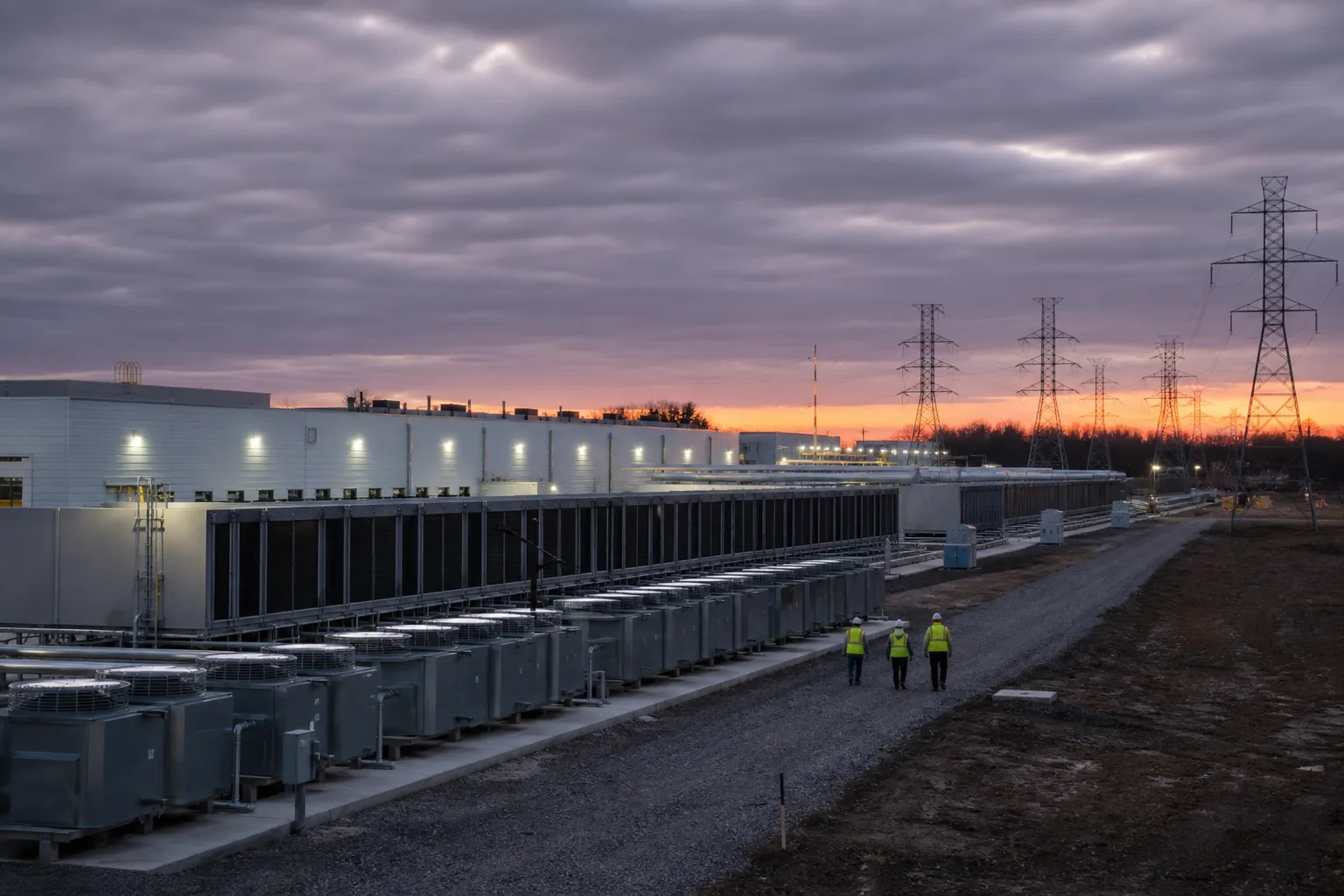
New York’s data center moratorium has become an unusually vivid test of how badly America wants to win the AI race. The immediate fight is about permits, power and local control. The larger one is about whether states can demand cleaner, more accountable infrastructure without quietly handing the next generation of computing to somebody else.
Donald Trump has blasted the New York move as a “terrible decision.” Pershing Square founder Bill Ackman has gone further, warning that restricting AI buildout while China expands could leave “democracy at risk.” Those are deliberately oversized phrases, but they land because AI policy is no longer an abstract Washington conversation. It is transmission lines, substations, warehouses full of GPUs, and the communities asked to host them.
My read is that both sides are identifying a real danger. New York cannot treat every large data center as an unwanted industrial nuisance. But the industry cannot keep acting as if local residents should simply accept a power-hungry facility because someone, somewhere, wants faster chatbot responses.
- The proposed data center moratorium has become a proxy fight over whether New York can participate seriously in the AI economy.
- Critics say a data center moratorium could send investment, computing capacity, and high-paying technical jobs to competing states.
- Donald Trump called New York’s move a “terrible decision,” while Bill Ackman tied AI infrastructure to competition with China.
- New York still faces a legitimate problem: data centers need enormous amounts of electricity, transmission capacity, and local trust.
Table of Contents
Why the data center moratorium matters beyond New York
On paper, a data center moratorium is a pause or limit on new development while officials review energy, environmental, or grid impacts. But that pause can determine where AI companies put billions of dollars in capital. Computing infrastructure is remarkably mobile at the planning stage. If a developer concludes that New York is too uncertain, it can look to Virginia, Texas, Ohio, Georgia, or Arizona instead.
That matters because the AI boom is built on physical concentration. Training and serving large models requires vast clusters of specialized chips, networking hardware, cooling systems and dependable electricity. A cloud region is not a coffee shop you can open around the corner when demand appears. It can take years of land deals, utility coordination, equipment orders and construction.
Electricity demand from data centers, AI and crypto puts a useful reality check on the rhetoric: this is an energy-system challenge, not merely a zoning dispute.
New York already knows what constrained energy infrastructure feels like. The state has aggressive climate targets, expensive electricity in many areas, an aging grid in need of upgrades, and a political culture rightly skeptical of projects that arrive with glossy renderings and vague promises. A data center moratorium reflects those pressures. It is not irrational for a state to ask where the power will come from, who pays for grid upgrades, and whether fossil-fuel plants will stay online longer to support a supposedly digital future.
The AI race argument is real, but it can be misused
Ackman’s warning links the data center moratorium directly to China’s AI ambitions. The basic case is hard to dismiss. The country that controls plentiful compute, advanced chips, energy supply and the software built on top of them will have meaningful economic and national-security advantages. The US is already trying to slow China’s access to the most advanced AI chips through export controls. Building bottlenecks at home would be a strange self-own.
Trump’s criticism runs on a similar instinct. If New York closes the door to major facilities, the work does not vanish; it relocates. The state loses tax revenue, construction work, technical jobs and a seat at the table as AI companies choose where to build their next campuses.
Frankly, this is where the anti-moratorium case is strongest. States cannot say they want AI startups, research labs and high-tech employment while making the underlying compute unavailable or prohibitively difficult to develop. AI has a supply chain, and data centers sit right in the middle of it.
Still, invoking China does not automatically make every proposed project wise. The industry has used urgency before. Remember the breathless rush around crypto mining, when operators hunted cheap power and towns were left debating noise, grid strain and what exactly they had received in return? AI data centers are economically more consequential than many mining operations, but that is an argument for higher standards, not a free pass.
A data center moratorium should be a deadline, not a destination
The useful question is not whether New York should permanently ban data centers. It plainly should not. The real test is whether a temporary data center moratorium produces clear rules quickly enough to protect communities without freezing investment in place.
A serious framework would ask developers to disclose expected power demand, water use, backup-generation plans, grid-upgrade costs and local job commitments. It would prioritize facilities that can shift some demand away from peak periods, contract for new clean generation, use lower-water cooling designs where appropriate, and locate where transmission capacity can realistically support them. None of that is glamorous. Neither is building a substation, but it is the difference between an AI strategy and a press release.
New York should also resist the temptation to make a single category of project carry every energy-policy failure on its back. Data centers can be huge loads, yes. But a state that wants electrified buildings, electric vehicles, domestic manufacturing and AI research must build more generation and transmission regardless. The grid problem was waiting long before generative AI became Silicon Valley’s favorite acronym.
New York risks confusing caution with leadership
The data center moratorium debate exposes a broader American weakness: everybody wants the benefits of advanced technology, but the infrastructure needed to produce those benefits is perpetually somebody else’s problem. Residents want reliable power and clean air. Companies want rapid permits and cheap electricity. Politicians want both outcomes without confrontational decisions on transmission corridors, generation projects or utility reform.
That bargain does not exist. Somebody has to make the tradeoffs visible.
If New York’s pause leads to transparent standards, faster grid investment and credible community protections, it could become a model other states follow. If it turns into an open-ended data center moratorium with no workable path back, competitors will gladly take the projects and the influence that comes with them. In the AI era, compute capacity is becoming something like rail infrastructure in the industrial age: easy to dismiss until you realize the economic map has been redrawn around it.
The uncomfortable question for New York is simple. Does it want to shape the terms of the AI buildout, or merely watch it happen somewhere else?

