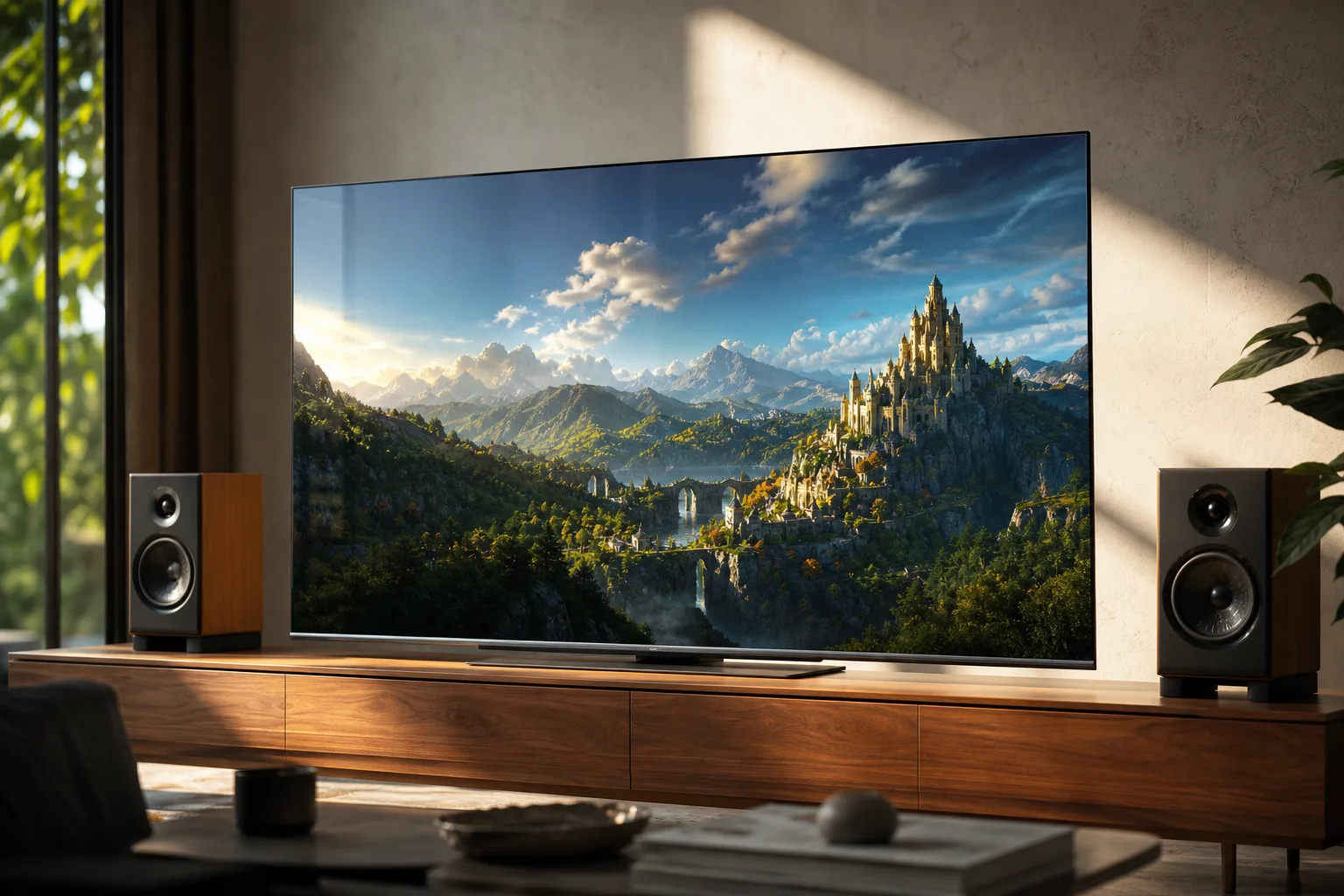
- Sony Bravia 9 II delivers unusually accurate color, 3,800-nit HDR highlights, and exceptional reflection handling for bright living rooms.
- Sony Bravia 9 II improves local dimming over Sony’s Bravia 7 II, though off-angle blooming remains an unavoidable LED compromise.
- The flagship costs substantially more than Sony’s lower-tier RGB LED model and competes directly with premium OLED televisions.
- Two HDMI 2.1 ports limit the appeal for households juggling a console, gaming PC, soundbar, and streaming hardware.
Table of Contents
Sony Bravia 9 II makes daylight less of an enemy
A great television can look magical in a dark room. The harder trick is making a movie look good at 2 p.m., with sunlight bouncing off the coffee table and somebody refusing to close the blinds. That is where the Sony Bravia 9 II makes its strongest case. Sony’s flagship RGB LED set appears built for the kind of living room where an OLED’s cinematic strengths can get swallowed by reflections.
The headline technology is an RGB LED backlight. Instead of relying on the familiar blue LEDs found behind most LCD televisions, the panel uses separate red, green, and blue light sources. That gives the display more room to reproduce saturated colors before the usual filters and LCD layer do their work. It sounds like a detail for spec-sheet obsessives, but it has a visible purpose: richer bright colors without turning skin tones into the sort of orange mess that makes every actor look like they have just returned from a beach holiday.
Sony showed an early version of this approach in Tokyo in 2025, and the company is now bringing it into a TV market that has been waiting for a credible successor to the mini-LED arms race. The original Bravia 9 was already one of the better local-dimming LCD sets available. The Sony Bravia 9 II is Sony’s attempt to make that formula feel current rather than merely brighter.
Brightness is only half the story
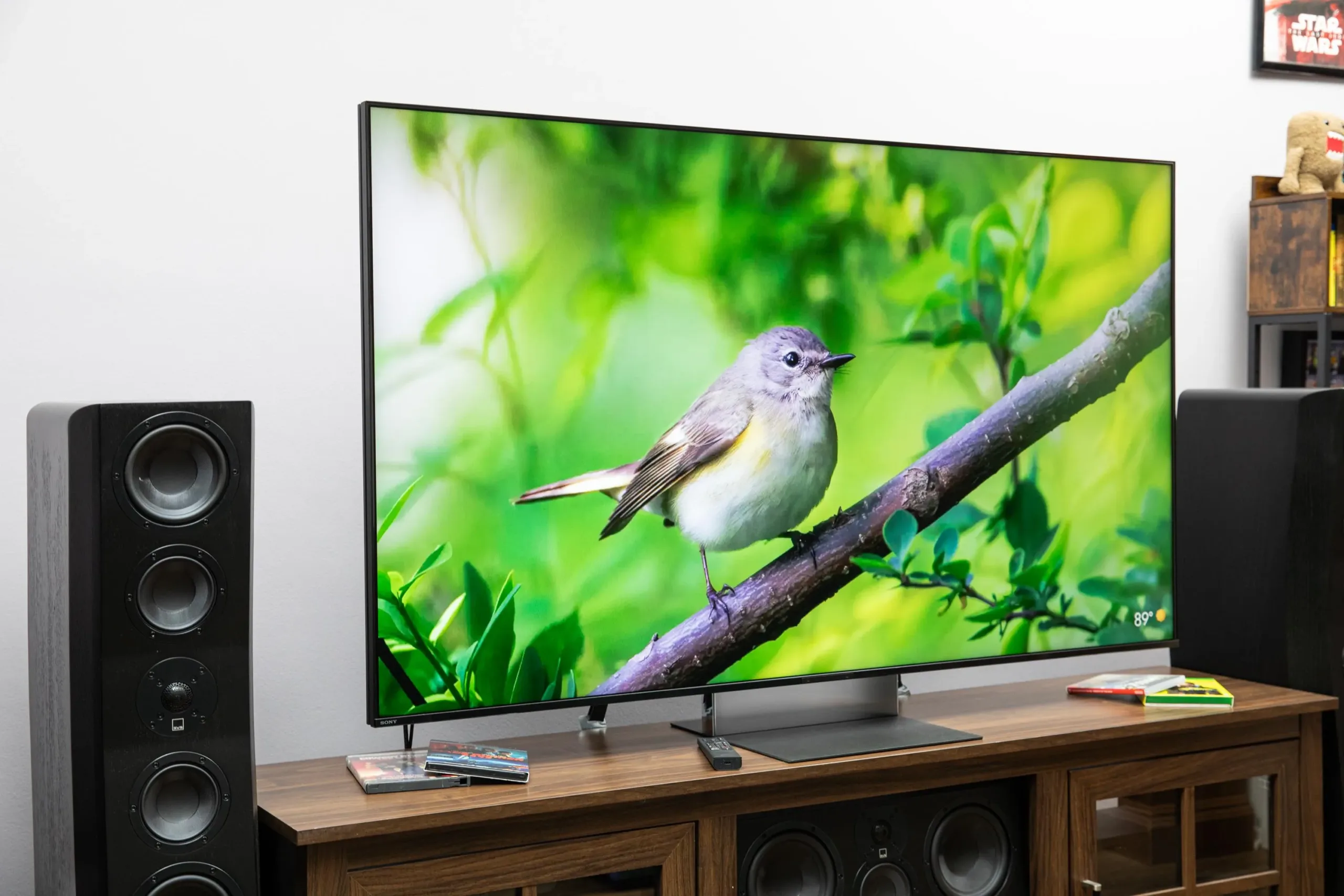
Reported measurements put the TV at roughly 3,800 nits for small HDR highlights and 885 nits on a full white screen. Those are serious numbers. A flash of sunlight on water, a chrome reflection, a spell effect, or an explosion can have the intensity HDR filmmakers intended instead of looking like someone raised the exposure slider and called it a day.
But raw brightness is a slightly silly contest once a television clears a certain threshold. Plenty of sets can blast light at your face. The useful question is whether a TV can manage that light with restraint. Sony’s processing has long been the company’s quiet advantage, particularly with lower-quality streaming feeds and broadcast video. On the Sony Bravia 9 II, that processing appears to preserve shadow detail and depth instead of flattening an image in pursuit of showroom punch.
Professional mode is tuned for darker, more accurate viewing, while Cinema mode offers a more immediately vivid presentation. The difference shows up quickly outside a test lab: a set tuned for a retail floor can make a carefully graded film look ridiculous, while an accurate picture can seem lifeless in an ordinary lounge. Sony is generally better than most at giving owners usable choices without burying them under a maze of picture settings.
There is one measurement caveat: SDR reds reportedly run too saturated and do not reach their intended brightness. It is not ideal, though it is also the sort of flaw many owners may never spot outside a direct comparison. The bigger picture is that the Sony Bravia 9 II seems to handle grayscale, skin tones, foliage, and blue skies with the calm precision Sony buyers expect at this price.
The anti-reflective screen may be the real upgrade
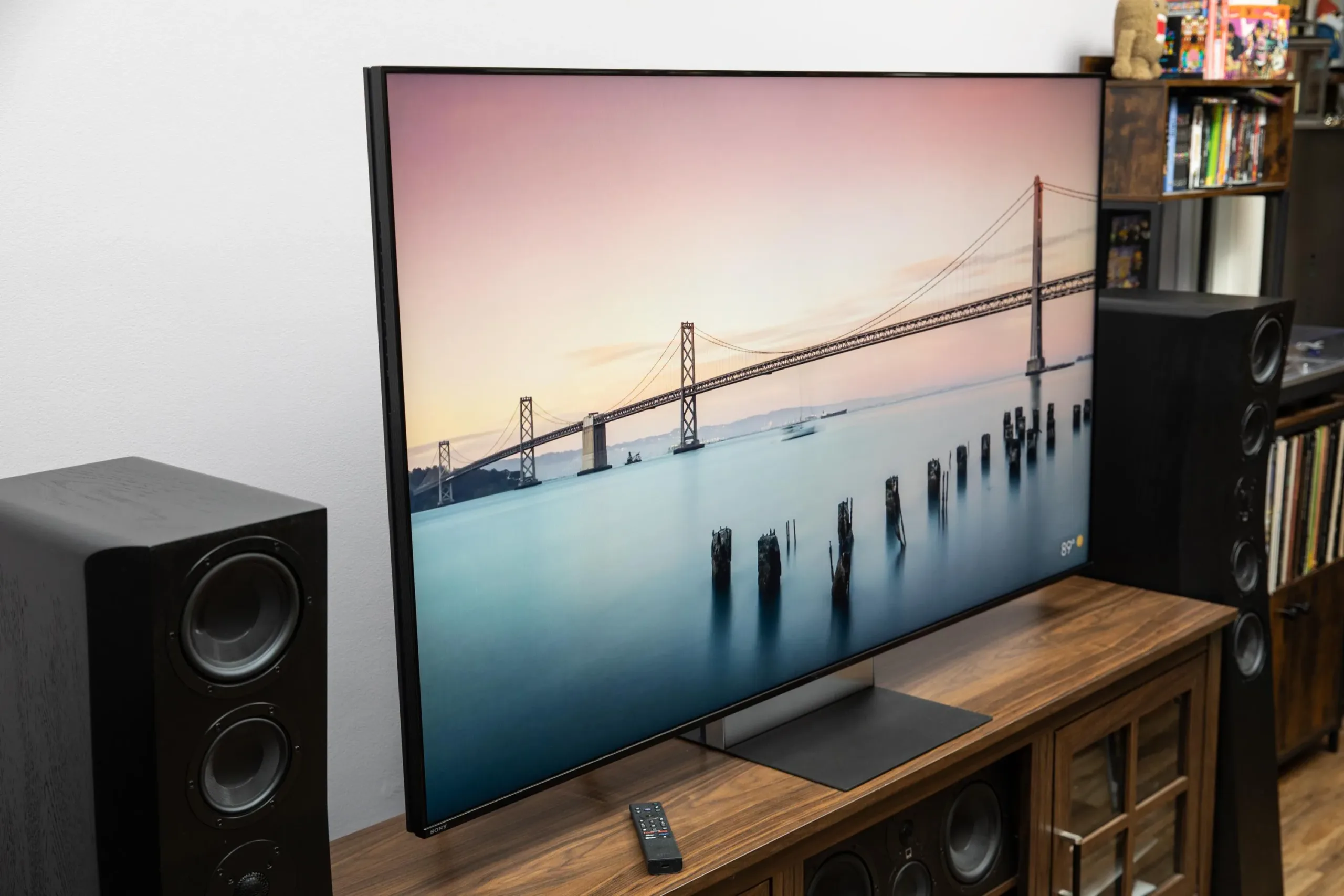
Frankly, the anti-reflective treatment is the feature I would pay attention to before the peak-nit figure. Bright lamps and windows reportedly collapse into a muted haze rather than appearing as sharp mirror images across the screen. That is an enormous quality-of-life improvement, especially for anyone whose TV lives opposite a wall of windows. You do not need a technical explanation to appreciate it; you just stop noticing your own living room during a film.
The effect does weaken as viewers move far to the side, but it remains effective until roughly 70 degrees off-axis. That is an unusually generous result for an LCD-based display. It also makes the Sony Bravia 9 II more plausible for a big family room, where not everybody gets the center seat. And yes, the center seat is still the best one. It always is.
Sony offers the television in 65-, 75-, 85-, and 115-inch sizes. The unusually large option signals where premium TV makers see the market going: less like a replacement for a modest set in the den, more like a substitute for a projector. A 115-inch display that can stand up to daylight changes the equation, even if its price will place it firmly in luxury territory.
If you are shopping, start with the Bravia television lineup. Just be prepared to read the fine print, because Sony has not fixed one of its more irritating premium-TV habits.
Local dimming still has an OLED-shaped problem
The Sony Bravia 9 II has more dimming zones than the less expensive Bravia 7 II, allowing it to isolate bright and dark parts of an image more finely. From a central viewing position, the result is said to be very good. Subtitles and fireworks create only modest glow, while high-contrast HDR scenes retain their drama.
Still, this is an LED television. Light from the backlight has to pass through an LCD layer, and it cannot be controlled at the individual-pixel level the way it can on OLED. Move farther off-center and blooming becomes more obvious, including colored light bleeding into nearby shades. That is the fundamental tradeoff, not a minor footnote. If your favorite movies are black-heavy, space-set, or relentlessly nocturnal, OLED remains the cleaner answer.
That does not make the Sony Bravia 9 II a failure. It makes it a highly polished LCD with the constraints of LCD. TCL’s X11L is cited as stronger in blooming control in some comparisons, while Sony’s own Bravia 8 II QD-OLED line offers the deeper blacks that home-theater purists will still prefer. The right choice depends less on which technology wins a forum argument and more on where the television will sit.
A premium price demands fewer compromises
The flagship is around $1,000 more than the 65-inch Bravia 7 II, with the gap widening at larger sizes. For that money, buyers get higher highlight brightness, a more capable anti-reflective surface, and improved dimming control. Those are meaningful upgrades, particularly in a sunlit room. They are not automatically worth the premium for someone who watches mostly at night.
Then there is the frustrating port situation. The Sony Bravia 9 II has four HDMI inputs, but only two are HDMI 2.1. One doubles as eARC, meaning a soundbar can consume one of the two ports needed for a PlayStation 5, Xbox Series X, gaming PC, or another 4K 120Hz source. For a flagship television in 2026, that feels stingy. Samsung, LG, and several other premium competitors have spent years making four full-bandwidth ports the expected arrangement.
Sony does include 4K at 120Hz, variable refresh rate, and auto low-latency mode, alongside Dolby Vision, HDR10, HLG, Google TV, Dolby Atmos, and DTS:X. The lenticular stand is also an unexpectedly stylish touch, which sounds trivial until you have seen how many expensive televisions arrive with feet that resemble leftover parts from a flat-pack desk.
My read is simple: the Sony Bravia 9 II may be the most convincing RGB LED option for people who watch in difficult, bright spaces and want Sony’s unusually mature image processing. But OLED has not been dethroned. It has merely been challenged on the terrain where it has always been least comfortable: the real world, curtains open, life happening around the screen.
Frequently Asked Questions
What is the Sony Bravia 9 II?
The Sony Bravia 9 II is Sony’s flagship RGB LED television for 2026. It uses clusters of red, green, and blue LEDs for its backlight instead of a conventional blue backlight, creating a wider range of colors.
Is RGB LED better than OLED for a bright room?
The Bravia 9 II is well suited to bright rooms because it has high light output and an anti-reflective screen. The source calls it the best bright-room TV available, though the reviewer would still buy an OLED.
How many HDMI 2.1 ports does the Bravia 9 II have?
Sony provides two HDMI 2.1 inputs on the Bravia 9 II, one of which also handles eARC for a soundbar or receiver. The other two HDMI ports are HDMI 2.0.
Does the Sony Bravia 9 II support Dolby Vision?
Yes. The Bravia 9 II supports Dolby Vision, HDR10, and HLG. It also supports Dolby Atmos and DTS:X audio formats and uses Google TV.