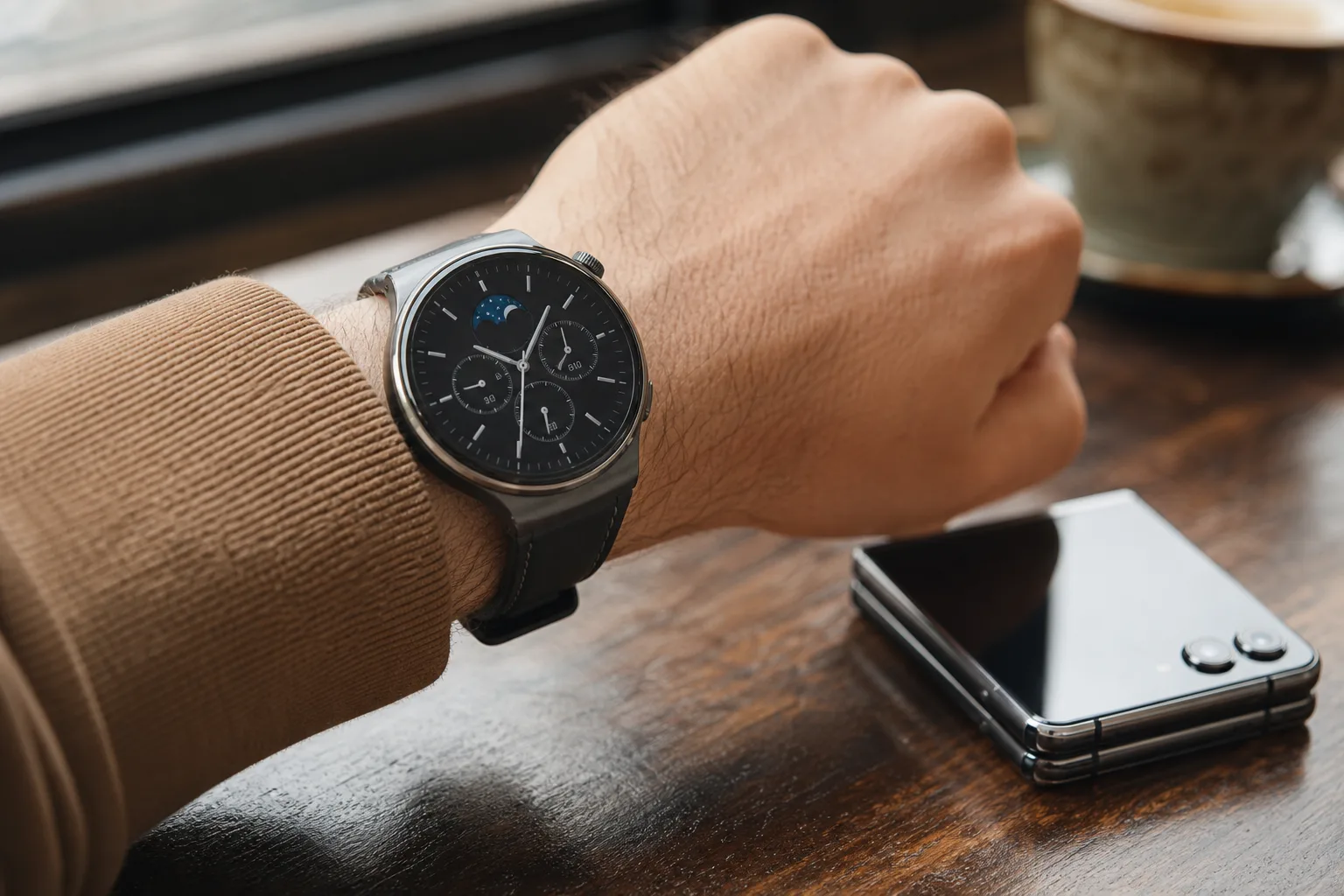
- Leaked marketing material identifies the Galaxy Watch 9 as powered by Qualcomm’s Snapdragon Wear Elite processor rather than Samsung Exynos silicon.
- The Galaxy Watch 9 would mark Samsung’s biggest smartwatch chip change after years of relying exclusively on its own Exynos platforms.
- Qualcomm’s 3nm wearable chip promises more performance and local AI capacity, though Samsung has not yet detailed feature plans.
- Samsung is expected to unveil its next smartwatch alongside new foldable phones at its upcoming Unpacked event.
Table of Contents
Galaxy Watch 9 appears set for a chip reset
Samsung has spent years treating its smartwatch processor as an in-house affair. That appears to be over. Newly surfaced promotional imagery points to the Galaxy Watch 9 running Qualcomm’s Snapdragon Wear Elite, a move that would replace the Exynos chips Samsung has used across its modern Galaxy Watch lineup.
The image, circulated by veteran leaker Evan Blass through his Leakmail newsletter, reportedly carries a pretty unambiguous line: the standard watch is ‘Powered by Snapdragon Wear Elite.’ This is not a benchmark, a vague supply-chain rumor, or a close-up of an unreleased circuit board. It looks like launch marketing. Still, Samsung itself has not made the announcement, so treat it as very strong evidence rather than formal confirmation.
That distinction matters in consumer tech, where a polished render can sometimes outlive a canceled feature. But my read is that the processor question is now effectively settled ahead of Samsung’s expected Unpacked launch next week.
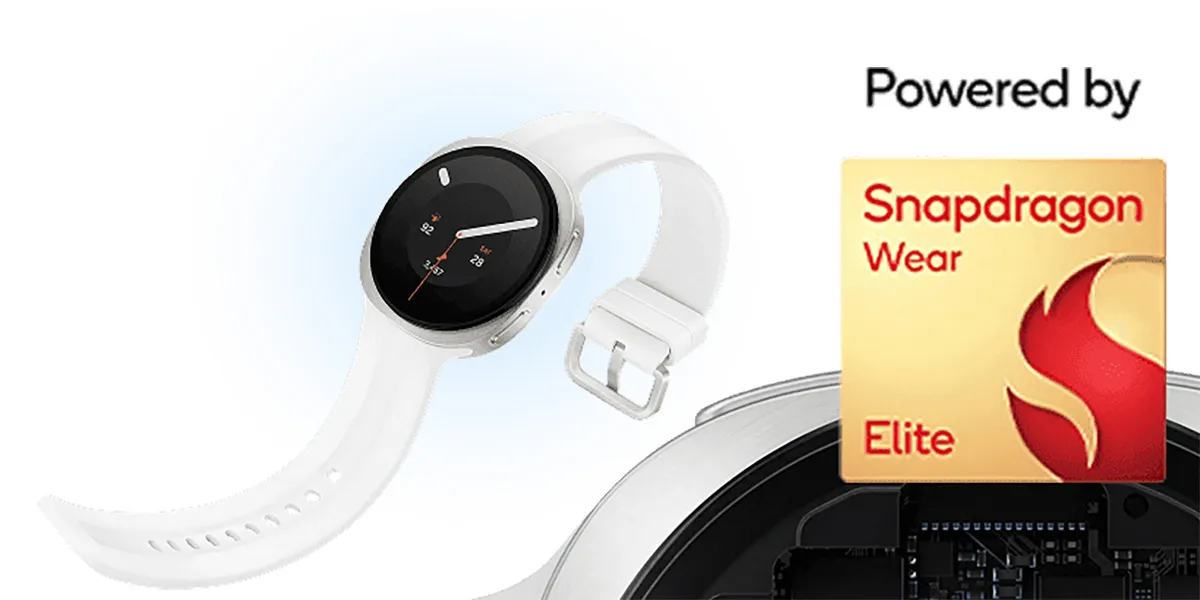
The Galaxy Watch 9 is particularly interesting because the leaked wording reportedly refers to the regular model, not a presumed Galaxy Watch Ultra successor. Samsung is not keeping Qualcomm’s newest wearable platform as a premium-model perk, at least if this material reflects the final product. That could make the mainstream watch the more consequential release. The Galaxy Watch 9 may therefore be the clearest signal of how broadly Samsung intends to embrace Qualcomm’s platform.
Why Samsung is leaving Exynos behind
Samsung’s old strategy made sense for a long time. Its Exynos wearable chips gave the company a degree of control over performance, power draw, and the Wear OS experience at a moment when Qualcomm’s smartwatch offerings were difficult to recommend. For several product cycles, Qualcomm’s Wear hardware felt like a dated engine dropped into an expensive new car: manufacturers could improve the display, add sensors, and polish the software, but there was only so much they could do with the machinery underneath.
Samsung’s partnership with Google on Wear OS helped revive the platform, and its Exynos W-series chips were a meaningful part of that recovery. The Galaxy Watch generations all benefited from Samsung having a silicon roadmap that was tailored to a major Android wearable launch.
Qualcomm now says it has a competitive answer. Snapdragon Wear Elite was introduced earlier this year as a 3nm smartwatch platform with claims of substantially improved general performance and more headroom for AI workloads. Qualcomm says its wearable silicon offers faster overall performance and additional power for AI tasks, though the real test will be what device makers ship with it. The company’s broader wearable portfolio is available through its official Snapdragon wearables page.
Samsung’s decision to adopt that chip points to two conclusions. Qualcomm has finally delivered a platform Samsung considers worthy of its flagship smartwatch, and Samsung may have decided it no longer needs to carry the full cost and complexity of developing a distinct smartwatch processor every year. The second point is more commercially important.
Snapdragon Wear Elite needs to earn its place
A 3nm label is encouraging, but it is not a magic spell. Smaller manufacturing processes can improve efficiency and performance, yet battery life depends on screen brightness, GPS use, health tracking frequency, modem behavior, software scheduling, and the eternal smartwatch problem: people expect a tiny gadget on their wrist to behave like a phone without needing phone-sized battery capacity.
For people who actually wear these devices overnight for sleep tracking, the practical question is plain: can the Galaxy Watch 9 last through a full day, a workout, a night, and part of the following morning without becoming another charging obligation? Faster app launches are welcome. More stable GPS is welcome. But nobody buys a health tracker because a settings screen opens 300 milliseconds sooner.
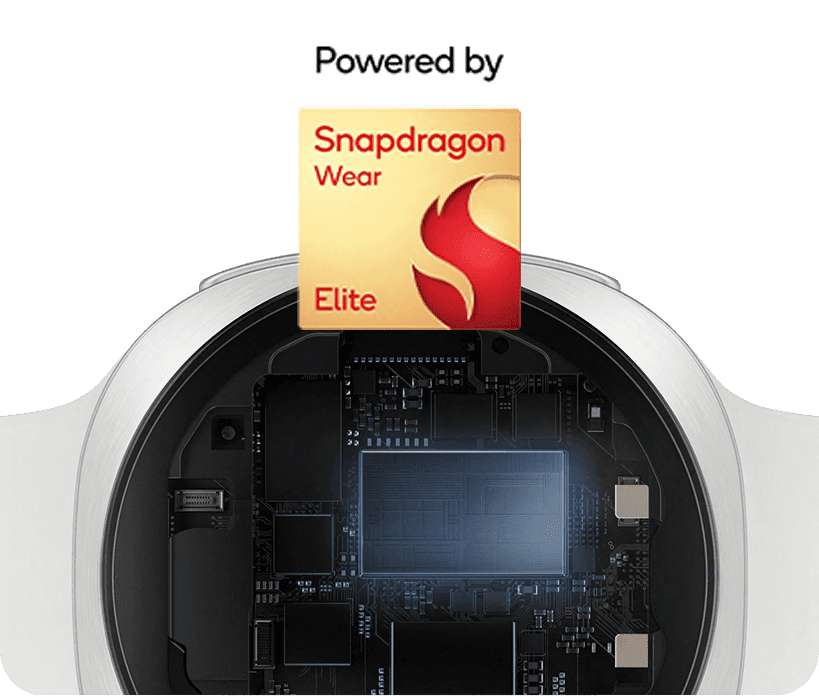
Samsung also has an AI story to explain. Qualcomm has emphasized AI processing capacity in Snapdragon Wear Elite, and Samsung has been eager to place Galaxy AI across its phone, tablet, and health software. There are sensible uses for local processing on a watch: interpreting health trends more quickly, reducing reliance on a phone connection, improving voice commands, or handling alerts with more context. But ‘AI’ can just as easily become a marketing decal slapped on existing features.
Samsung Health is the area to watch. The company already collects enormous quantities of sleep, activity, heart-rate, and workout data from compatible devices. More on-device computation could make certain insights faster or more private, depending on implementation. It could also invite tougher questions about what gets processed locally, what gets sent to Samsung’s servers, and how users can control that data. Those details matter far more than an AI badge on a keynote slide.
A useful test for Qualcomm’s wearable comeback
The implications extend beyond one Samsung launch. The Galaxy Watch 9 could become Qualcomm’s most visible proof that its wearable chip business has moved beyond the frustrating years when Android watch makers were left working around aging hardware. If Samsung can deliver noticeably better endurance, smooth performance, and useful health features on Snapdragon Wear Elite, other brands will notice.
Google, OnePlus, Xiaomi, Mobvoi, and Fossil’s former hardware partners have all had reasons to want a stronger common Android watch platform. Apple’s vertical control remains the benchmark on the iPhone side, while Samsung has occupied an unusual middle ground: using Google’s Wear OS while controlling much of the hardware experience. Moving to Qualcomm narrows that gap between Samsung and the wider Android ecosystem.
There is a possible downside, too. Samsung’s Exynos chips gave it a differentiator. A shared Qualcomm foundation can make it harder to claim technical independence if rival watches get access to broadly similar performance. Samsung will need to stand apart through sensors, software, industrial design, charging, durability, and health features that are genuinely useful rather than buried in a subscription prompt six months later.
For now, the leaked Galaxy Watch 9 branding delivers the headline: Samsung seems ready to bet its next wrist computer on Qualcomm. The more revealing question is what Samsung does with that bet. For the Galaxy Watch 9, a new chip is the easy part. Making a watch people stop thinking about charging is where this launch could actually matter.