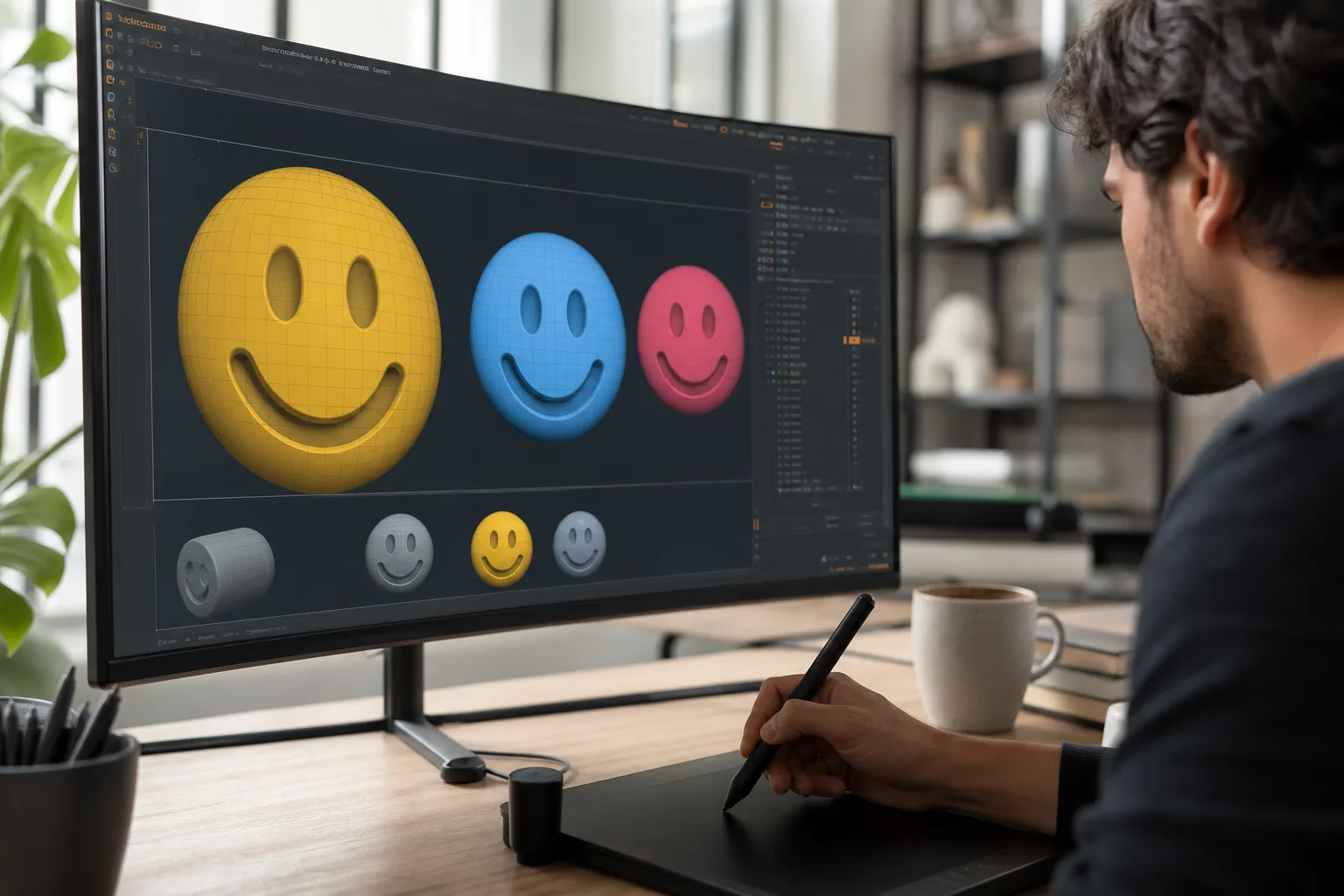
- Google 3D emoji are available as raw OBJ files for developers, artists, and anyone with a digital project in mind.
- The release offers a behind-the-scenes look at the design decisions involved in turning familiar symbols into 3D objects.
- Because the files use OBJ, they can move easily between 3D software, game engines, prototypes, and stranger experiments.
- Google’s decision gives emoji a chance to become reusable visual material beyond the tightly controlled world of messaging apps.
Table of Contents
Google 3D emoji are now building blocks
Emoji have spent decades trapped in tiny rectangles: a yellow face on a chat bubble, a heart in a notification, a skull punctuating an increasingly bleak group thread. Google 3D emoji are meant to escape that flat, familiar world. Google has released the underlying 3D asset files for its Noto Emoji designs, opening the door for artists, developers, students, and inveterate meme-makers to put them into their own projects.
The practical detail matters. These are raw .OBJ files, a widely supported 3D format that can be imported into tools such as Blender and many game-development workflows. Google’s pitch is broad: immersive virtual spaces, independent apps, and, yes, strange internet jokes. That last category is probably where the public will have the most fun. Give the internet a set of expressive 3D faces and it will find uses no design team could possibly plan for.
Google 3D emoji first appeared as part of the company’s Noto Emoji work, its effort to create a broadly usable and visually consistent emoji library. The company marked World Emoji Day by explaining both the release and a deceptively thorny question at its center: what, exactly, is an emoji face when it has depth?
Why Google 3D emoji needed more than a little depth
A 2D emoji can get away with visual sleight of hand. A circle, two dots, and a curved line read instantly as a smiling face. Once that same face can be rotated, lit, enlarged, and dropped into a virtual scene, the shortcuts start showing. Is it a ball? A flat coin with a raised surface? A mask? Each answer changes how light lands on it, how it casts a shadow, and whether it looks charming or vaguely unsettling.
That design problem is more serious than it sounds. Emoji work because they are recognized in a split second, often at tiny sizes. A creator building a 3D version has to retain that instant readability while deciding how much physical realism to add. Too little volume and the model looks like a sticker that wandered into a game engine. Too much detail and it stops feeling like emoji altogether.
My read is that Google’s approach is sensible precisely because it does not treat depth as an excuse to chase Pixar-level polish. The familiar symbols need to survive the transition, not become miniature animated-film characters. The slightly exaggerated forms and simplified surfaces in Google 3D emoji are doing a lot of work: they preserve the visual shorthand people already understand.
There is also a cultural reason to keep the designs approachable. Emoji are not proprietary characters in the way Mickey Mouse or a blockbuster game mascot is. They are shared punctuation for modern conversation, although each platform has long interpreted them through its own visual language. Apple’s emoji have a glossy, soft-edged personality; Microsoft has repeatedly reworked its look; Samsung has had its own occasionally divisive interpretations. Google’s Noto library sits closer to infrastructure, which makes an open release feel more natural.
What open-source 3D emoji could actually be good for
Let’s be honest: the phrase “immersive emoji world” has the faint aroma of a product demo nobody asked for. We have seen this movie before, from the metaverse land rush to companies trying to turn every ordinary interaction into an avatar experience. Remember when Google killed Stadia? The industry is very good at selling a future before proving people want to live in it.
Still, Google 3D emoji have more grounded uses than a giant virtual room full of dancing aubergines. An indie developer could use them as accessible visual cues in a casual game. A teacher could bring them into a simple 3D lesson. A designer might prototype reactions for an augmented-reality interface without commissioning custom assets from scratch. Streamers and motion artists will almost certainly turn them into reaction graphics. The barrier to experimenting is now much lower.
The OBJ choice helps because it is not a locked-in, Google-only file type. OBJ has been around for years and is supported by a large spread of modeling, rendering, and engine software. It is not the most feature-rich format in every modern pipeline, but it is familiar plumbing. For an open asset library, familiar plumbing beats a fancy proprietary drain every time.
Developers should still read the licensing details before shipping anything commercial. “Open source” is often used loosely in creative-asset conversations, and permissions can differ for models, textures, modifications, and redistribution. Google publishes Noto resources through its own project channels, including the official Noto Emoji repository on GitHub, where the relevant documentation and files can be checked directly.
An open release is a small challenge to platform control
The bigger point is not that every app will suddenly be filled with floating smileys. It is that Google 3D emoji take a visual language usually mediated by operating systems and platform gatekeepers and turn part of it into raw material. Normally, users see emoji as finished product: Apple, Google, or Samsung decides how the face looks, then the rest of us tap it.
Now the models can become ingredients. That is a modest but meaningful shift for creators who work outside giant platform ecosystems. It also fits the broader direction of digital design, where asset libraries, templates, and open tools increasingly shape what small teams can make without a blockbuster budget.
Will this produce a killer VR experience? Probably not. But useful open assets tend to have a longer, stranger life than the companies releasing them expect. Somewhere, someone is already importing Google 3D emoji into Blender and making a cursed short film. Frankly, that is a more convincing case for the release than any metaverse slogan.