

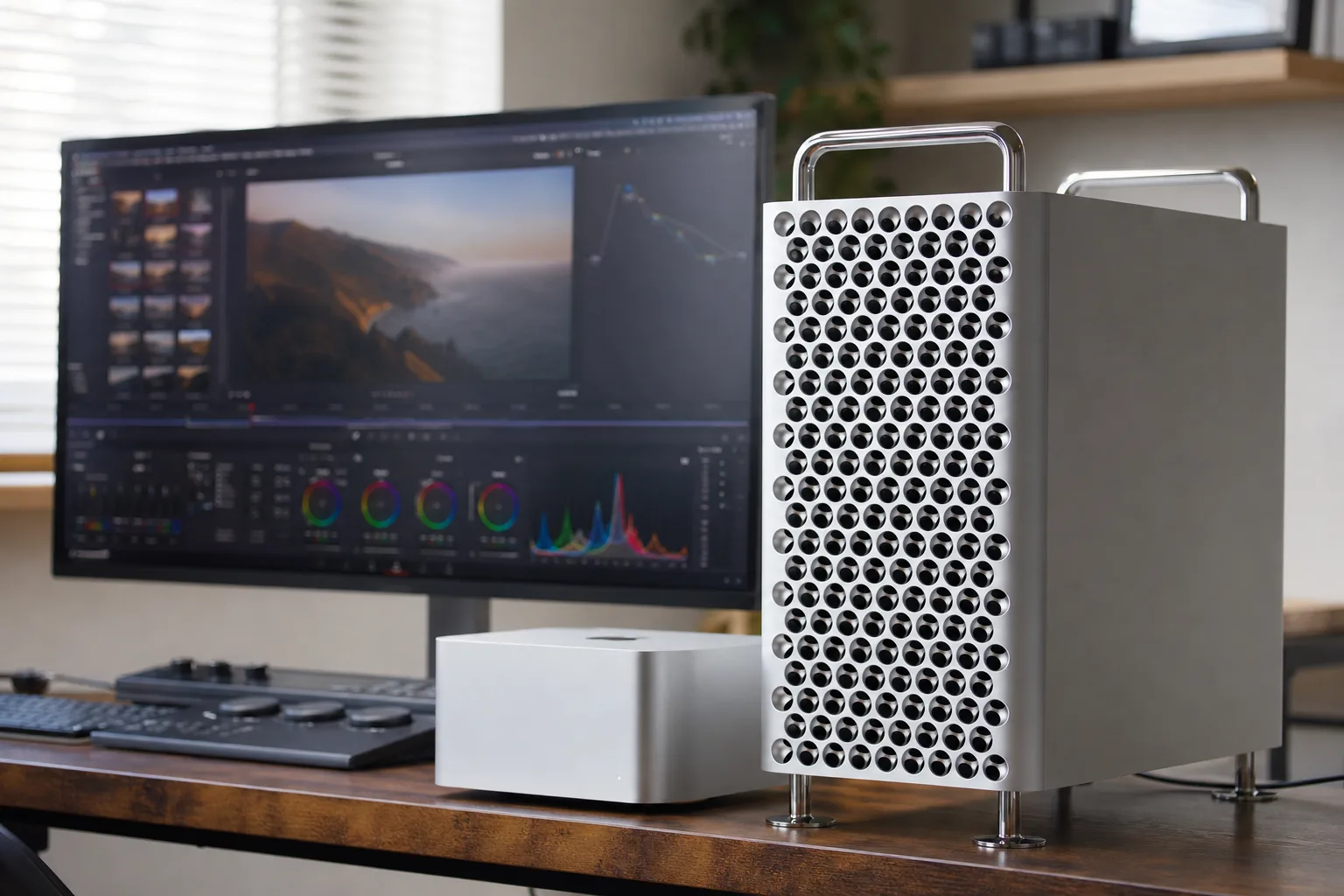
- Apple’s reported Mac Pro plans included an Intel-based workstation intended for specialized professional workloads after the silicon transition.
- A separate M3 Ultra machine in Apple’s Mac Pro plans reportedly died before it could launch alongside the refreshed Mac Studio.
- The cancellations expose the core problem: PCIe expansion could not justify the Mac Pro’s large premium over equivalent Mac Studio performance.
- Apple is expected to keep pushing high-end desktop buyers toward the Mac Studio, potentially with an M5 Ultra refresh.
Table of Contents
Apple’s Mac Pro plans reportedly went further than anyone saw
The Mac Pro did not vanish because Apple forgot about it. According to Bloomberg’s Mark Gurman, Apple’s Mac Pro plans included two additional machines that were built internally and then abandoned: one powered by Intel, and another based on Apple’s M3 Ultra chip. That is a far stranger ending for Apple’s flagship workstation than a routine product cancellation.
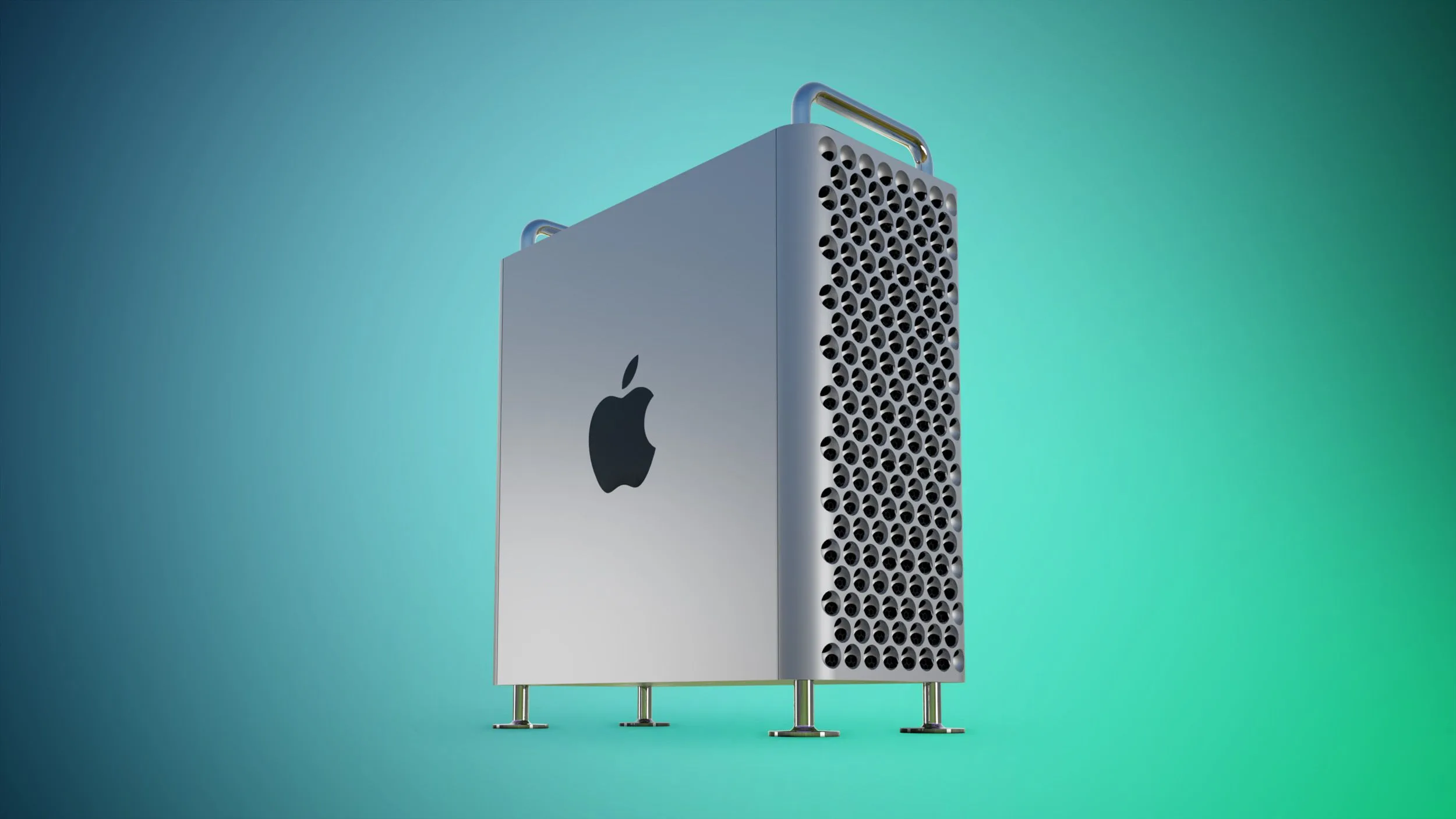
Gurman says the projects carried the codenames J170 and J190. J170 was reportedly a new Intel Mac Pro designed for particular uses, despite Apple having completed its move from Intel processors to Apple silicon. J190, meanwhile, would have put an M3 Ultra inside the familiar tower enclosure and arrived around the same time as the M3 Ultra Mac Studio in early 2025.
Neither machine reached customers. Those Mac Pro plans have since given way to Apple discontinuing the Mac Pro, closing a product chapter that began in 2006 and survived several dramatic reinventions. The current story has a similarly uncomfortable logic, though the failure is economic rather than thermal.
Why an Intel Mac Pro still made sense on paper
The most revealing part of these Mac Pro plans is J170. Apple had completed its Intel-to-Apple-silicon transition by the time J170 was in active development, so an Intel tower being considered afterward sounds almost absurd at first glance. But professional computing is full of expensive, stubborn dependencies. A post-production house, scientific lab, audio facility, or enterprise team may rely on a specialized PCIe card, legacy driver, x86-only tool, or tightly validated workflow that cannot be swapped out over a weekend.
Gurman does not provide specifics about which customers or workloads J170 was intended to serve. That matters. We should not pretend every old plug-in or expansion card would have required Intel. Apple silicon Macs can run plenty of established professional software, and macOS has had translation tools such as Rosetta 2 for years. Yet kernel-level extensions, hardware drivers, virtualized operating systems, and niche production equipment are another matter entirely.
My read is that Apple briefly considered a bridge product for customers whose spending is enormous but whose migration timetable is glacial. Think of it like replacing the engine in a working commercial truck: the owner may love the efficiency gains, but not if the new engine means every custom attachment stops working. Apple apparently decided that this customer slice was not large enough, or not strategically attractive enough, to keep an Intel Mac Pro alive.
That decision fits Apple’s broader behavior. The company has historically been willing to leave legacy technology behind when it believes the future is clear — optical drives, headphone jacks, 32-bit apps, and now x86 Macs. Professionals may complain, sometimes with good reason, but Apple rarely maintains a parallel platform indefinitely.
Mac Pro plans ran into a Mac Studio problem
J190 faced a more immediate problem: it apparently used the same M3 Ultra chip as the Mac Studio. The Mac Pro’s meaningful distinction would therefore have been its PCIe expansion slots, plus the physical room and serviceability of a tower. Those are real benefits for a certain class of buyer. But they are not remotely enough for most people to pay roughly twice as much for broadly similar processor and graphics performance.
The Apple silicon Mac Pro already demonstrated this tension. It was a handsome, quiet workstation with PCIe expansion slots. For the people who need fast storage, video I/O, audio DSP, networking, or specialty capture cards, the expansion slots matter. For everyone else, the Mac Studio was the obvious answer: smaller, substantially cheaper, and essentially just as quick.
The product overlap was impossible to ignore, and Apple’s Mac Pro plans did not appear to offer a convincing way around it. For more information, see Apple’s newsroom.
The M3 Ultra Mac Pro would have made that comparison even harsher. Apple could have refreshed its tower on schedule, but doing so would not solve the product’s central question: what does this machine do that the Studio cannot, and is that answer worth thousands of dollars? If the response is “it has PCIe slots,” that is a good answer for a narrow market, not a durable foundation for a mass-produced flagship.
The even larger workstation chip never arrived
Gurman’s report also connects these canceled products to Apple’s earlier work on an “Extreme” class of chip, reportedly designed to double the CPU and GPU resources of an Ultra processor. That would have given the Mac Pro a proper performance moat. A Studio could take Ultra; the tower could take Extreme. Clean product separation, no awkward pricing conversation.
But chip design does not work like stacking two extra Lego bricks. Bigger packages are difficult to manufacture, costlier to validate, harder to cool, and vulnerable to weak demand. Apple’s Ultra chips already use a sophisticated die-to-die approach. Going beyond that may have produced a technically impressive processor with too few buyers to justify the development and manufacturing burden. Frankly, this is the part of the story that kills any easy claim that Apple simply stopped caring about pros. It seems Apple explored the obvious solution and found the numbers did not work.
What comes after the Mac Pro?
For buyers, the practical outcome is blunt: Apple’s Mac Pro plans appear to have given way to a single high-end desktop strategy centered on Mac Studio. Gurman expects an M5 Ultra Studio as early as this fall. If that happens, Apple will keep improving the machine most creative professionals can actually justify buying, rather than maintaining a tower that mainly exists to preserve an old category.
There is still a gap in Apple’s lineup for customers who need PCIe cards and want Apple silicon. Some will move to external Thunderbolt hardware, some will hold onto older towers, and some will look at Windows workstations equipped with Nvidia GPUs and a much wider universe of internal expansion. Apple has chosen to tolerate that leakage.
Could the Mac Pro return? Never say never, especially with a company that brought the tower back once before. But any revival would need a chip or architecture that makes the product unmistakably better than a Mac Studio, not merely bigger. Until Apple finds that reason, the Studio is the workstation that matters — and the Mac Pro is becoming a very expensive memory.

