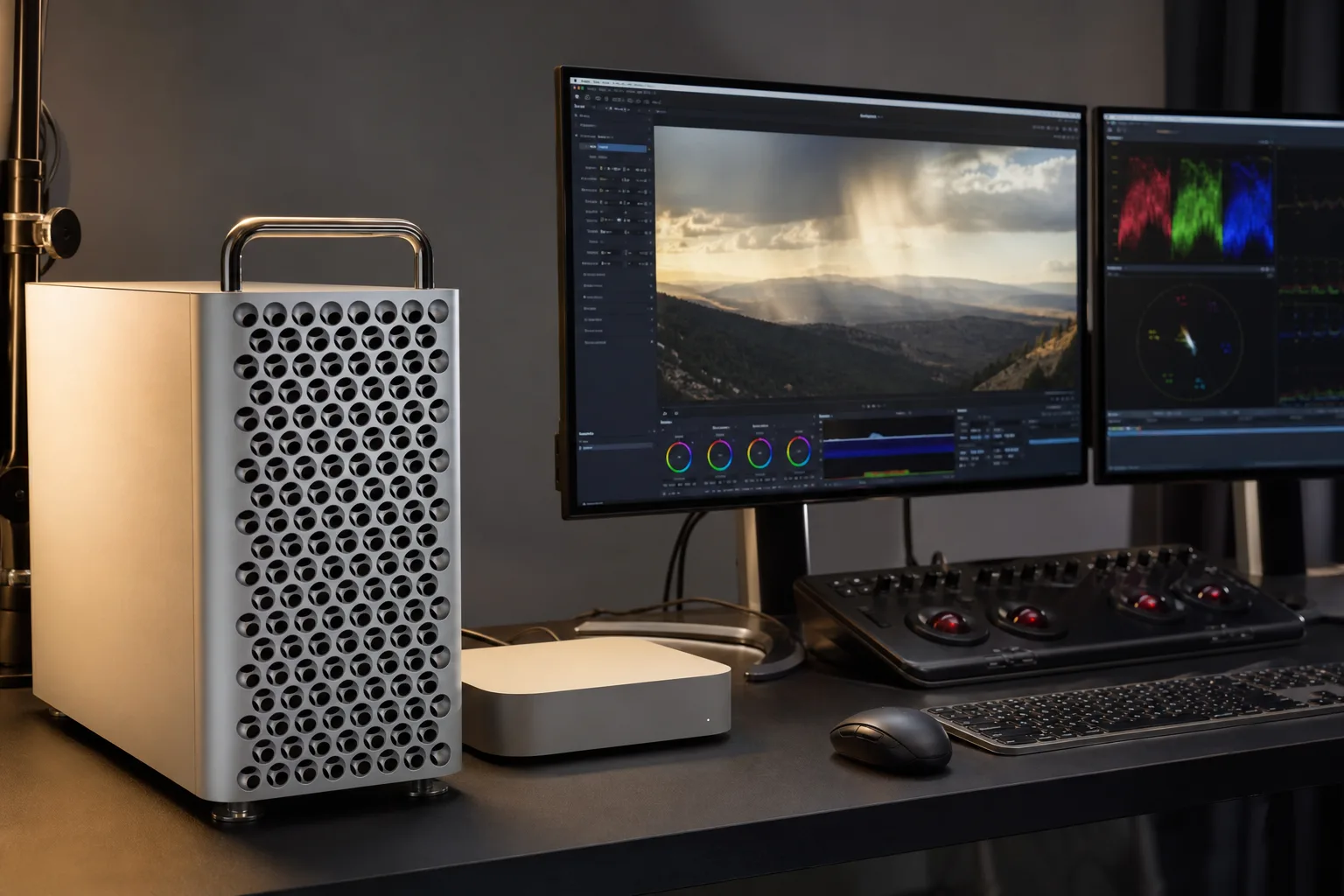
Apple didn’t merely stop selling a tower. The Mac Pro future appears to have been argued over, engineered in multiple directions, and then quietly abandoned when the economics no longer made sense. A new report from Bloomberg’s Mark Gurman says Apple had two unreleased Mac Pro designs in its pipeline: one based on Intel and another built around the M3 Ultra.
- The Mac Pro future reportedly included an Intel-based machine, even as Apple was building its own chips for Macs.
- Apple’s Mac Pro future also depended on M2 Extreme and M3 Extreme processors that were shelved over cost and demand concerns.
- An unreleased M3 Ultra Mac Pro was reportedly intended to arrive alongside the M3 Ultra Mac Studio in early 2025.
- Apple now directs high-end desktop buyers toward Mac Studio, leaving expansion-minded professionals without a current flagship tower.
Table of Contents
The Mac Pro future ran into more than one dead end
The most striking detail is the alleged Intel model, known internally as J170. Apple’s formal transition away from Intel made the idea of a fresh Intel Mac Pro sound backwards at first. But it also makes a certain amount of sense. High-end workstation buyers don’t upgrade like laptop shoppers. They may depend on specialized PCIe cards, particular drivers, x86 virtualization, legacy rendering software, or sprawling production systems that cannot simply be replaced over a weekend.
That reportedly made an Intel tower a potential bridge for customers whose workflows had not caught up with Apple silicon. It would have been an unusual product: Apple selling its own processors everywhere else while keeping one Intel machine alive for the people with the hardest-to-move workloads. Think of it as the last diesel van in a fleet going electric. Inelegant, perhaps, but useful when the job still demands it.
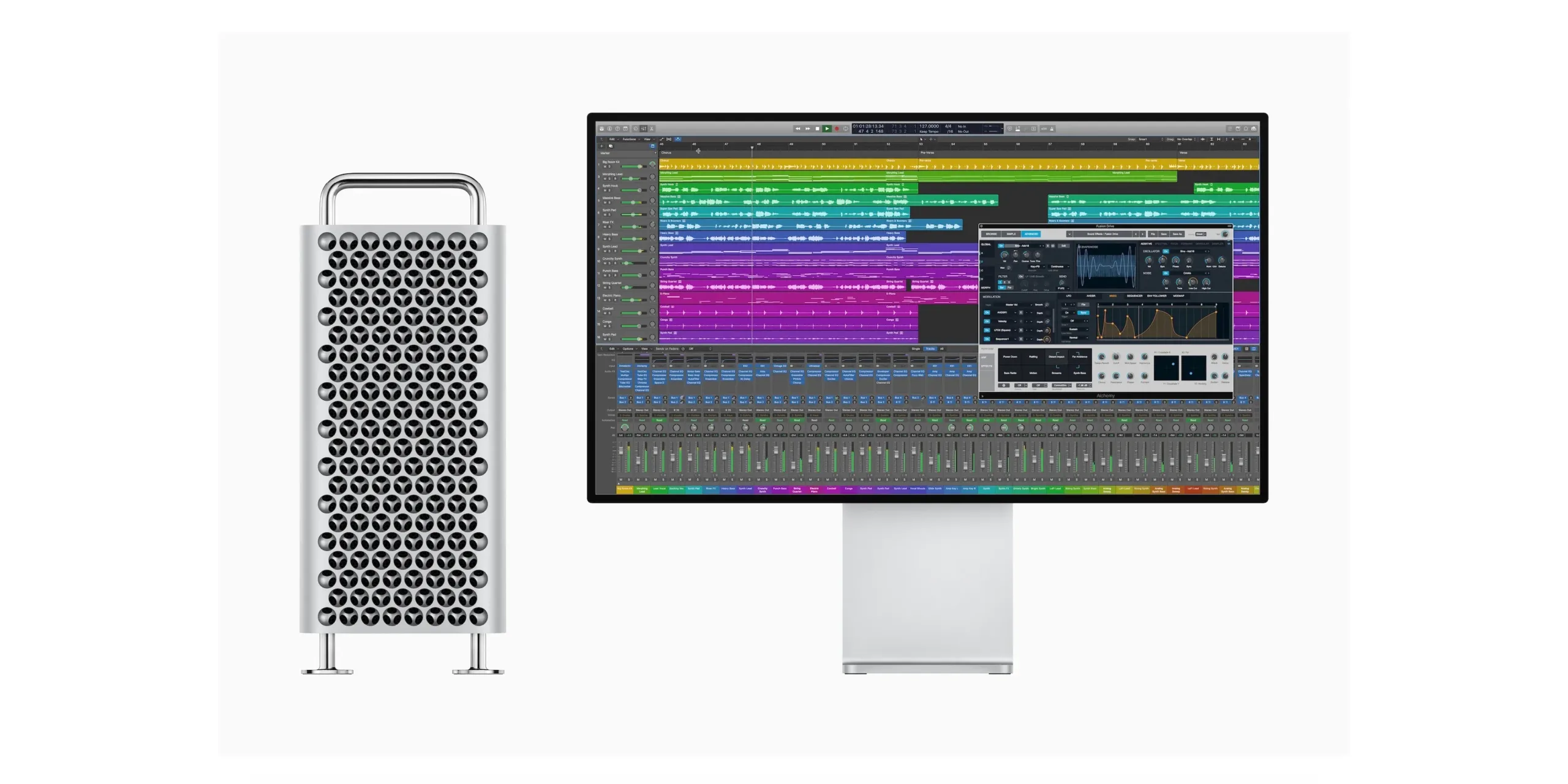
Apple never shipped J170, and it has not publicly confirmed that it existed. Bloomberg’s reporting is nonetheless credible in the context of Apple’s awkward professional-desktop transition. The company’s Intel Mac Pro was designed around user upgrades and massive internal expansion. The Apple silicon Mac Pro retained PCIe slots, but its unified-memory architecture and tightly integrated chip design meant many of the old reasons for buying a tower had vanished. For those customers, the Mac Pro future was always tied to flexibility as much as raw performance.
The Extreme chip was the missing piece
The bigger story behind the Mac Pro future is Apple’s reported work on M2 Extreme and M3 Extreme chips. Gurman says Apple developed both versions before ending the projects because of cost and demand worries. The plan was reportedly simple in concept: Ultra would power the Mac Studio, while Extreme would give the Mac Pro an unmistakable performance tier above it.
That distinction mattered. When Apple introduced the M2 Ultra Mac Pro, it created a problem the company never convincingly solved: the Mac Studio delivered essentially the same processor in a much smaller, cheaper package. The tower offered expansion slots, yes, but Apple silicon prevented those slots from doing the one thing many power users wanted most: accepting an aftermarket GPU. For video editors, 3D artists, scientists, and audio facilities, that made the value proposition painfully narrow.
An Extreme chip could have restored the hierarchy. More CPU cores, more graphics capability, more memory bandwidth, and potentially a meaningful reason to choose a tower over a studio. But building that processor would likely have required combining multiple Ultra-class dies. That is expensive silicon, difficult packaging, and a limited-volume market. Frankly, Apple may have looked at the expected sales and decided it was designing a Formula 1 engine for a very small parking lot.
The unreleased M3 Ultra Mac Pro, codenamed J190, was reportedly planned to debut alongside the M3 Ultra Mac Studio in early 2025. If that schedule was real, its cancellation suggests the Mac Pro future was not killed in one dramatic meeting. It was likely a series of product decisions: first, the Extreme tier became too costly; then the regular Ultra tower became too redundant; finally, the company concluded that Mac Studio was enough.
Why Mac Studio won the argument
Apple formally discontinued the Mac Pro in March and steered customers to the Mac Studio. From a business perspective, the call is hard to dispute. Mac Studio is compact, powerful, quieter than most workstation towers, and substantially easier to position. A buyer can understand it in seconds: choose Max or Ultra, add memory and storage, plug in displays, get to work.
The Mac Pro required a more uncomfortable explanation. It was bigger, far more expensive, and had expansion slots that did not turn it into the modular workstation many long-time Mac users expected. Apple’s own Mac Studio product page makes the company’s new center of gravity obvious: performance is now sold through the system-on-a-chip, not through a chassis ready for years of component swaps.
That philosophy has worked brilliantly for the overwhelming majority of Mac owners. Apple silicon delivers exceptional performance per watt, and the Mac Studio has become a genuinely formidable machine for editing, music production, software development, and photography. But the Mac Pro future raises a fair question about the customers at the outer edge of those categories. What happens when a facility needs specialized hardware, an enormous local storage setup, or an upgrade path that does not involve replacing an entire computer?
Apple has chosen integration over the workstation tower
There is precedent for this retreat. Apple has repeatedly shown that it will walk away from products with devoted followings when the product no longer supports its broader strategy. Remember when it killed the original iPod line, or when Stadia vanished from Google’s plans? Different companies, same cold logic: affection does not sustain a category that no longer fits the model.
For Apple, the Mac Pro future was constrained by its greatest technical success. Unified memory, integrated graphics, and tightly controlled silicon have made Macs more efficient and more predictable. They have also made a traditional workstation tower less meaningful. You cannot fully embrace a sealed, highly integrated chip design and simultaneously promise the open-ended upgrade culture that made the old Mac Pro special.
Reports indicate new Mac Studio models with M5 Ultra chips could arrive as soon as this fall. That will probably satisfy most buyers who once considered a Mac Pro, and Apple will point to that fact as proof it made the right call. My read is that the company did make the right call for its business. For the small group that needs a Mac with real modularity, though, Apple has effectively said the workstation tower is over. The Mac Pro future now depends on whether those customers remain willing to work around that decision.