
- The Claude Reflect dashboard turns conversational AI habits into a monthly report, with break reminders and scheduled quiet hours.
- The Claude Reflect dashboard lacks a true time counter for now, leaving users without the clearest possible measure of usage.
- Anthropic’s AI fluency recommendations can spot repetitive prompting and suggest Projects as a more organized way to work.
- Break notifications are easy to dismiss, so the tool works best as a personal cue rather than a hard parental-control-style block.
Table of Contents
The Claude Reflect dashboard puts a mirror next to the prompt box
AI companies have spent the last two years teaching us how much work a chatbot can absorb. Draft the email. Fix the spreadsheet. Explain the code. Brainstorm dinner. The Claude Reflect dashboard is Anthropic’s small but telling acknowledgment that a tool built to be endlessly available can also become a place where people lose track of an afternoon.
It lives inside Claude’s settings and produces a retrospective of your conversations over the past month, with options to look back three, six or 12 months. Think Spotify Wrapped with less confetti and more self-awareness. The report attempts to characterize how you have been using the assistant, then offers a few controls that may help if your Claude tab has started to feel like a permanent fixture of the workday.
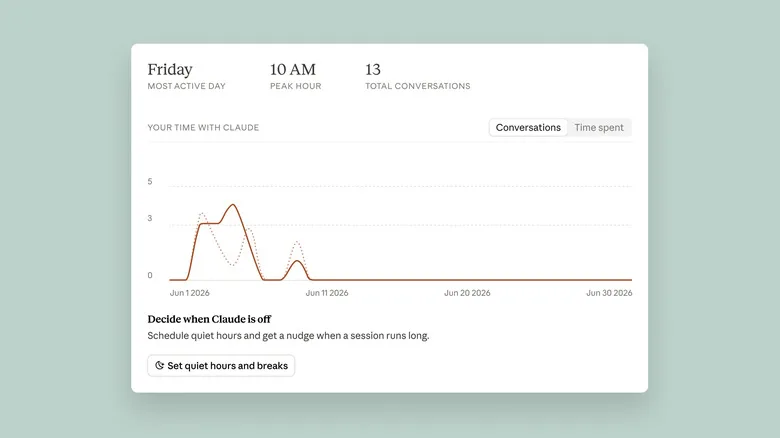
Frankly, I like the premise. Most digital-wellbeing products were designed for scrolling: social feeds, video apps, mobile games. Generative AI is different. People can spend hours with it while believing they are being productive, because often they are. That makes the question less about raw screen time and more about whether the interaction is still helping you think and act, or merely postponing both.
Anthropic has positioned this as a wellbeing feature rather than a productivity scorecard, which is probably wise. Nobody needs a chatbot assigning a gold star for asking it 400 questions before lunch.
How to find and use the Claude Reflect dashboard
To open the Claude Reflect dashboard, go to Claude on the web, select your profile and name, choose Settings, then select Reflect. Claude may take a moment to prepare the first report. The default view covers the previous month, while a selector at the top lets you expand the reporting period.
The most useful controls are under the broader Time and focus settings. You can ask Claude to send a break reminder after 15, 30 or 45 minutes of use, or after longer intervals. These are nudges, not locks. A prompt can be dismissed, just as anyone who has swatted away Apple’s Screen Time warnings knows. Still, a mildly annoying interruption can be enough to break an unhelpful loop.
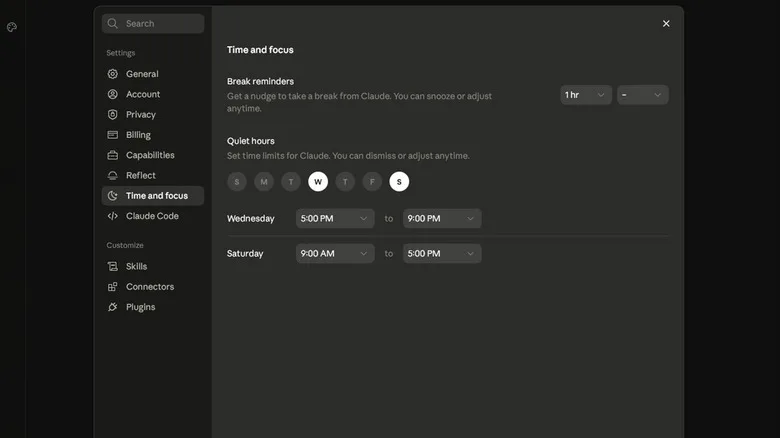
Quiet hours are the firmer option. You can define a different blocked-out period for every day of the week: perhaps no Claude between 5 p.m. and 8 p.m. on weekdays, while leaving a Saturday research session untouched. This matters because a one-size-fits-all digital curfew rarely survives contact with real life. A student’s Tuesday looks nothing like a freelancer’s Sunday.
The feature’s limits are also clear. The Time spent tab currently displays “coming soon,” rather than a total number of minutes or hours. Ryn Linthicum, Anthropic’s head of wellbeing policy, told Engadget that the company did not have an internal time-tracking system in place when work on Reflect began. That is a reasonable explanation, but it leaves a conspicuous gap. Without a time figure, the Claude Reflect dashboard can describe behavior without telling you its scale.
Why an AI time tracker is harder than Screen Time
Apple’s Screen Time and Google’s Digital Wellbeing tools largely deal in a simple metric: time in an app. That number is blunt, but at least it is legible. Twenty minutes in a banking app and two hours in TikTok are plainly different kinds of engagement, even if both show up as usage.
Claude complicates that model. An hour spent having an assistant summarize interview transcripts, debug a stubborn script or prepare a study outline may be useful work. An hour spent repeatedly rephrasing the same anxiety into a new prompt probably is not. The Claude Reflect dashboard appears to be trying to assess patterns, not just duration, and that is the more ambitious route.
But Anthropic should still ship the basic number. Users deserve to see both: the quantity of time and an interpretation of what they were doing with it. Hiding one side of that equation, even temporarily, makes it too easy to rationalize overuse. We have all called something “research” when it was really procrastination wearing glasses.
Reflect’s best idea may be its advice on working differently
The report also includes an AI fluency section that generates suggestions based on your habits. If you repeatedly paste the same background into fresh conversations, for example, Claude may recommend using Projects to keep related context, instructions and materials together. That is less flashy than a break notification, but potentially more valuable.
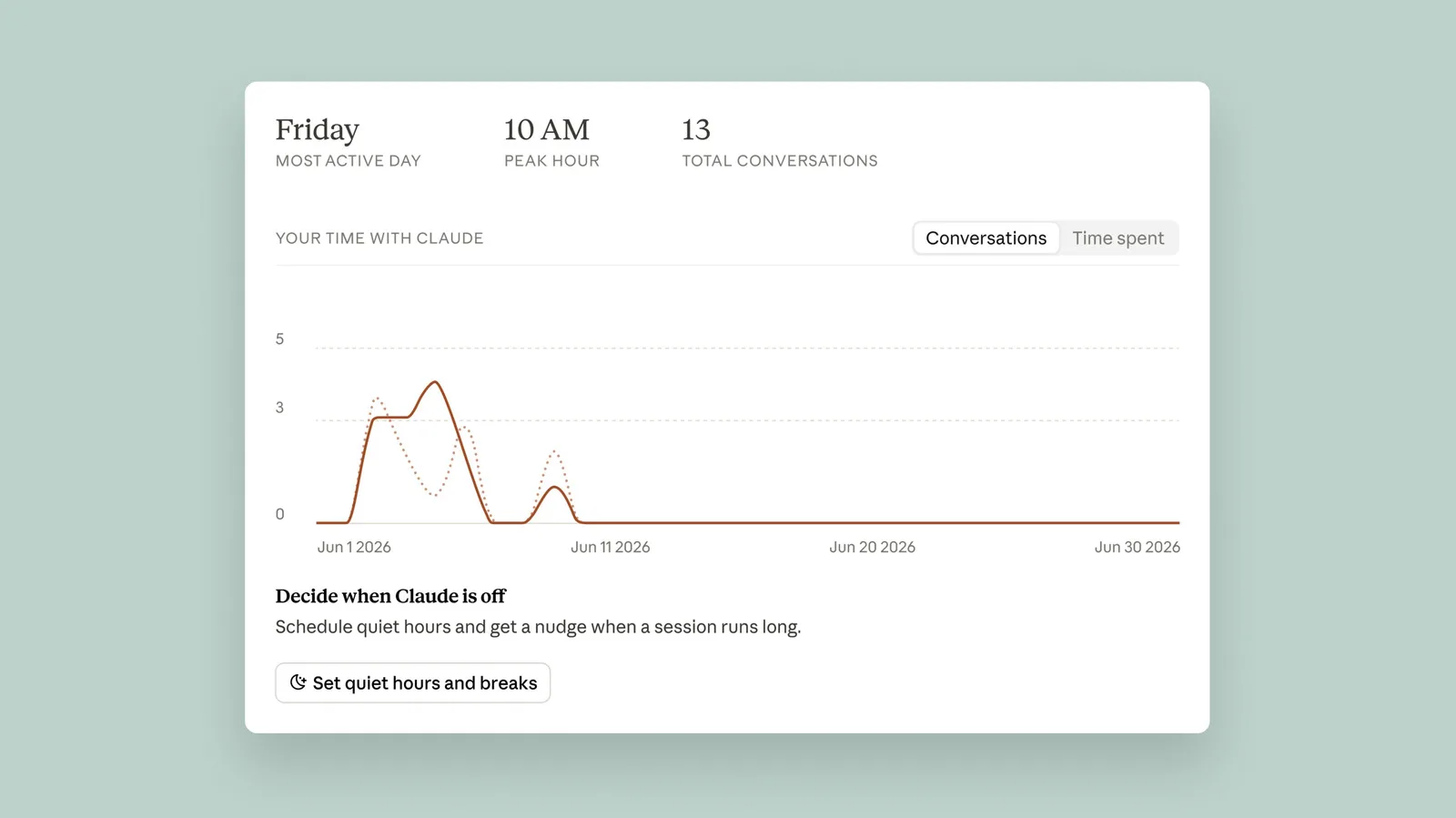
This is where the Claude Reflect dashboard can earn its place. Better organization means fewer repetitive prompts, less context rebuilding and, ideally, fewer conversations that sprawl because the user has lost the thread. Projects will not solve every workflow problem, but they are a sensible answer for anyone using Claude across a recurring assignment, a class or a long-running personal project.
The bigger industry lesson is about restraint. OpenAI, Google, Microsoft and Anthropic are all racing to make assistants more capable and more present across people’s devices. The next necessary competition should be over clear activity records, understandable boundaries and product design that does not treat every additional minute of attention as an unquestioned win.
Anthropic’s new tool is not a cure for compulsive AI use. It is optional, its nudges are dismissible, and its missing time metric weakens the first version. Yet the Claude Reflect dashboard is a more mature signal than the industry usually offers: sometimes the smartest move a chatbot can suggest is closing the laptop and going outside. Whether its rivals copy that instinct may say more about their priorities than any benchmark chart.
Frequently Asked Questions
What is the Claude Reflect dashboard?
The Claude Reflect dashboard is a settings feature in Anthropic’s Claude chatbot that summarizes patterns in a user’s recent conversations. It also offers break reminders, customizable quiet hours and suggestions intended to help people use Claude with more intention.
Does Claude Reflect show exactly how much time I spend using Claude?
Not yet. The dashboard includes a Time spent area, but it currently says ‘coming soon.’ Anthropic wellbeing policy lead Ryn Linthicum said the company had not built an internal system to measure time spent in Claude when Reflect was being developed.
Can Claude quiet hours stop me from using the chatbot?
Quiet hours are designed to put a boundary around access during periods you choose, with separate schedules available for each day. But users remain in control of their settings, and break nudges can be dismissed, so the feature depends on a willingness to honor the boundary.